
Display ads are visual digital advertisements (images, HTML5, or video) placed on websites, apps, and connected TV to reach target audiences and prompt consideration for food purchases.
Display ads are files delivered through ad networks or programmatic platforms. Food chains use display ads to present menu items, promotions, and brand messages to users while they browse content. Ads include image banners (e.g., 300×250, 728×90), responsive creatives that adapt to screen size, and short video spots (6–30 seconds). Delivery channels include web publisher inventory, in-app placements, and connected TV. Targeting options include contextual targeting by page topic, audience segments by demographics and interests, and behavioural targeting based on past searches or site visits. Measurement metrics include viewable impressions, click-through rate (CTR), view-through conversions, and post-view attribution windows (commonly 1–30 days).
How do display ads move customers from awareness to consideration?
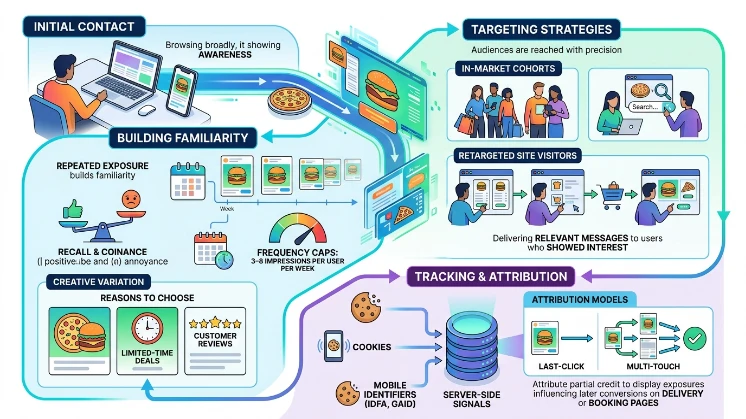
Display ads increase consideration by delivering repeated, relevant messages to users who have shown interest and by presenting concrete product and offer details.
Repeated exposure builds familiarity. Display campaigns commonly use frequency caps set to 3–8 impressions per user per week to balance recall and annoyance. Creative variation shows menu items, limited-time deals, and customer reviews to highlight reasons to choose a food chain. Audiences include in-market cohorts and retargeted site visitors who viewed menus or added items to carts. Tracking uses cookies, mobile identifiers (IDFA, GAID), and server-side signals. Attribution often uses a mix of last-click and multi-touch models to attribute partial credit to display exposures that influenced later conversions on delivery or booking pages.
What targeting strategies do food chains use with display ads?
Food chains use layered targeting: geographic targeting, behavioural and intent audiences, and contextual placements tuned to meal times and local demand.
Geographic targeting restricts delivery to postal codes, cities, or radii around outlets. Behavioural targeting selects users interested in dining, delivery apps, or specific cuisines. Contextual targeting places ads on pages about recipes, food blogs, or local events. Time-parting aligns ad delivery with peak decision times, breakfast (06:00–09:30), lunch (11:00–14:00), and dinner (17:00–20:30). Performance segmentation measures CTR and conversion rate by segment to reallocate budget toward high-performing groups. Lookalike or similar-audience models expand reach by matching attributes of known converters.
What creative elements increase purchase consideration in display ads?
High-performing creatives show clear product images, explicit price or offer information, and concise action cues that explain next steps.
Product photography uses close-up shots with consistent lighting and scale indicators (for example, a 12-inch pizza slice). Offer text displays numeric discounts or savings (for example, “£5 off orders over £20”). Include delivery or collection options and estimated times (for example, “Ready in 20 minutes”). Mobile-first creatives use legible fonts at 12–16 px equivalent, and file sizes under 150 KB to preserve load speed. Video creatives run 6–15 seconds and open with the product visually within the first 2 seconds. A/B tests compare headline phrasing, image crops, and offer thresholds to determine uplift in engagement and view-through conversions.
How do food chains measure the impact of display ads on consideration?
Measurement relies on viewable impressions, view-through conversions, assisted conversions, and lift studies to quantify influence on consideration.
Viewable impressions follow the IAB/MRC standard: at least 50% of pixels in view for one continuous second for display, and two seconds for video. View-through conversions count conversions within a set post-impression window, commonly 7–30 days. Assisted conversions track display as an intermediary touch in multi-channel funnels. Incrementality or uplift studies compare a test group exposed to display with a holdout group that is not exposed to estimate causal impact. Key performance indicators include lift in organic search for brand terms, lift in direct site visits, and changes in menu page dwell time. Reporting uses dashboards with daily and weekly granularity and confidence intervals for experiment results.
What role does frequency and sequencing play in consideration?
Frequency and sequencing ensure messages progress from broad awareness to specific offers without causing ad fatigue.
Campaigns set frequency caps to limit impressions per user per day or week and reduce CPM waste. Sequencing arranges creatives to follow a logic: initial ads highlight brand or cuisine, mid-funnel ads focus on menu highlights and customer ratings, and later ads include time-limited offers or promotional codes. Sequence length varies by objective and purchase cycle; typical sequences run 3–7 exposures across 7–21 days for recurring purchase categories like casual dining. Monitoring key signals such as declining CTR or rising negative feedback triggers creative rotation or reduced frequency.
Which attribution models show display’s influence on consideration?
Multi-touch attribution, data-driven attribution, and holdout tests provide the clearest signals of display influence on consideration.
Multi-touch attribution assigns fractional credit across multiple touchpoints in the user journey. Data-driven attribution uses observed conversion paths to allocate weights to channels. Holdout or control-group experiments remove display exposure for a subset of users to measure incremental lift. For immediate reporting, view-through metrics and assisted conversion reports offer short-term insights. For causal measurement, randomised controlled trials with statistically significant sample sizes yield robust estimates of display-driven increases in consideration and conversion.
What data and privacy constraints affect display campaigns in the UK?
UK campaigns must respect GDPR and ePrivacy rules and use consented identifiers or privacy-preserving alternatives for targeting and measurement.
Campaigns collect consent via consent management platforms before using non-essential cookies for behavioural targeting. Where consent is absent, contextual targeting and publisher-provided identifiers replace behavioural signals. Server-side tagging and first-party data capture strengthen measurement while reducing reliance on third-party cookies. Privacy-preserving measurement includes aggregated reporting, cohort-based analytics, and postback APIs that limit personally identifiable information. Campaigns document lawful bases for processing personal data and maintain retention schedules for user signals.
What components make an effective display campaign for food chains?
Effective campaigns combine precise audience segments, mobile-optimised creatives, time-parted delivery, and measurement frameworks that include incrementality testing.
Audience segments combine location, recent menu interaction, and purchase frequency. Creatives show clear product shots, numeric offers, and explicit fulfilment options. Delivery schedules align with meal decision windows and promotions. Measurement frameworks include viewability tracking, view-through conversions, and periodic uplift experiments. Budget allocation uses a mix of prospecting (broad contextual and lookalike reach) and remarketing (site visitors and cart abandoners) with dynamic creative optimisation to serve relevant menu items by user behaviour.
What benefits do food chains see when display ads increase consideration?
Benefits include higher purchase intent signals, increased direct and organic site traffic, and improved conversion rates from retargeted audiences.
Consideration uplift often translates to a measurable rise in branded search queries and a higher rate of return visits. Retargeted users convert at higher rates than cold audiences; conversion lifts range between 2× and 5× over prospecting audiences in many campaigns. Display-driven consideration also shortens time-to-purchase by keeping offers visible during decision windows. Improved measurement and creative testing reduce wasted spend and increase return on ad spend (ROAS) for mid-funnel objectives.
Explore More Expert Insights:
How Cloud Kitchens Nurture Demand Using Menu-Focused Banner Ads
How Restaurants Improve Repeat Order Intent Using Retargeting Ads
What real use cases show display ads driving consideration for food brands?
Examples include promoting a new menu item across urban zip codes, retargeting users who viewed menus with limited-time discounts, and using dynamic creatives to show nearby outlet availability.
A campaign that targeted users within a 3-mile radius of city-centre outlets promoted a new seasonal dish with image and video creatives during lunch and evening peaks. The campaign measured a 40% lift in menu page visits and a 25% lift in booking intents among exposed users. Another campaign retargeted users who viewed a delivery checkout but abandoned; these users received a time-limited “£3 off” creative and returned at a 2.8× higher conversion rate than non-retargeted visitors.
Check Out the Full Article:
How Cloud Kitchens Boost Demand Using Display Campaigns
How should teams structure operations for display-driven consideration?
Teams centralise audience and creative strategies, run weekly performance reviews, and schedule quarterly uplift tests to validate long-term impact.
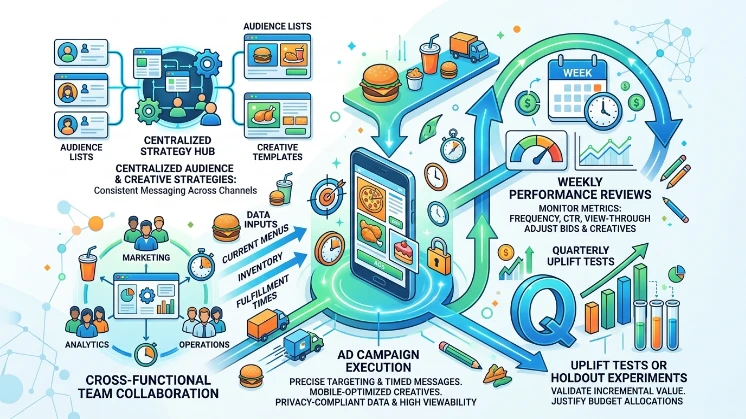
Centralised audience lists and creative templates ensure consistent messaging across channels. Weekly reviews monitor frequency, CTR, and view-through metrics to adjust bids and creatives. Quarterly uplift tests or holdout experiments validate incremental value and justify budget allocations. Collaboration between marketing, analytics, and operations teams ensures creatives reflect current menus, inventory, and fulfilment times.
Display ads increase purchase consideration for food chains by delivering targeted, timed, and creative messages that highlight products, offers, and fulfilment options. Campaigns require precise targeting, mobile-optimised creatives, viewability and incrementality measurement, and privacy-compliant data practices.
For conversion-focused tactics, see:
Food Chain Display Ads That Turn Consideration Into Final Purchases