
Retargeting ads are targeted digital ads shown to users who previously visited a restaurant’s website or placed an order, aimed at increasing repeat orders by reminding and re-engaging those users.
Retargeting uses tracking pixels, cookies, or mobile identifiers to record visitor actions. Restaurants capture events such as menu views, basket abandonment, or completed orders. Platforms then deliver ads across display networks, social channels, and connected TV to those recorded users. Entities involved include the restaurant (advertiser), the ad platform (publisher), and the tracking service (data processor). Retargeting segments include browse-based, cart-based, and post-purchase cohorts. Real examples include showing a banner of a previously viewed pizza to a user who checked the pizza page, or a discount code in a social feed for a customer who abandoned checkout.
How does retargeting increase repeat order intent?
Retargeting increases repeat order intent by delivering timely, personalised reminders that match a user’s prior interactions and nudge them back to complete a new purchase.
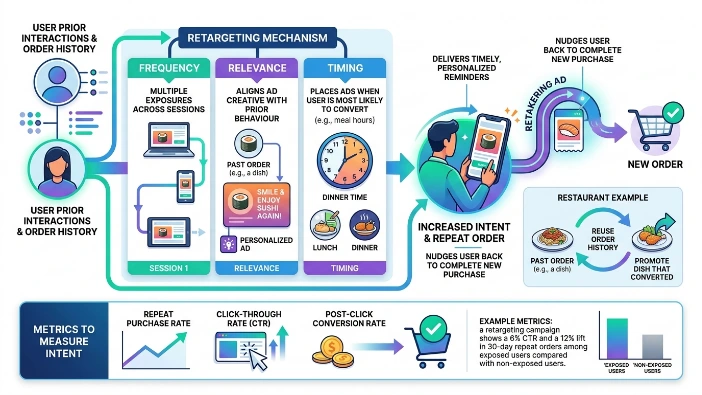
The mechanism relies on frequency, relevance, and timing. Frequency ensures multiple exposures across sessions; relevance aligns ad creative with prior behaviour; timing places ads when the user is most likely to convert, such as meal hours. Restaurants reuse order history to promote dishes that previously converted. Metrics to measure intent include repeat purchase rate, click-through rate (CTR), and post-click conversion rate. Example metrics: a retargeting campaign shows a 6% CTR and a 12% lift in 30-day repeat orders among exposed users compared with non-exposed users.
What tracking and data components are required for restaurant retargeting?
Required components include a tracking pixel or SDK, event schema for user actions, a customer identifier, and a consent mechanism for lawful data use.
Tracking pixels collect page visits and product views. SDKs collect in-app events for mobile ordering apps. Event schema defines actions: page_view, menu_item_view, add_to_cart, purchase, and frequency_of_orders. A customer identifier links browser activity to an email or phone number when the user opts in. Consent mechanisms capture GDPR and UK Data Protection requirements; record consent timestamps and scopes. Data processors include ad platforms, tag managers, and customer data platforms (CDPs). Example: a restaurant implements a pixel that records add_to_cart and purchase events, then maps those events to a hashed email for personalised social ads.
Which audiences should restaurants target with retargeting ads?
Restaurants should target three core audiences: cart abandoners, past purchasers within 30–90 days, and high-frequency browsers who viewed menus multiple times.
Cart abandoners include users who added items but did not complete checkout within 24 hours. Past purchasers include customers with at least one purchase in the last 90 days; segment further by order value (>£20) and frequency (1 vs 3+ orders). High-frequency browsers include users with three or more menu item views within seven days. Each audience requires tailored messaging: cart abandoners get recovery prompts, past purchasers get loyalty or new-item notices, and browsers get discovery-focused ads.
How should creatives and messaging vary by audience for repeat orders?
Creatives should match the user’s prior action: show the exact item for cart abandoners, personalised recommendations for past purchasers, and highlight variety for high-frequency browsers.
Cart abandonment creatives include the exact basket image, item names, and simplified checkout CTA. Past purchaser creatives use order history to suggest complementary items or upsells and reference the last order date. High-frequency browser creatives showcase bestsellers or limited-time dishes to trigger curiosity. Use clear price information and simple visual hierarchy: item photo, item name, price, and CTA. Include urgency only when factual (limited stock, closing time). User who ordered sushi three weeks earlier sees an ad promoting a new sushi platter with a 10% returning-customer discount.
How do frequency and timing influence repeat order outcomes?
Optimal frequency uses 3–7 ad impressions per user over 7–14 days, and timing schedules impressions around meal windows: 11:00–14:00 and 17:00–21:00.
High-frequency exposure increases recall but risks ad fatigue. Limit impressions with caps: 2–3 per day and 10–14 per campaign window. Schedule ads to peak one hour before typical ordering times. For past purchasers, set re-engagement windows at day 7, day 30, and day 60 after purchase. For cart abandoners, schedule the first ad within two hours, follow-up at 24 hours, then a final reminder at 72 hours. Cart abandoners receive one ad at 1 hour, one at 24 hours, and one at 72 hours, each within lunch or dinner windows.
What measurement framework proves retargeting lifts repeat orders?
A measurement framework uses controlled exposure (holdout groups), standard KPIs (repeat purchase rate, incremental revenue, ROAS), and attribution windows aligned to campaign goals.
Create a control group that does not receive retargeting and an exposed group that does. Compare 30-day repeat purchase rates and incremental revenue per exposed user. Use attribution windows: 24-hour, 7-day, and 30-day post-impression. Calculate return on ad spend (ROAS) as incremental revenue divided by ad spend. Track cost per incremental repeat order (CPRO) as ad spend divided by additional orders from exposure.
What privacy and compliance requirements apply in the UK?
Restaurants must obtain explicit consent before using tracking for personalised ads, store consent records, and provide clear opt-out choices to comply with UK GDPR and PECR.
Consent collection must be granular and document the purpose: advertising, analytics, and personalisation. Hash personal identifiers before sharing with ad platforms. Offer cookie banners with clear choices and a mechanism to withdraw consent. Maintain a data processing agreement with vendors and perform data protection impact assessments for large-scale profiling. A restaurant shows a cookie consent dialog that lets users accept advertising cookies and records consent timestamp and source.
What technology stack supports effective restaurant retargeting?
A typical stack includes a website pixel or mobile SDK, a tag manager, a customer data platform (CDP), an ad platform account, and analytics for measurement.
The pixel or SDK captures events; the tag manager deploys scripts without code changes; the CDP unifies user identifiers and builds audience segments; the ad platform executes campaigns across display and social channels; analytics tracks outcomes. Integrate order data from POS or delivery partners into the CDP to improve personalisation. Use hashed identifiers for upload to ad platforms to create custom audiences. POS sends completed orders to the CDP in real time, the CDP updates a “30-day past purchaser” segment, and the ad platform serves tailored creative to that segment.
Explore More Expert Insights:
How Food Brands Educate Customers Using Product Awareness Ads
How Cafes Build Visit Intent Using Local Banner Advertising
What are common use cases for retargeting that increase repeat orders?
Common use cases include cart recovery, personalised cross-sells after purchase, win-back campaigns for lapsed customers, and promotion of limited-time offers to known customers.
Cart recovery targets users who abandon orders and recovers lost revenue with reminder ads. Personalised cross-sells show complementary sides or drinks after a known purchase. Win-back campaigns target customers with no orders in 60–180 days and present incentives to return. Limited-time offers inform past purchasers about new seasonal menus or flash discounts. A restaurant runs a 30-day win-back campaign offering a fixed-value voucher to customers who ordered only once in the last year.
Learn Everything About It Here:
How Restaurants Drive Online Orders Using Retargeting Ads
How should restaurants test and optimise retargeting campaigns?
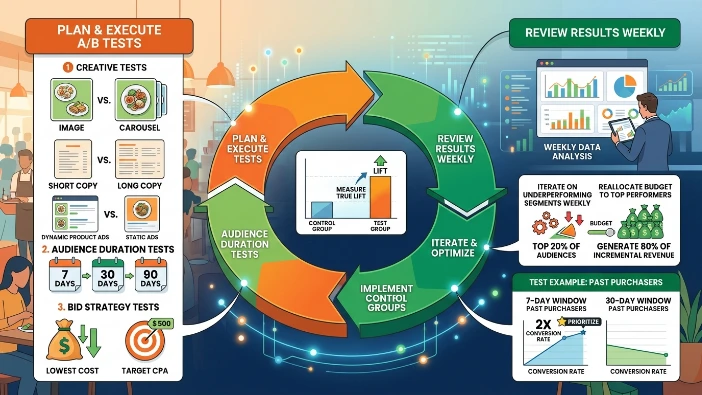
Test with A/B splits on creative, audience duration, and bid strategy; measure using holdouts and iterate weekly on underperforming segments.
Run A/B tests for image versus carousel, short copy versus long copy, and dynamic product ads versus static ads. Test audience windows such as 7 days, 30 days, and 90 days. Compare bidding strategies: lowest-cost versus target-CPA. Use a control holdout group for each major test to measure true lift. Review results weekly and reallocate budget to the top 20% of audiences that deliver 80% of incremental revenue. Compare 7-day versus 30-day past purchaser segments; if 7-day yields 2x conversion rate, prioritise that window.
Dive Deeper Into This Topic:
Retargeting Restaurant Ads That Turn Past Orders Into Repeat Purchases