A fintech campaign ad that converts feature awareness into active users is a targeted digital ad designed to move users from knowing a product feature to performing a defined action, such as signing up, enabling a feature, or completing a first transaction.
A converting fintech campaign ad focuses on one clear outcome. It identifies a specific feature (for example, instant transfers, budgeting tools, or credit card rewards), selects a measurable activation event (account funding, card activation, or first payment), and directs users to a streamlined path that removes friction. Campaigns run on display networks, social platforms, programmatic channels, and in-app inventories. Each placement uses creative and messaging tied to the activation metric. Campaigns use tracking to attribute actions to ads and optimise spend toward the highest-performing segments.
How do fintech teams define the activation event for feature-driven ads?
Activation events are single, measurable actions that signify a user has adopted a feature, such as completing identity verification, enabling recurring payments, or using a credit card for a purchase.
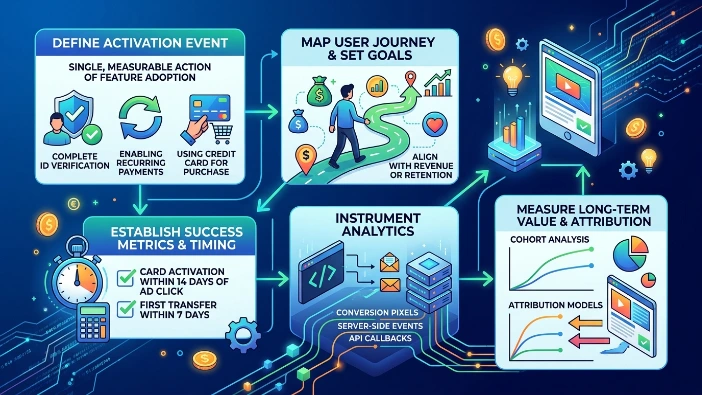
Teams map the user journey and choose an event that aligns with revenue or retention goals. They set a clear success metric and timing window, for example, “card activation within 14 days of ad click” or “first transfer within 7 days.” Teams instrument analytics to record the event with conversion pixels, server-side events, or API callbacks. They use cohort analysis to measure long-term value from users who completed the activation event versus those who did not. Attribution models assign credit to display ads when the ad click or view precedes the activation within the chosen window.
Which ad formats drive feature activation most effectively?
Ad formats that drive feature activation include interactive display creatives, rewarded in-app units, and video ads with deep links that open specific onboarding screens.
Interactive display creatives let users explore a feature within the ad, reducing cognitive load before clicking. Rewarded in-app units provide a clear incentive to complete an activation, such as in-app credits for linking a payment method. Video ads with deep links show the feature in action and send users directly to the onboarding screen, bypassing the home page. Use ad formats that preserve context: if the feature requires identity verification, link directly to the verification flow; if it requires funding, link to the deposit screen. Measure format performance by activation rate and cost per activation.
What targeting strategies improve conversion from awareness to activation?
Targeting strategies that improve conversion include behavioural retargeting, lookalike audiences based on high-value activators, and contextual placements aligned with financial intent.
Behavioural retargeting focuses on users who visited feature pages or dropped out during onboarding. Lookalike audiences use the characteristics of users who completed activation events to find similar prospects. Contextual placements run ads on pages about personal finance, credit card comparison, or money management tools. Use first-party data segments such as email lists and anonymous site visitors for higher relevance. Pair targeting with time-based rules, prioritising users who engaged recently, for example, within 30 days. Track lift by comparing conversion rates across segments.
How do creatives and messaging shift users from feature awareness to action?
Effective creatives provide a single, clear instruction, demonstrate the feature’s immediate benefit, and include a deep link that opens the specific activation step.
Creatives state the action and the benefit in one line, for example, “Get 1.5% cashback on groceries—Activate your card in 3 minutes.” Visuals show the activation screen or a progress bar to set expectations. The call-to-action uses verbs tied to the activation event: “Activate Card,” “Link Account,” or “Start First Transfer.” Use variant testing for headlines, subheads, and visuals. Match the creative to the landing experience so users see continuity when they click. Track click-to-activation funnel drop-off and iterate until the activation rate reaches target thresholds.
What measurement and attribution methods validate campaign impact?
Measurement requires conversion tracking at the activation event, deterministic matching for logged-in users, and multi-touch attribution to apportion credit across channels.
Implement conversion pixels and server-side event forwarding to ensure accuracy. Use deterministic matching via hashed emails or user IDs for cross-device attribution when users sign in. Use a multi-touch attribution model or holdout experiments to measure incremental impact. Run A/B tests with control groups that do not see the campaign and measure the difference in activation rates. Calculate cost per activation, activation-to-revenue conversion, and projected customer lifetime value for activated cohorts. Use these metrics to decide budget allocation.
Which campaign components are necessary for regulatory compliance and user trust?
Necessary components include clear disclosures, consent flows for data collection, secure deep links, and adherence to advertising rules for financial products in the UK.
Display all mandatory terms such as eligibility, fees, and representative APR for credit products where applicable. Obtain explicit consent before collecting personal data or initiating identity verification. Use secure deep links that open within the app or to HTTPS landing pages. Ensure creatives do not make misleading claims about returns, guarantees, or approvals. Retain records of ad creatives and targeting settings to support audits. Coordinate with legal and compliance teams to maintain up-to-date documentation and approval processes.
What optimisation processes increase activation rates during a live campaign?
Optimisation processes include real-time bidding rules, creative rotation based on activation rate, and automated audience pruning to focus spend on high-converting segments.
Set bid multipliers for audiences with higher historical activation rates. Pause or reallocate spend from placements with poor activation and high cost per activation. Implement creative rotation rules to prioritise variants with higher click-to-activation ratios. Use frequency caps to prevent ad fatigue and use sequential messaging to guide users through multiple steps: awareness, benefits, and activation prompt. Run short tests for targeting changes and scale only when a statistically significant improvement in activation rate appears.
What are the main benefits of feature-focused fintech campaign ads?
Feature-focused ads increase short-term activation, improve early engagement, and provide measurable signals for product-market fit.
They convert passive interest into a measurable action and accelerate onboarding. They increase the percentage of users who reach revenue-driving states, such as funded accounts or active cardholders. They provide clear data on which features drive retention and lifetime value. Feature-specific campaigns also support product prioritisation by quantifying impact on user behaviour.
Complete Details Available Here:
How Finance Brands Promote Credit Cards Using Display Campaigns
Which real-world use cases demonstrate measurable outcomes?
Common use cases include credit card activation campaigns, instant transfer onboarding, and budgeting tool enablement, with measurable increases in activation within set windows.
A credit card activation campaign links ads to the card activation flow and measures activations within 14 days. An instant transfer onboarding campaign links to the deposit screen and measures first transfer within 7 days. A budgeting tool campaign sends users to enable the feature and measures the proportion who set three budget categories within 10 days. Each use case tracks cost per activation, activation rate, and subsequent revenue or retention metrics.
Explore More Expert Insights:
Insurance Retargeting Ads That Convert Policy Consideration Into Active Signups
Banking Display Ads That Turn Loan Interest Into Approved Applications
How do teams set goals and KPIs for a fintech campaign?
Teams set KPIs that align with revenue and retention, such as cost per activation, activation rate, activation-to-first-revenue rate, and 30-day retention for activated users.
Define an absolute target for each KPI, for example, cost per activation under £25, activation rate above 12%, activation-to-revenue conversion above 30%, and 30-day retention above 45%. Monitor KPI trends daily during the launch phase and weekly after stabilisation. Tie financial forecasts to activation targets to calculate expected incremental revenue. Use these KPIs to make go/no-go decisions for scaling budgets.
Read the Detailed Explanation:
How Fintech Platforms Educate Users Using Feature Banner Campaigns
Which technical setup is required to run and scale these campaigns?
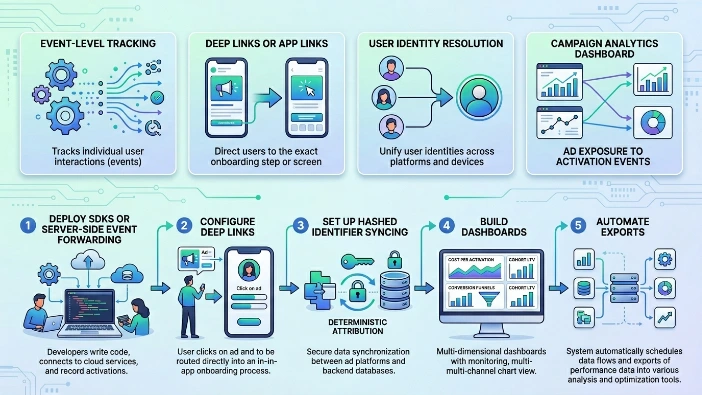
Technical setup requires event-level tracking, deep links or app links, user identity resolution, and a campaign analytics dashboard that maps ad exposure to activation events.
Deploy SDKs or server-side event forwarding that record activation events. Configure deep links that open the app to the exact onboarding step. Set up hashed identifier syncing between ad platforms and backend systems for deterministic attribution. Build dashboards that display cost per activation, conversion funnels, and cohort LTV. Automate exports of performance data for optimisation workflows.