

Charity galas are organised fundraising events that combine a charitable purpose with public attendance, donor activity, entertainment, and formal recognition. In 2026, UK news coverage depends on whether a gala provides a clear public-interest story supported by verifiable facts.
What makes a charity gala newsworthy in the UK?
A charity gala becomes newsworthy when it presents a clear public-interest story, measurable fundraising results, notable participants, community impact, or significant charitable activity. Editors assess relevance, evidence, timing, originality, and the strength of the information supplied.
Newsworthiness describes the editorial value of an event for a news organisation. A charity gala is not automatically newsworthy because it raises money. The event needs a specific development that gives journalists a reason to report it.
Several factors create that development:
- A significant fundraising total.
- A measurable community outcome.
- A major charitable initiative.
- Attendance by a recognised public figure.
- A new partnership supporting the charity.
- A record-breaking donation.
- A substantial increase in beneficiary support.
- A response to a current UK social issue.
For example, a gala that raises £500,000 to expand specialist support services has a stronger factual news angle than an announcement that simply confirms the event took place.
Why does public interest matter?
Public interest refers to information that affects, informs, or interests a wider audience. Charity stories often connect fundraising activity with issues such as homelessness, disability support, medical research, youth development, education, and community services.
The strongest stories explain the connection between the event and its measurable charitable outcome.
How do UK journalists assess a charity gala story?
UK journalists assess charity gala stories through news value, factual accuracy, audience relevance, timeliness, originality, available evidence, and the clarity of the central announcement. A concise story with verified details gives editors a stronger basis for determining editorial relevance.
Journalists need information that can be checked and understood quickly. A charity gala announcement therefore requires precise details rather than general statements.
Important information includes:
- Charity name.
- Event name.
- Event date.
- Event location.
- Fundraising amount.
- Fundraising objective.
- Number of attendees.
- Names and roles of notable participants.
- Beneficiary group.
- Programme highlights.
- Quotes from relevant representatives.
- Supporting statistics.
- Contact information.
For example, “the gala raised £250,000 for youth education programmes” provides a specific result. “The gala was a huge success” provides an opinion without measurable evidence.
Why are numbers important in charity news?
Numbers provide concrete evidence. A fundraising total, attendance figure, number of beneficiaries, percentage increase, or number of projects funded gives journalists information that supports factual reporting.
The timing of those numbers also matters. A final fundraising figure announced after the event creates a different news angle from an initial fundraising target announced before the gala.
What information should a charity gala press release contain?
A charity gala press release should identify the event, explain its charitable purpose, present measurable results, name relevant participants, provide verified quotations, and describe the beneficiary impact. The opening paragraphs need to communicate the main news clearly and factually.
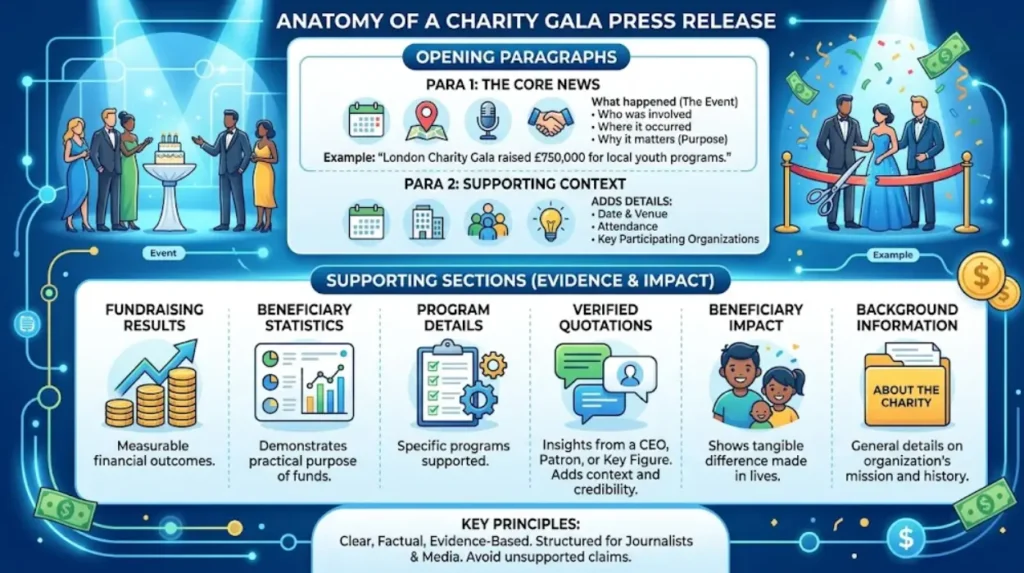
A press release is a structured information document prepared for journalists and media organisations. Its purpose is to communicate a specific news development.
A charity gala release generally follows a logical sequence.
What belongs in the opening?
The opening paragraph identifies the most important development. It answers the basic questions of what happened, who was involved, where it happened, and why it matters.
For example, a release can state that a London charity gala raised £750,000 for a defined programme supporting disadvantaged young people across three boroughs.
The second paragraph can provide supporting context. It can identify the event date, venue, attendance, and participating organisations.
What belongs in the supporting sections?
Supporting sections provide evidence and context. These sections include fundraising results, beneficiary statistics, programme details, quotations, and background information about the charitable organisation.
A quotation from a charity chief executive can explain the significance of the fundraising result. A beneficiary statistic can demonstrate the practical purpose of the funds.
The information needs to remain factual. Unsupported claims reduce the usefulness of the release for editorial reporting.
Which charity gala elements generate stronger news angles?
Strong charity gala news angles focus on measurable outcomes, significant donations, beneficiary impact, new initiatives, notable participation, community relevance, and unusual developments. These elements transform an event announcement into a defined story with identifiable editorial information.
Different gala components create different news angles. The strongest angle depends on what happened and what changed because of the event.
Does fundraising performance create news value?
Fundraising performance creates a clear news angle when the result is significant and verifiable. A record donation, unexpected fundraising milestone, or substantial increase from the previous year provides measurable information.
For example, a charity announcing a £1 million fundraising total can report the amount, previous total, percentage increase, and intended use of the funds.
Do notable attendees generate coverage?
Notable attendees can increase the editorial relevance of an event when their participation has a direct connection to the charity or the event’s purpose.
Relevant participants include public figures, senior business leaders, researchers, athletes, artists, civic representatives, and community leaders.
The individual’s role needs to be accurately identified. Attendance alone does not define the central story.
Does beneficiary impact strengthen the story?
Beneficiary impact connects fundraising activity with a measurable outcome. For example, a charity can explain that gala proceeds will fund 2,000 additional meals, 100 educational placements, or a defined expansion of support services.
Specific outcomes help journalists understand where the money goes and why the event matters.
How does timing affect charity gala news coverage?
Timing affects charity gala coverage because journalists prioritise current developments, timely announcements, and information connected to active public interest. Announcing a confirmed fundraising result immediately after an event gives the story a clear and current news peg.
A news peg is the specific development that makes a story timely. For charity galas, the news peg can be the event itself, a fundraising result, a new initiative, or a significant announcement made during the evening.
Timing also relates to the UK news cycle. National events, major political developments, public emergencies, sporting events, and other high-profile stories compete for editorial attention.
A gala announcement therefore needs a defined point of relevance.
When is post-event information most useful?
Post-event information becomes useful when it confirms results that were not available before the gala. Examples include the final amount raised, confirmed attendance, newly announced partnerships, and funds allocated to a specific programme.
A post-event release also provides journalists with verified outcomes rather than future expectations.
Why do photographs and evidence matter for charity gala coverage?
Photographs and supporting evidence strengthen charity gala coverage by giving journalists visual material and verifiable details. Relevant images include speakers, award presentations, charitable representatives, fundraising moments, and event activities with accurate captions.
Visual material supports coverage when it directly relates to the reported event. A clear photograph of a charity representative presenting an award provides stronger editorial context than a generic venue image.
Useful supporting materials include:
- High-resolution event photographs.
- Accurate photo captions.
- Speaker names and job titles.
- Fundraising figures.
- Charity statistics.
- Event programme details.
- Verified quotations.
- Background information.
Image captions need to identify people, locations, and activities accurately. Incorrect names or descriptions create factual problems for publishers.
How does a charity gala story reach different UK audiences?
A charity gala story reaches different UK audiences when its information contains relevant national, regional, community, or sector-specific angles. Location, beneficiary geography, participant relevance, and charitable purpose determine which audiences find the story useful.
UK media includes national newspapers, regional publications, local news organisations, specialist publications, business media, community outlets, and sector-focused platforms.
A London-based gala supporting a national charity has a different geographic relevance from a Manchester gala funding services for Greater Manchester residents.
What creates regional relevance?
Regional relevance comes from identifiable local connections. These include the event location, local attendees, regional beneficiaries, local fundraising results, and projects operating within a specific area.
For example, a Birmingham gala raising £300,000 for West Midlands youth services contains a direct regional news angle.
What creates sector relevance?
Sector relevance connects the charity’s work to a specialist audience. Medical research, education, housing, environmental protection, social care, disability services, and community development all have distinct editorial audiences.
A gala supporting a new cancer research programme therefore has potential relevance beyond general charity reporting.
What role does social impact play in charity gala coverage?
Social impact explains the measurable change produced by charitable activity. Charity gala coverage becomes more informative when it connects fundraising results with defined beneficiaries, funded programmes, service expansion, research activity, or community outcomes.
Social impact is the practical result produced by charitable funding or activity. It provides context for the financial figures associated with a gala.
A £400,000 fundraising total becomes more informative when the charity explains its intended use. The funds can support additional staff, new community programmes, research activity, equipment, accommodation, or direct beneficiary services.
Impact statements need evidence.
For example:
- £200,000 funds a new regional support programme.
- £100,000 provides educational resources for 5,000 pupils.
- £75,000 supports additional research staff.
- £25,000 funds emergency community assistance.
These details give journalists information that can be incorporated into factual reporting.
How can charity galas develop stronger news stories in 2026?
Charity galas can develop stronger news stories in 2026 by defining a specific news angle, collecting verified results, documenting social impact, preparing accurate media information, and connecting the event with relevant national, regional, community, or specialist audiences.
The process begins before the event. Organisers identify the primary story and determine which facts require confirmation.
During the event, organisers collect accurate attendance information, fundraising updates, photographs, quotations, and programme details.
After the event, they confirm final figures and beneficiary information.
The resulting story needs one central development. Supporting information then establishes context.
This approach separates a charity gala announcement from a general event description. The focus remains on what happened, why it matters, and what measurable result followed.
Explore More Expert Insights:
Why Earned News Coverage Beats Paid Ads for Events
How News Coverage Builds Backlinks and SEO Authority
What are the main factors that determine charity gala news coverage?
Charity gala news coverage depends on newsworthiness, measurable results, public interest, timely information, verified evidence, strong social-impact details, relevant participants, accurate media materials, and a clear connection between the event and its charitable purpose.
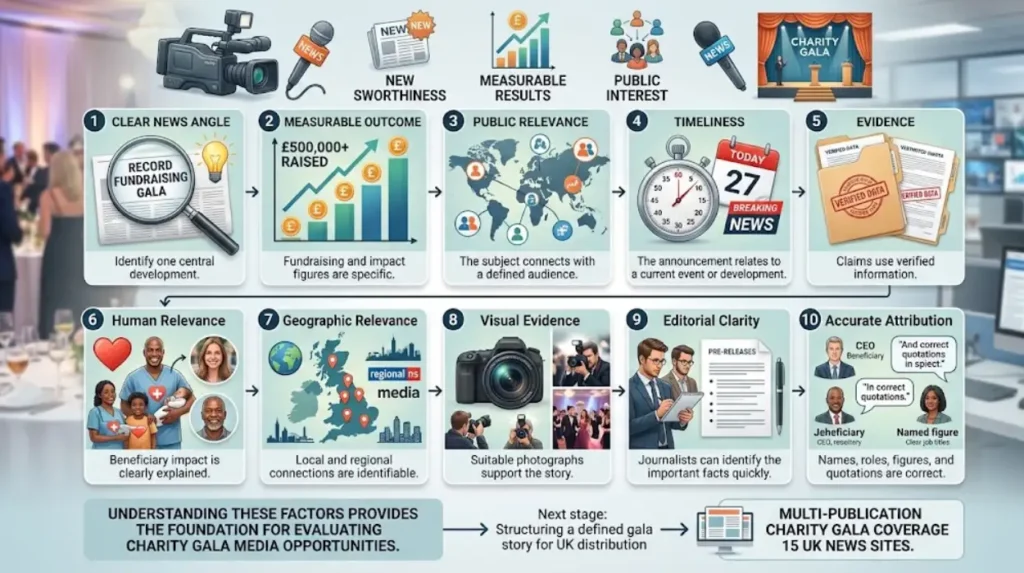
The main factors are:
- Clear news angle: The story identifies one central development.
- Measurable outcome: Fundraising and impact figures are specific.
- Public relevance: The subject connects with a defined audience.
- Timeliness: The announcement relates to a current event or development.
- Evidence: Claims use verified information.
- Human relevance: Beneficiary impact is clearly explained.
- Geographic relevance: Local and regional connections are identifiable.
- Visual evidence: Suitable photographs support the story.
- Editorial clarity: Journalists can identify the important facts quickly.
- Accurate attribution: Names, roles, figures, and quotations are correct.
Understanding these factors provides the foundation for evaluating charity gala media opportunities. The next stage examines how a defined gala story can be structured for broader UK distribution through:
For readers evaluating the practical distribution stage,
15 UK news sites provides the next level of information about multi-publication charity gala coverage.



