
Educational institutions and EdTech platforms across the United Kingdom use high-intent display advertising to convert interested learners into enrolled students. These campaigns target users already researching courses, certifications, and online learning programmes.
High-intent display ads target users already showing strong enrollment interest through browsing behaviour, course exploration, and engagement activity. These ads focus on converting interested learners into applicants or paying students by promoting specific programmes, deadlines, and enrollment-related educational offers across digital platforms.
High-intent display ads are digital advertisements shown to users who already interacted with educational content. These users visited course pages, compared certifications, downloaded brochures, attended webinars, or explored pricing information.
BOFU marketing focuses on decision-stage audiences. These users no longer search for general learning information. They evaluate final enrollment options, payment structures, course schedules, and provider credibility.
Display advertising supports this stage through precise audience targeting and conversion-focused messaging.
For example, a learner researching online data analytics certifications in London can later see ads promoting:
“September 2026 Cohort Now Open” or “Limited Seats for Weekend Classes.”
Educational platforms use behavioural data to identify strong purchase intent. Common indicators include:
Multiple visits to course pages, repeated curriculum reviews, application form activity, and abandoned enrollment checkouts.
Unlike TOFU campaigns focused on broad visibility, BOFU campaigns prioritize enrollment actions. Unlike MOFU campaigns focused on course exploration, BOFU campaigns emphasize urgency, trust, and conversion readiness.
How do EdTech platforms identify high-intent learners?
EdTech platforms identify high-intent learners through behavioural tracking, engagement scoring, retargeting systems, and first-party data analysis. These systems detect users actively comparing educational options, reviewing enrollment information, and interacting repeatedly with course-related digital content before making registration decisions.
High-intent users display measurable behavioural patterns. Educational advertisers analyse these actions using tracking pixels, analytics platforms, and customer relationship management systems.
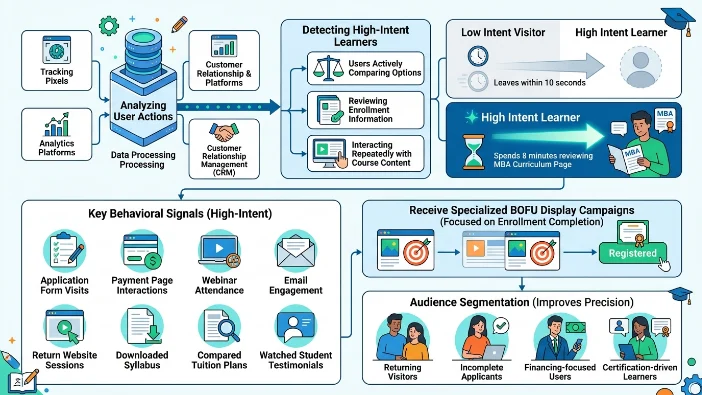
A learner who spends eight minutes reviewing an MBA curriculum page demonstrates stronger intent than a visitor leaving within ten seconds.
Application form visits, payment page interactions, webinar attendance, email engagement, and return website sessions. Downloaded the syllabus, compared tuition plans, and watched recorded student testimonials. These users receive specialized BOFU display campaigns focused on enrollment completion.
Audience segmentation improves precision further. Educational platforms separate users into categories such as:
Returning visitors, incomplete applicants, financing-focused users, and certification-driven learners.
Retargeting technology plays a central role. Users who leave before enrollment continue seeing educational ads across: News websites, professional blogs, career portals, and mobile applications. These campaigns maintain visibility during the final decision stage.
Why do high-intent display ads increase course enrollments?
High-intent display ads increase enrollments because they target users already interested in specific educational programmes. Decision-stage advertising improves conversion rates by delivering relevant enrollment messaging, deadline reminders, financing details, and trust-focused educational content directly to engaged prospective students online.
Enrollment-focused advertising works because the audience already understands the educational need. The remaining challenge involves provider comparison and final commitment.
Display ads reduce this gap through repeated exposure and conversion-oriented communication. “Industry-Recognised Certification,” “Flexible Evening Learning,” or “Enroll Before June Intake Closes.”
What types of display ads perform best for enrollment-focused campaigns?
Retargeting ads, dynamic display ads, testimonial banners, and enrollment deadline campaigns perform strongly for EdTech conversion goals. These formats deliver personalized educational messaging that aligns with user behaviour, course interests, and final-stage decision-making activity across digital channels and devices.
Retargeting ads remain the highest-performing BOFU advertising format for many educational platforms.
How do landing pages support high-intent display advertising campaigns?
Landing pages support high-intent display campaigns by matching advertisement messaging with enrollment-focused information. Strong landing pages improve conversion rates through consistent educational content, simplified application processes, trust indicators, and clear next-step actions for prospective students evaluating final course options.
A landing page is the destination users reach after clicking a display advertisement.
Landing page alignment directly impacts enrollment performance. Users expect the same message, course focus, and value proposition presented in the advertisement.
How do EdTech platforms personalize enrollment-focused display advertising?
EdTech platforms personalize enrollment-focused display ads using behavioural data, demographic targeting, geographic segmentation, and learning-interest analysis. Personalisation improves enrollment conversions because learners receive educational messaging directly aligned with their goals, schedules, certification interests, and professional development requirements.
Artificial intelligence systems increasingly optimise personalisation automatically. These systems analyse:
Click patterns, engagement rates, and conversion behaviour to improve campaign delivery continuously.
Explore More Expert Insights:
How Schools Increase Enrollment Using Banner Advertising Campaigns
How Educational Institutes Use Banner Ads to Increase Admissions
What metrics measure the success of high-intent display advertising?
Educational platforms measure display advertising success through enrollment conversions, cost-per-acquisition, click-through rates, application completions, and return-on-ad-spend metrics. These measurements identify which campaigns generate qualified student enrollments and improve decision-stage advertising performance across educational markets.
Enrollment conversion remains the most important BOFU performance metric. Completed registrations, submitted applications, tuition payments, and advisor consultation bookings.
Cost-per-acquisition measures advertising efficiency. This metric calculates the total advertising spend required to generate one enrolled student. For example, a platform spending £4,000 to acquire 20 enrolled learners records a £200 acquisition cost per student.
Click-through rates measure advertisement engagement quality. Higher rates indicate stronger message relevance and audience alignment. Landing page conversion rates identify post-click performance. A campaign generating traffic but low applications signals: Poor landing-page experience, weak messaging alignment, or enrollment friction.
View-through conversions also matter in BOFU advertising. Some learners view display ads but later return through direct search before enrolling.
Attribution systems track these delayed conversions. Session duration, repeat visits, abandoned applications, and device-level conversion behaviour. These insights improve future campaign optimization.
How do high-intent display ads support EdTech business growth?
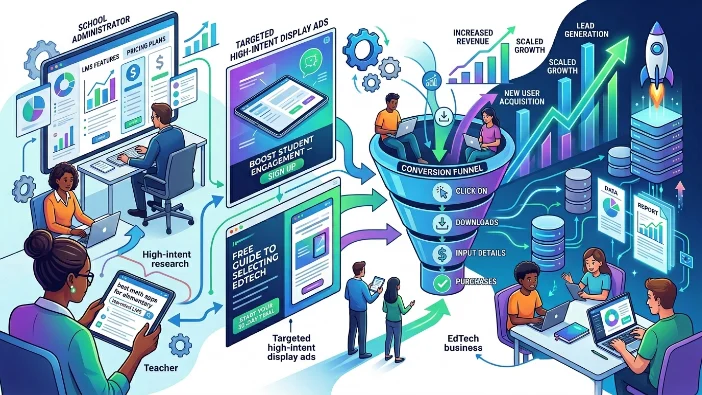
High-intent display ads support EdTech growth by increasing enrollment efficiency, reducing acquisition waste, improving student targeting, and strengthening conversion performance. These campaigns help educational providers scale revenue by focusing advertising investment on learners already prepared for enrollment decisions.
Enrollment-focused advertising directly impacts business growth because student acquisition drives revenue generation. Efficient BOFU campaigns reduce wasted advertising spend by prioritizing high-conversion audiences instead of broad awareness traffic.
For example, an online university investing in targeted postgraduate display campaigns achieves stronger enrollment efficiency than campaigns targeting untargeted general audiences. High-intent campaigns also improve forecasting accuracy. Educational platforms can estimate:
Expected enrollments, seasonal demand patterns, and programme-specific conversion performance.
These insights support operational planning and budget allocation. Conversion-focused display campaigns strengthen competitive positioning as well. Educational providers remaining visible during final-stage comparisons maintain stronger enrollment opportunities against competing platforms.
Integrated marketing strategies improve results further. High-intent display advertising performs best when combined with:
Email nurturing, webinar campaigns, student testimonials, and CRM automation systems.
Readers seeking foundational educational advertising strategies can read:
How Schools Increase Enrollment Using Banner Advertising Campaigns
Readers exploring:
How EdTech Platforms Build Course Interest Using Banner Advertising