
Banner ads help EdTech platforms reach online learners across websites, apps, and digital platforms. These ads improve course visibility, attract targeted audiences, and increase repeat engagement. Educational businesses use banner advertising to support awareness, course discovery, and learner interest during the early research stage.
EdTech platforms operate in a competitive digital education market. Online learners compare multiple courses before making enrollment decisions. Banner ads place educational content in front of users during browsing sessions, article reading, video watching, and mobile app usage.
A banner ad is a visual digital advertisement displayed on websites or mobile applications. It contains text, images, course messaging, and a clickable destination. In education marketing, banner ads commonly promote online certifications, short courses, bootcamps, language programs, and professional development training.
EdTech platforms use banner advertising because online education decisions involve long research cycles. Learners often spend 7 to 30 days comparing course topics, tuition fees, delivery formats, and learning outcomes before selecting a provider.
For readers exploring learner engagement strategies, [Insert Link to MOFU Article] explains how targeted display campaigns increase enrollment consideration. Readers researching conversion-focused education campaigns can explore [Insert Link to BOFU Article].
Educational banner campaigns often focus on high-interest categories such as coding courses, healthcare certifications, finance training, and artificial intelligence programs. For example, a data analytics course advertisement can appear on technology blogs, career development websites, or university news platforms.
Banner advertising supports awareness at the top of the marketing funnel. At this stage, the goal is education and visibility instead of direct enrollment conversion.
How do banner ads work for EdTech marketing campaigns?
Banner ads work by displaying educational promotions to selected online audiences through advertising networks. Platforms choose targeting settings based on demographics, interests, browsing activity, devices, and website categories. The system then distributes ads across websites where potential learners spend time online.
Banner advertising uses automated digital ad systems. These systems connect advertisers with websites that offer advertising space. When a user visits a webpage, the advertising network instantly selects and displays a relevant banner ad.
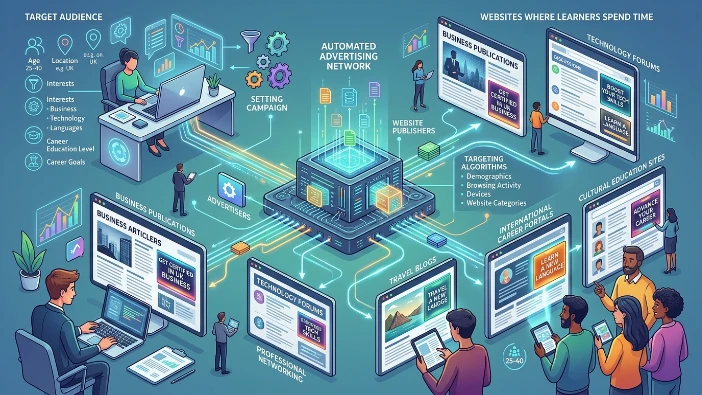
EdTech platforms configure campaigns based on audience characteristics. Common targeting categories include age groups, professional interests, education levels, and career goals.
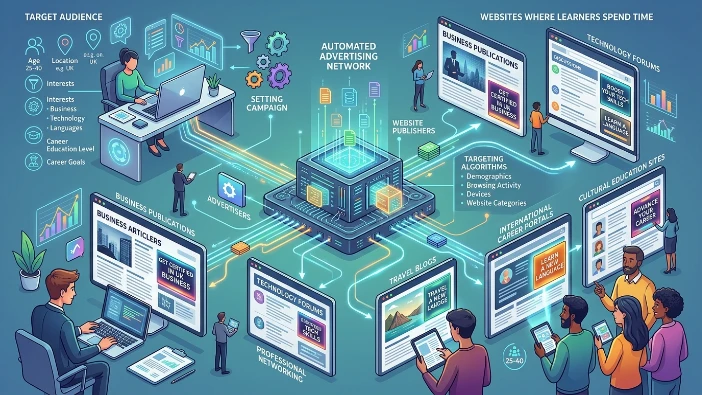
A professional certification platform targeting UK learners aged 25 to 40 can display ads on business publications, technology forums, and professional networking websites. A language learning platform can show ads on travel blogs, international career portals, and cultural education websites.
Banner ads normally contain four core elements. The first element is a headline that identifies the course topic. The second element is visual content such as course graphics or student imagery. The third element is supporting text that explains the learning benefit. The fourth element is a clickable action leading to a course page.
Most advertising systems track impressions, clicks, engagement rates, and landing page visits. These metrics help education marketers measure campaign visibility and audience interaction.
What types of banner ads do EdTech platforms use?
EdTech platforms use static banners, animated banners, responsive banners, mobile banners, and retargeting banners. Each format serves different educational goals such as awareness, engagement, course comparison, or learner re-engagement across desktop and mobile environments.
Static banner ads use fixed images and text. These ads load quickly and support simple educational messaging. A university preparation course can use a static banner promoting “12-Week IELTS Training Program.”
Animated banner ads include movement and transitions. These ads highlight multiple learning features in one display. An animation can present course modules, instructor highlights, and completion certificates within a single advertisement.
Responsive banners automatically adjust to screen size and website layout. This format improves visibility on desktops, tablets, and smartphones. Responsive advertising supports mobile learning growth in the United Kingdom, where smartphone-based browsing remains high among younger learners.
Mobile banners focus specifically on smartphone users. These ads use vertical layouts, short text, and simplified graphics. Mobile-first education campaigns often promote language apps, microlearning lessons, and career-focused short courses.
Retargeting banners display ads to users who previously visited a course page or education website. These ads help maintain learner awareness after initial research activity.
Why are banner ads important in the United Kingdom education market?
Banner ads support course visibility across the United Kingdom’s growing online education sector. Digital learning demand continues to increase among university students, professionals, and adult learners. Banner campaigns help education providers maintain consistent online presence during learner research journeys.
The United Kingdom has a strong digital education environment. Universities, training institutes, and online learning providers compete across professional certifications, remote learning programs, and career development courses.
Online learners in the UK often compare multiple education providers before selecting a program. Banner advertising helps institutions remain visible during this comparison process.
Career-focused education categories receive high digital engagement. Examples include cybersecurity training, project management certifications, software development courses, and business analytics programs.
Banner advertising also supports regional audience targeting. Education providers can display ads to learners in London, Manchester, Birmingham, Glasgow, and Leeds using location-based settings.
Seasonal education cycles influence campaign activity. Many institutions increase advertising during January enrollment periods, summer admissions, and September academic sessions.
Educational platforms also use banner campaigns to support awareness around online learning flexibility. Common messages focus on remote access, evening classes, self-paced study, and professional advancement opportunities.
How do EdTech platforms target the right learners with banner ads?
EdTech platforms target learners using demographic data, interests, browsing behavior, keywords, devices, and website categories. This targeting process improves ad relevance and helps educational campaigns reach audiences actively researching courses, certifications, or career advancement opportunities.
Demographic targeting focuses on characteristics such as age, gender, education level, and employment status. A postgraduate preparation course can target university graduates aged 21 to 30.
Interest-based targeting uses online behavior patterns. Users who frequently visit education blogs, career websites, and professional learning platforms receive more education-related advertisements.
Keyword targeting connects banner ads with relevant webpage content. A cloud computing course advertisement can appear beside articles discussing artificial intelligence, data infrastructure, or software engineering.
Device targeting allows advertisers to customize campaigns for desktop or mobile users. Mobile-focused campaigns often use shorter headlines and simplified visuals because smartphone screens have limited display space.
Geographic targeting supports region-specific educational promotions. UK-based institutions often target learners within selected cities or regions depending on campus locations or tuition policies.
Behavioral targeting tracks previous online actions. For example, a learner who visited several finance certification pages can later receive accounting and investment course advertisements across other websites.
What benefits do banner ads provide for EdTech platforms?
Banner ads increase educational visibility, improve audience reach, support repeated learner exposure, and strengthen course awareness. They also help platforms deliver targeted messaging at scale across websites, mobile applications, and online educational content environments.
Banner advertising supports continuous online visibility. Learners often require repeated exposure before remembering a course provider or educational category.
Education campaigns also benefit from broad audience reach. Banner networks distribute ads across thousands of websites, allowing institutions to appear in multiple online environments simultaneously.
Targeted advertising improves campaign efficiency. Instead of displaying ads to general audiences, platforms focus on users interested in learning, certifications, or professional development.
Banner ads support measurable performance tracking. Advertisers monitor impressions, clicks, click-through rates, and landing page activity to evaluate campaign effectiveness.
Visual consistency is another advantage. Educational institutions use consistent branding, colors, and course messaging across campaigns to strengthen recognition.
Cost control also supports campaign scalability. Platforms can set daily budgets, geographic limitations, and audience filters based on marketing objectives.
Educational organizations frequently combine banner advertising with search marketing, video advertising, and email communication to strengthen awareness across multiple digital channels.
Explore More Expert Insights:
How Educational Institutes Use Banner Ads to Increase Admissions
How Schools Increase Enrollment Using Banner Advertising Campaigns
How do learners interact with educational banner ads?
Learners interact with banner ads during online browsing sessions across news websites, educational portals, blogs, forums, and mobile applications. Engagement typically begins with visual recognition, followed by clicks, course exploration, and additional information research.
Most educational banner interactions begin during unrelated browsing activity. A user reading a business article can notice a project management certification advertisement placed beside the content.
Visual elements strongly influence interaction rates. Course imagery, graduation visuals, certification graphics, and learning dashboards often increase attention.
Headlines also affect engagement. Clear educational messaging such as “Digital Marketing Certification Course” communicates the course category immediately.
Landing pages play an important role after the click. Effective course pages normally include tuition information, course outlines, instructor details, duration, and enrollment schedules.
Learners rarely make immediate enrollment decisions after one advertisement. Instead, banner ads introduce awareness and encourage further research.
Repeated exposure strengthens recognition over time. A learner who sees the same education provider across multiple websites becomes more familiar with the institution and its courses.
Readers exploring:
How Institutes Increase Enrollment Consideration Using Targeted Display Ads
Readers interested in final-stage retargeting and admission-focused campaigns can explore:
How Institutes Drive Final Admission Decisions Using Retargeting Banner Campaigns
How are banner ads shaping the future of online education marketing?
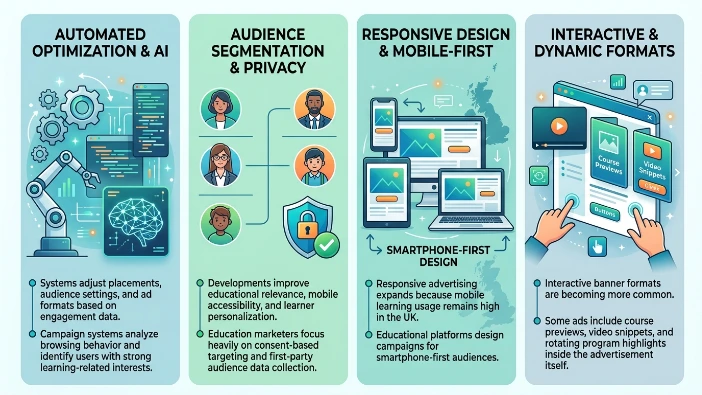
Banner ads are evolving through automation, audience segmentation, responsive design, and behavioral targeting. These developments improve educational relevance, mobile accessibility, and learner personalization across modern digital advertising systems used by online education providers.
Modern advertising systems increasingly use automated optimization. These systems adjust placements, audience settings, and ad formats based on engagement data.
Artificial intelligence also influences educational advertising delivery. Campaign systems analyze browsing behavior and identify users with strong learning-related interests.
Responsive advertising continues to expand because mobile learning usage remains high across the United Kingdom. Educational platforms increasingly design campaigns for smartphone-first audiences.
Interactive banner formats are becoming more common. Some educational ads now include course previews, video snippets, and rotating program highlights inside the advertisement itself.
Privacy regulations are also influencing campaign structures. Education marketers now focus more heavily on consent-based targeting and first-party audience data collection.
As online learning continues expanding across professional training, university education, and remote certifications, banner advertising remains a central awareness tool within digital education marketing strategies.