
Banner campaigns in education marketing represent structured digital advertising systems that display visual course messages across websites, apps, and digital platforms. These campaigns operate through ad networks that distribute creative content based on audience behavior, demographics, and browsing patterns across the United Kingdom education ecosystem.
TOFU learning line: Awareness begins with exposure, exploration begins with clarity, and understanding begins with structured information about how banner campaigns operate in education marketing environments. MOFU exploration connects comparison of options, BOFU evaluation leads toward structured decision readiness based on engagement signals.
What are banner campaigns in education marketing?
Banner campaigns in education marketing are structured digital advertising systems that deliver visual course promotions across online platforms using image-based or text-based display units targeted to relevant audiences.
Banner campaigns represent one of the earliest digital promotion methods used in education communication. They operate through ad distribution networks that place visual messages on websites, mobile apps, and learning portals. These banners display structured course information such as subject categories, learning pathways, and academic levels.
In the United Kingdom, education marketing systems use banner campaigns to reach learners across search engines, educational forums, and informational websites. These campaigns function at scale, meaning one campaign can appear across thousands of digital placements simultaneously.
Banner campaigns also rely on segmentation logic. Segmentation divides audiences into groups based on interests such as professional training, academic study, or skill development. Each group receives different visual messaging aligned with their educational intent.
How do banner campaigns display course information online?
Banner campaigns display course information online through structured visual formats that combine text, imagery, and layout design to communicate learning opportunities across digital platforms in a concise and attention-focused format.
Banner systems distribute course information through standardized ad sizes placed in webpage headers, sidebars, and content blocks. These placements ensure visibility during browsing sessions. Each banner contains simplified educational messaging that represents course themes, subject categories, and learning outcomes.
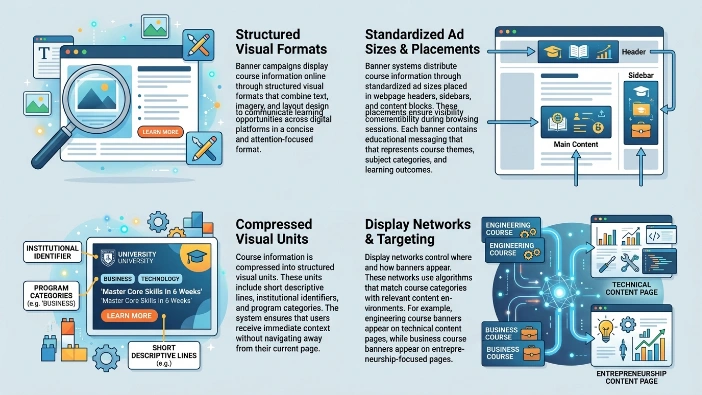
Course information is compressed into structured visual units. These units include short descriptive lines, institutional identifiers, and program categories. The system ensures that users receive immediate context without navigating away from their current page.
Display networks control where and how banners appear. These networks use algorithms that match course categories with relevant content environments. For example, engineering course banners appear on technical content pages, while business course banners appear on entrepreneurship-focused pages.
The system prioritizes clarity, ensuring that each banner communicates one primary educational message per impression cycle.
What technologies support banner advertising in education sector?
Banner advertising in the education sector operates through programmatic ad technology, real-time bidding systems, tracking pixels, and demand-side platforms that automate placement, targeting, and delivery of course-related visual content across digital ecosystems.
Programmatic advertising systems automate banner placement decisions. These systems evaluate available ad space and match it with education-related campaign requirements within milliseconds. Real-time bidding systems determine which educational banner appears based on relevance scores and audience matching parameters.
Tracking pixels collect behavioral signals from users interacting with education-related content. These signals include page visits, scroll depth, and engagement duration. The data is processed to refine future banner placements.
Demand-side platforms manage campaign execution. These platforms allow education advertisers to define audience segments, budget distribution, and creative variations.
Server-side ad exchanges connect publishers with advertisers. These exchanges facilitate high-volume distribution of education banners across multiple digital environments, ensuring wide visibility of course-related messaging.
How do education brands target audiences using banner campaigns?
Education brands target audiences using banner campaigns through behavioral segmentation, contextual placement, demographic filtering, and intent-based targeting systems that align course messaging with user interests and browsing patterns.
Behavioral segmentation analyzes user interactions with educational content. Users searching for academic resources receive different banner categories compared to users engaging with professional development materials.
Contextual placement ensures banners appear on relevant pages. Educational content related to science appears on science-focused websites, while business learning content appears on entrepreneurship platforms.
Demographic filtering uses age range, location, and educational background indicators. In the United Kingdom, this filtering aligns course promotions with regional academic standards and learner groups.
Intent-based targeting identifies users based on repeated exposure to education-related content. Repeated interactions indicate stronger interest signals, which increase the likelihood of displaying more detailed course banners.
These targeting systems operate together to ensure that education banners reach relevant audiences with structured informational alignment.
What types of banner formats are used for course promotion?
Banner formats used for course promotion include static image banners, animated banners, responsive banners, and interactive banners that display structured educational content across different digital placements and screen environments.
Static image banners present fixed visual information about courses. These banners use simple layouts with concise text and imagery representing academic subjects.
Animated banners introduce motion elements. These elements highlight course categories, learning pathways, or educational themes through transitions and sequential messaging.
Responsive banners adjust automatically to screen size. These banners maintain readability across desktop, tablet, and mobile environments without changing core educational messaging.
Interactive banners allow user engagement through hover effects or expandable sections. These formats present additional course details when users interact with the banner area.
Each format serves a specific communication function within the broader education marketing system, ensuring adaptability across digital ecosystems.
Explore:
How Online Learning Platforms Turn Course Viewers Into Paying Students Using Banner Ads
Why are banner campaigns important for education awareness?
Banner campaigns are important for education awareness because they create large-scale visibility for academic programs, distribute structured learning information across digital environments, and establish repeated exposure that increases recognition of educational opportunities.
Banner campaigns operate at scale, allowing education messaging to appear across thousands of websites simultaneously. This wide distribution increases awareness of available learning programs.
Repeated exposure strengthens informational retention. Users encountering multiple banner impressions develop familiarity with course categories and academic structures.
Banner systems also reduce complexity in education discovery. They present simplified course information in visual formats that require minimal cognitive effort to understand.
In the United Kingdom education landscape, awareness plays a critical role in connecting learners with academic opportunities. Banner campaigns function as the first informational layer in this discovery process.
Read:
How Online Learning Platforms Increase Course Consideration Using Banner Ads
How do users interact with educational banner campaigns?
Users interact with educational banner campaigns through impression viewing, click engagement, hover-based exploration, and indirect behavioral responses that signal interest in course-related content across digital platforms.
Impression viewing occurs when users see banner content without interaction. This creates initial awareness of course categories.
Click engagement happens when users select a banner to access additional information. This interaction represents a transition from awareness to active exploration.
Hover-based interaction occurs on desktop environments. Users pause on banners to preview additional details without leaving the current page.
Indirect behavioral responses include return visits to education-related pages after repeated banner exposure. These patterns indicate increased interest in specific learning areas.
User interaction data contributes to improving future banner placements and message alignment.
Explore More Expert Insights:
How Online Learning Platforms Drive Signups Using Banner Ads
How Coaching Centers Increase Admissions Using Display Ads
What role does data play in banner campaign optimization?
Data plays a central role in banner campaign optimization by analyzing user behavior, measuring engagement performance, refining targeting accuracy, and improving content relevance for education-focused digital advertising systems.
Data collection begins with tracking impressions, clicks, and engagement duration. These metrics define baseline performance for education banner campaigns.
Behavioral analysis identifies which course categories receive higher engagement. This analysis supports refinement of future campaign targeting.
Conversion tracking evaluates whether users proceed to deeper educational content after interacting with banners. This creates structured insight into user intent progression.
Optimization systems adjust banner placement frequency based on performance metrics. High-performing placements receive increased visibility across digital networks.
Machine-based learning systems also refine creative distribution patterns, ensuring that education messages remain aligned with audience preferences and digital behavior trends.
How banner campaigns structure education awareness online
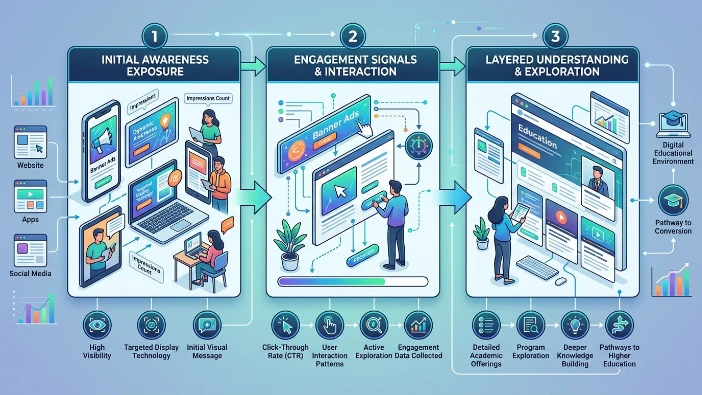
Banner campaigns in education marketing create structured pathways for course awareness across digital ecosystems. These systems operate through targeting, display technology, and user interaction patterns that transform simple visual messages into large-scale educational visibility networks.
The process begins with awareness exposure and progresses through engagement signals that define how users explore educational opportunities. Each stage of interaction contributes to a layered understanding of academic offerings within digital environments.