
AI search tools are software applications that synthesize web data using natural language processing to answer user queries directly. These systems index published research reports by crawling public web pages, parsing unstructured text, extracting core data points, and storing structured entities in proprietary vector databases.
Generative search engines, conversational AI assistants, and enterprise research platforms retrieve published documents via web scrapers or direct publisher APIs. When a researcher or industry professional queries an artificial intelligence engine for UK market statistics or academic findings, the underlying large language model processes the indexed text. It identifies relevant documents based on semantic similarity scores rather than simple keyword matches.
Document Parsing and Vector Embedding
Large language models convert research reports into numerical vectors during the indexing phase. Each paragraph, table, and data chart transforms into high-dimensional coordinates that map semantic meaning. When a user submits a search query, the system vectorizes the query and scans the database for the closest semantic matches. Published reports with clear structural hierarchies, explicit data tables, and explicit metadata rank higher in retrieval-augmented generation pipelines.
Retrieval-Augmented Generation Mechanics
Retrieval-augmented generation combines external database searches with text generation. The AI engine searches its indexed corpus for authoritative research documents matching the prompt context. It then extracts specific data passages, compiles them into a contextual prompt context, and drafts a synthesized answer. The engine appends source citations or hyperlinks back to the original domain if the indexing configuration recognizes the publisher as a reliable authority.
Why Is Tracking AI Citations Important for Research Publishers?
Tracking artificial intelligence citations is important because generative search engines increasingly bypass traditional web traffic paths by delivering complete answers directly to users. Publishers must monitor these citations to measure true content reach, evaluate brand authority, and protect intellectual property from unauthorized data scraping.
Traditional web analytics rely on HTTP referral headers, Google Analytics tracking pixels, and standard click-through rates. Conversational search interfaces alter this data flow. When an artificial intelligence tool answers a user query using data from a published UK research report, the user receives the insight instantly without visiting the publisher website. Consequently, traditional traffic metrics drop while the actual distribution and influence of the research expand across digital ecosystems.
Measuring Content Impact Beyond Traffic
Content impact now spans zero-click searches, where users consume information directly on the search engine results page. Publishers measure true influence by tracking how often generative models synthesize their specific data points, statistics, and definitions. High citation frequency establishes a report as an authoritative source within specific industry verticals, which drives long-term brand equity and institutional recognition across the United Kingdom.
Protecting Intellectual Property Rights
Automated scraping bots harvest public research documents to train proprietary models without explicit publisher consent. Monitoring AI citations enables publishers to verify whether commercial artificial intelligence models utilize copyrighted findings. Organizations identify unauthorized data usage, audit licensing agreements, and evaluate whether their robots.txt files or paywall implementations successfully restrict automated data ingestion.
Explore More Expert Insights:
How Financial Services Build Trust Using Educational Banner Advertising
How Agencies Increase Buyer Engagement Using Display Remarketing Ads
What Are the Core Methods Used to Detect AI Citations?
The core methods used to detect artificial intelligence citations include log file analysis, brand mention monitoring, referrer header tracking, and custom URL parameter deployment. These techniques isolate conversational search bot traffic from standard human visitors and traditional search engine crawlers.
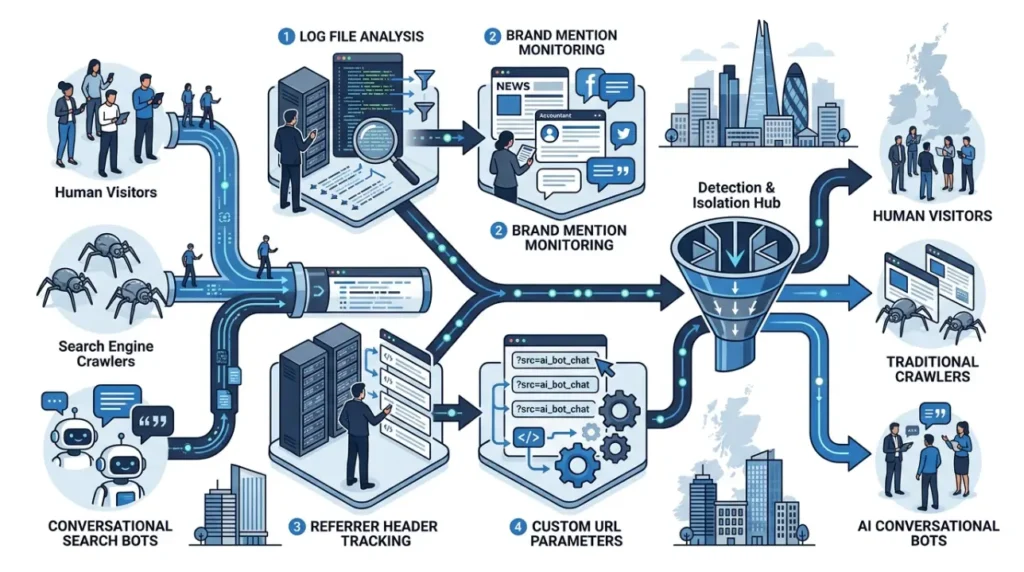
Detecting generative search citations requires specialized technical monitoring because conversational interfaces use different user-agent strings and request patterns compared to traditional crawlers like Googlebot. Publishers deploy multiple tracking mechanisms simultaneously to capture accurate citation data across various artificial intelligence platforms and enterprise search products.
Log File Analysis for Bot Detection
Server log files record every HTTP request hitting a web server, including requests from artificial intelligence retrieval bots. Publishers analyze these logs for known user-agent strings associated with major conversational search tools. For example, tracking requests from user-agents like OAI-SearchBot or ClaudeBot reveals when an artificial intelligence system actively crawls, indexes, or retrieves published research reports from the server environment.
Brand Mention Monitoring and Entity Tracking
Brand mention tools scan the web for unlinked and linked references to specific research titles, author names, and proprietary terms. Because many artificial intelligence models mention source organizations without hyperlinking back to the source URL, text-based monitoring identifies qualitative brand visibility. Software tools parse millions of web pages daily to detect occurrences of unique research findings, exact-match statistics, and proprietary survey titles across digital publications.
Custom URL Parameters and Redirects
Publishers distribute unique promotional links across different digital channels to isolate referral traffic sources. Appaching distinct tracking parameters to links shared in newsletters, press releases, or academic databases allows analytics platforms to separate human traffic from automated retrieval requests. When an artificial intelligence tool extracts and utilizes a distinct tracked URL, analytics suites record the precise referral origin and query context.
How Can Publishers Implement an AI Citation Tracking Workflow?
Publishers implement an AI citation tracking workflow by auditing existing web analytics, deploying specialized mention-tracking software, configuring server log parsers, and establishing recurring data review cycles. This structured process transforms raw server requests and web mentions into actionable intelligence.
Executing a reliable tracking workflow demands cross-functional collaboration between editorial, technical, and marketing teams. Organizations automate data collection to maintain continuous visibility into how generative search engines utilize their published research reports.
Step-by-Step Implementation Process
- Audit Existing Analytics Setup: Review current Google Analytics or alternative web property configurations to ensure proper event tracking and referral dimension reporting.
- Configure Server Log Analysis: Set up automated log parsing tools to isolate requests from artificial intelligence user-agents and conversational search retrieval bots.
- Deploy Brand Mention Tools: Implement text-monitoring software configured with exact-match strings for the published research report titles, unique data sets, and institutional names.
- Establish Review Cadence: Schedule weekly or monthly data analysis sessions to review citation trends, identify high-performing content types, and adjust digital publishing strategies.
What Are the Technical Challenges in Tracking AI Citations?
The technical challenges in tracking artificial intelligence citations include zero-click answer delivery, dynamic user-agent spoofing, fragmented platform ecosystems, and the absence of standardized referral protocols. These barriers obscure exact attribution data for publishers.
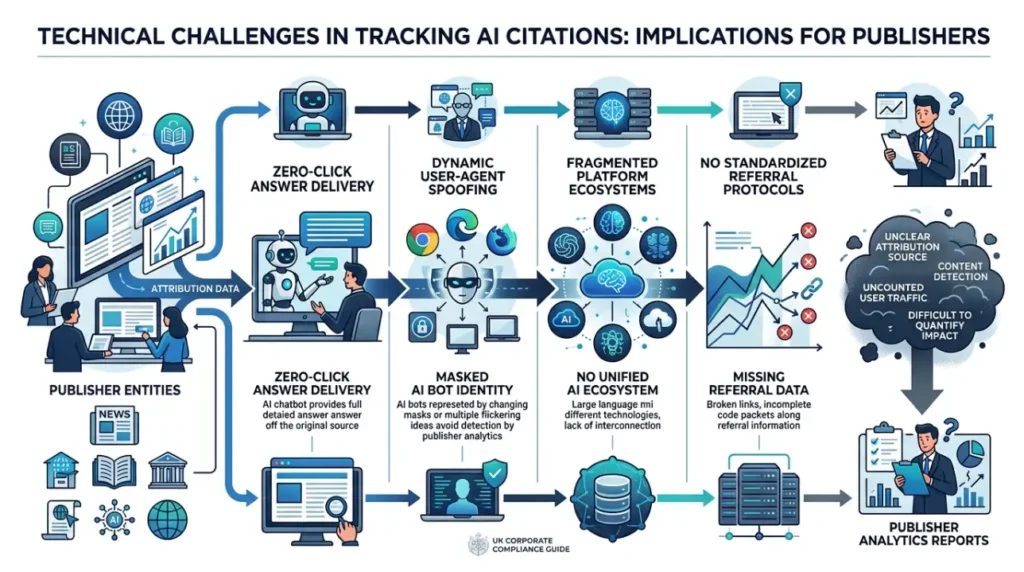
Unlike traditional hyperlink environments, conversational search tools operate with technical limitations that complicate metric collection. Publishers must navigate these hurdles to extract accurate insights from their digital assets.
Zero-Click Search Limitations
Zero-click searches occur when an artificial intelligence tool presents a complete answer derived from a research report without displaying a visible link or citation. When a user reads the synthesized answer and exits the search interface, no browser request reaches the publisher server. This dynamic eliminates standard web traffic signals, making it impossible to measure readership through conventional pageview metrics.
User-Agent Spoofing and Fragmentation
Many artificial intelligence crawlers and retrieval systems utilize generic user-agent strings or rotate IP addresses to mimic standard web browsers. This practice prevents web servers from identifying automated extraction processes through standard log file filters. Furthermore, the market fragmentation across dozens of competing conversational search engines requires publishers to maintain diverse, custom monitoring scripts for each distinct platform ecosystem.
How Do Structured Data and Semantic Markup Improve AI Citation Rates?
Structured data and semantic markup improve artificial intelligence citation rates by providing machine-readable definitions, explicit entity relationships, and standardized metadata that large language models easily parse. This technical optimization increases the probability of accurate data extraction and source attribution.
Search engines and conversational agents rely on schema markup to understand the context of published research reports. Implementing standardized markup transforms unstructured text into clear data entities that retrieval-augmented generation systems process with high precision.
Schema Markup Implementation for Research Reports
Publishers apply specific schema types such as ScholarlyArticle, Dataset, and Report to their digital publications. This markup explicitly defines authorship dates, institutional publishers, abstract summaries, and statistical variables. When an artificial intelligence crawler parses a marked-up document, the structured tags remove ambiguity regarding data ownership and research methodology, which increases the likelihood of receiving an explicit citation in generated answers.
Semantic Clarity and Entity Optimization
Writing with strict semantic clarity ensures that large language models correctly associate statistics with the publishing organization. Authors avoid ambiguous pronouns and vague modifiers, opting instead for explicit entity names and precise numerical values. Clear headings, concise bulleted summaries, and well-defined tables allow artificial intelligence extraction algorithms to isolate core research findings without misinterpreting contextual meanings.
Tracking artificial intelligence citations for published UK research reports requires specialized technical methods, including server log analysis, brand mention monitoring, and schema markup optimization. Because generative search engines frequently deliver zero-click answers without traditional hyperlinks, publishers must look beyond standard web traffic metrics to evaluate content reach. Implementing structured workflows and semantic markup ensures that research reports remain visible, citable, and properly attributed across modern digital information ecosystems.