
AI citation tracking for published UK research reports is the systematic process of monitoring LLMs, generative search engines, and conversational discovery platforms to measure how often algorithms reference, quote, link, or credit academic and commercial white papers originating in the United Kingdom.
Generative search engines replace traditional ten-blue-links layouts with synthesized prose. When a user asks an LLM or an AI-driven discovery engine a complex domain question, the system retrieves relevant documents, extracts data points, and builds a response. For British publishers, academic institutions, and corporate think tanks, understanding this distribution channel requires distinct measurement frameworks.
Tracking differs fundamentally from standard web analytics. Standard traffic acquisition relies on HTTP referrer headers captured by tools like Google Analytics or Matomo. AI tools, however, frequently summarize content internally without passing a traditional browser-level referrer string. Consequently, manual queries, log-file analysis, and specialized LLM monitoring suites form the core tracking apparatus.
How do generative search engines reference UK research reports?
Generative search engines reference UK research reports by parsing PDF documents, HTML web pages, and academic repositories, extracting quantitative data points, and embedding inline hyperlinks or brand attributions directly inside synthesized natural language answers.
Modern AI platforms utilize retrieval-augmented generation. When crawlers index a document published on a .co.uk or .ac.uk domain, they segment the text into vector embeddings. If a query matches those embeddings, the model integrates the findings into its output.
Inline Hyperlinks and Source Cards
Major discovery platforms display citations through two primary interfaces. First, they inject contextual inline hyperlinks anchored to specific keywords or phrases within the text block. Second, they generate visual source cards alongside the response window. These cards display the publication title, the domain name, and a direct outbound link.
Direct Brand Mentions Without Hyperlinks
Many conversational engines mention institutional names or report titles without providing a clickable link. In these instances, the AI attributes a statistic, chart, or qualitative insight to the publisher using natural language phrasing. Measuring these invisible citations demands brand-monitoring infrastructure that captures text strings across proprietary LLM outputs.
What metrics measure AI visibility and referring domains?
Metrics that measure AI visibility and referring domains include LLM citation frequency, brand mention volume, generative engine referral traffic, and the proportion of unique linking root domains originating from AI platforms.
Evaluating performance in generative ecosystems requires tracking both quantitative volume and qualitative attribution accuracy. Publishers measure these dimensions using a combination of server logs and specialized tracking software.
- Citation Frequency: The total number of times an LLM explicitly references a specific research report URL within a defined evaluation period.
- Mention Volume: The aggregate count of text-based references to the research title or authoring institution, regardless of whether a hyperlink is present.
- Referring Domains: The count of unique authoritative domains passing traffic or algorithmic value to the research landing page from AI-driven discovery interfaces.
- Share of Model: The percentage of times a specific research report appears in AI-generated answers for a targeted set of industry queries compared to competitor publications.
For deeper context on foundational visibility mechanics, refer to [How Do You Know Whether AI Search Tools Are Citing Your Published Research Report?].
Explore More Expert Insights:
How Investment Firms Build Awareness Using Market Insight Ads
How Finance Brands Improve Conversion Intent Using Retargeting Ads
What is the step-by-step process for tracking AI citations?
The step-by-step process for tracking AI citations involves auditing server log files for AI user-agents, executing systematic prompt testing across major LLM engines, deploying brand mention monitors, and analyzing referral traffic anomalies.
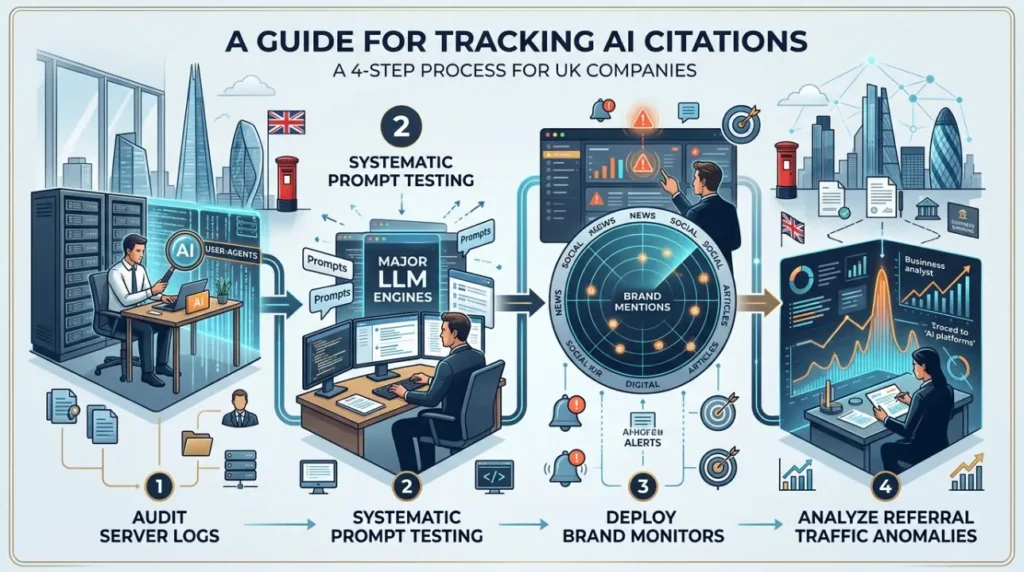
Executing a comprehensive tracking program ensures that UK publishers capture both direct link traffic and unlinked brand citations across conversational search platforms.
Step 1: Log File Analysis for AI Crawlers
Web server logs record every request made to a hosted research report PDF or landing page. Publishers inspect these logs for known AI user-agents, including GPTBot, OAI-SearchBot, ClaudeBot, and PerplexityBot. High crawl frequencies from these bots indicate active indexing and upcoming citation potential.
Step 2: Systematic Prompt Testing
Publishers construct a matrix of industry-specific queries that target the core findings of their research report. Analysts input these prompts into major generative search tools at regular intervals. Documenting whether the output references the report, quotes specific data points, or provides a link creates a baseline visibility score.
Step 3: Deployment of Automated Monitoring Tools
Manual testing provides qualitative snapshots, but automated tools scale the process. Publishers deploy monitoring solutions that query LLM APIs automatically. These tools scan outputs for exact match phrases, statistical data points unique to the report, and institutional names.
What tools and technologies identify AI-generated referral traffic?
Tools and technologies that identify AI-generated referral traffic include specialized log-file analyzers, LLM visibility tracking platforms, custom UTM tagging frameworks, and advanced web analytics segments.
Because standard analytics packages often misclassify AI referral traffic as direct traffic, publishers implement specialized technical configurations.
UTM Parameterization in Distribution Campaigns
When distributing a UK research report via email newsletters, press releases, or social channels, publishers append precise UTM tracking parameters. While AI engines rarely preserve these parameters when scraping original text, ensuring that outbound promotional links use structured tagging prevents attribution leakage from human readers discovering the report through secondary channels.
Specialized LLM Monitoring Platforms
Emerging software suites simulate user queries across multiple generative models simultaneously. These platforms parse millions of AI responses daily, alerting publishers whenever their brand name, report title, or specific URL appears in an AI-generated synthesis.
For organizations evaluating comprehensive execution strategies, exploring [Time Intelligence Media Group Research and Reports Services With AI Citation Tracking] provides additional operational insights into managed measurement solutions.
How do publishers optimize UK research reports for AI citations?
Publishers optimize UK research reports for AI citations by structuring documents with clear semantic hierarchies, publishing machine-readable data tables, utilizing explicit schema markup, and securing authoritative .uk backlinks.
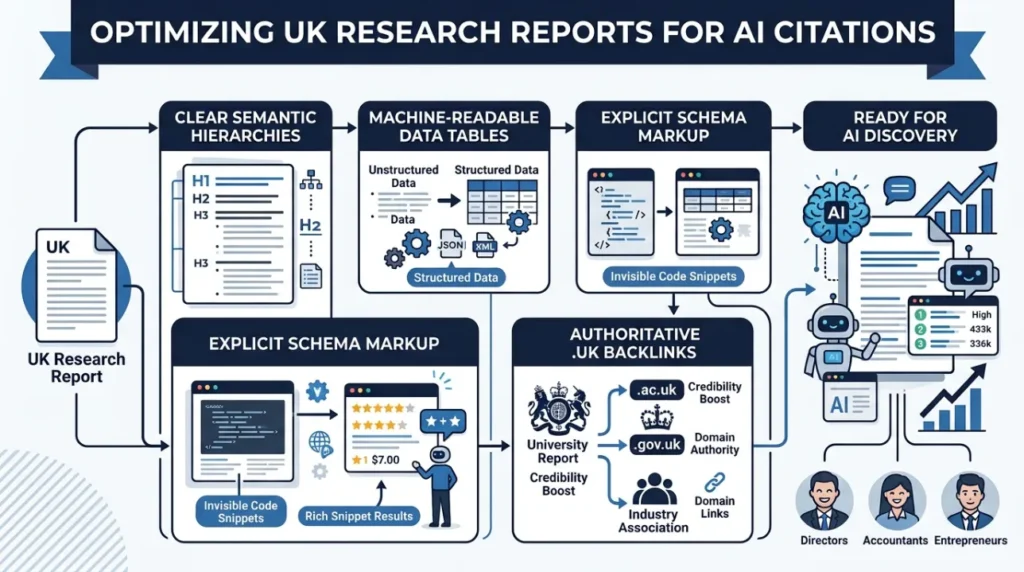
Generative engines prioritize content that is easy to parse, verify, and ingest. Technical and structural optimization directly influences how frequently an LLM selects a research report as a primary source.
Semantic Document Structure
Research reports require rigorous heading hierarchies, beginning with a clear H1 and progressing logically through H2 and H3 tags. Authors place direct, factual executive summaries at the top of each section. This design allows extraction algorithms to locate key findings without processing extraneous prose.
Structured Data and Schema Markup
Implementing schema markup, specifically ScholarlyArticle or Report JSON-LD data types, communicates document metadata directly to search engine crawlers. This code explicitly defines the publication date, author credentials, institutional publisher, and abstract.
Open-Access Repositories and PDF Accessibility
AI crawlers frequently ingest PDF documents stored in open-access repositories. Publishers ensure these files contain selectable text layers rather than flat raster images. Furthermore, embedding clear data tables with distinct row and column headers allows LLMs to extract quantitative statistics accurately.
What are the primary use cases for tracking AI citations in the UK?
Primary use cases for tracking AI citations in the UK include measuring academic impact, proving commercial ROI for corporate white papers, refining content distribution strategies, and benchmarking against competitor research publications.
Different organizational stakeholders utilize AI citation data to achieve distinct strategic objectives within the British media and research landscape.
Academic and Institutional Impact Measurement
Universities and research councils across the United Kingdom track AI citations to demonstrate the broader societal and technological impact of their studies. Funding bodies increasingly evaluate research reach through digital visibility metrics that extend beyond traditional citation indices like Scopus or Web of Science.
Corporate Think Tank Valuation
Commercial enterprises and financial institutions publish research reports to establish market authority. Tracking AI citations proves that industry analysts, journalists, and decision-makers rely on the publisher’s proprietary data when utilizing AI tools for market research.
Tracking AI citations, brand mentions, and referring domains generated by a published UK research report requires a combination of log-file analysis, prompt testing, and specialized monitoring infrastructure. As generative search replaces traditional discovery models, measuring unlinked brand attributions and AI-driven referral traffic ensures accurate attribution of intellectual property and institutional authority.