
Time Intelligence Media Group research and reports services with AI citation tracking provide UK enterprises with published industry studies, custom market data analyses, and algorithmic monitoring tools that record exact brand mentions, referring domains, and source citations generated across artificial intelligence search engines and large language models.
UK organisations operate within a rapidly shifting digital discovery landscape where traditional search engine optimisation yields visibility to generative engine optimisation. Research reports published by commercial entities face new distribution dynamics. Artificial intelligence platforms synthesize data directly from published documents, bypassing conventional click-through pathways.
Time Intelligence Media Group addresses this visibility shift by combining authoritative primary research production with dedicated tracking mechanisms. Enterprises commission comprehensive market reports that establish industry benchmarks, regulatory analyses, and consumer behavior metrics. Simultaneously, the integrated tracking service deploys automated scrapers and semantic auditing tools across major generative systems to map every instance of data attribution.
Understanding this dual framework requires examining how traditional publication methods integrate with algorithmic citation monitoring. Organisations can review foundational concepts regarding generative visibility through [How Do You Know Whether AI Search Tools Are Citing Your Published Research Report?], or examine comparative deployment strategies via [How to Track AI Citations, Brand Mentions and Referring Domains Generated by a Published UK Research Report].
How does the research and report creation process function for UK markets?
The research and report creation process for UK markets involves primary data collection, regulatory compliance verification through the Information Commissioner’s Office, statistical modeling, and formal document structuring designed for machine readability and human comprehension.
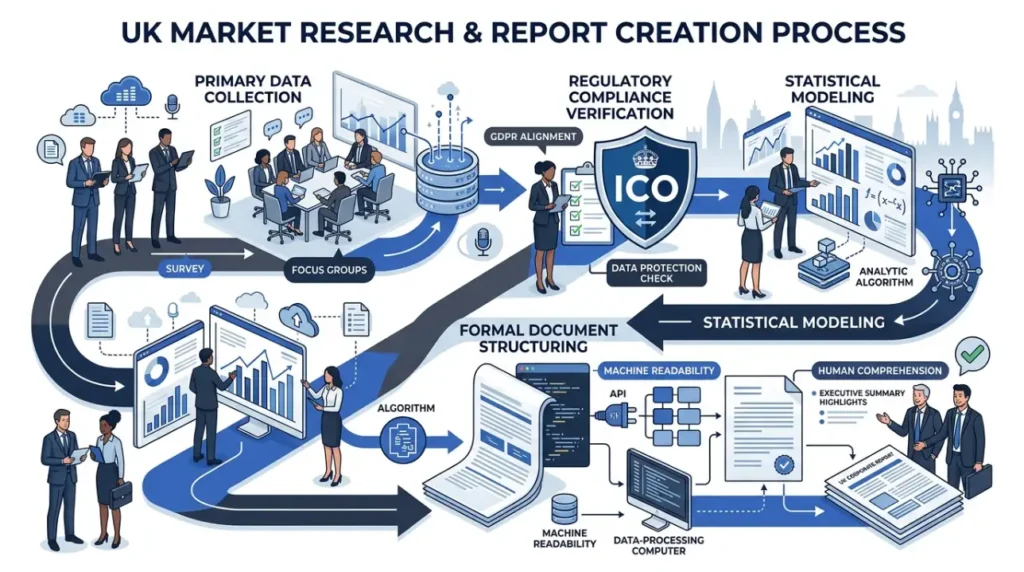
Producing an authoritative research report requires rigorous methodological standards that satisfy both human industry experts and machine learning crawlers. The workflow begins with scoping specific commercial objectives, followed by quantitative surveys and qualitative interviews targeting UK consumer demographics or B2B sectors.
Primary Data Collection and Sampling
Primary data collection relies on stratified random sampling of target populations across England, Scotland, Wales, and Northern Ireland. Sample sizes maintain statistical significance with confidence intervals of 95% and a margin of error below 5 percent. Analysts deploy digital questionnaires, telephone interviews, and focus groups to gather raw behavioral and economic inputs.
Statistical Modeling and Validation
Statistical modeling applies multivariate regression, sentiment analysis, and trend forecasting to raw datasets. Data scientists clean anomalies and cross-reference findings against official databases such as the Office for National Statistics. This validation ensures that final conclusions withstand peer review and regulatory scrutiny.
Document Architecture for Machine Readability
Document architecture utilises strict semantic HTML and structured PDF metadata. Headings, data tables, and statistical callouts receive schema markup. This technical formatting allows artificial intelligence models to parse exact figures, author attributions, and institutional affiliations without parsing errors.
What are the core components of AI citation tracking?
The core components of AI citation tracking include automated prompt query engines, semantic entity matching, referring domain attribution, and sentiment evaluation algorithms that continuously audit generative engine outputs.
Monitoring digital citations requires specialized technological infrastructure capable of querying large language models at scale. Unlike standard rank trackers that monitor static keyword positions, AI citation trackers evaluate dynamic, synthesized text generated in real time.
Automated Prompt Query Engines
Automated prompt query engines execute thousands of simulated user queries daily across dominant generative search platforms. These queries use semantic variations of industry keywords, brand names, and research report titles to trigger model responses. The system captures the complete text output of every generated answer.
Semantic Entity Matching and Attribution
Semantic entity matching scans generated text for specific brand mentions, statistical figures, and direct quotations originating from published reports. When an AI model attributes a statistic to a specific UK enterprise or research paper, the tracking system logs the exact context, timestamp, and query parameter.
Referring Domain and URL Extraction
Referring domain extraction identifies hyperlinks and plain-text source citations embedded within generative engine responses or associated footnote panels. The system maps these links back to the original hosting domain, measuring referral traffic velocity and domain authority impacts.
Explore More Expert Insights
Why Brands That Publish on News Sites Build Trust Faster Than Those on Social Only
The 39% Quality Problem: Why Most UK Sponsored Content Fails to Convert in 2026
What business benefits do these integrated services deliver to enterprises?
Integrated research and AI citation tracking services deliver measurable improvements in brand authority, verifiable return on marketing investment, competitive intelligence, and direct pipeline generation across generative search channels.
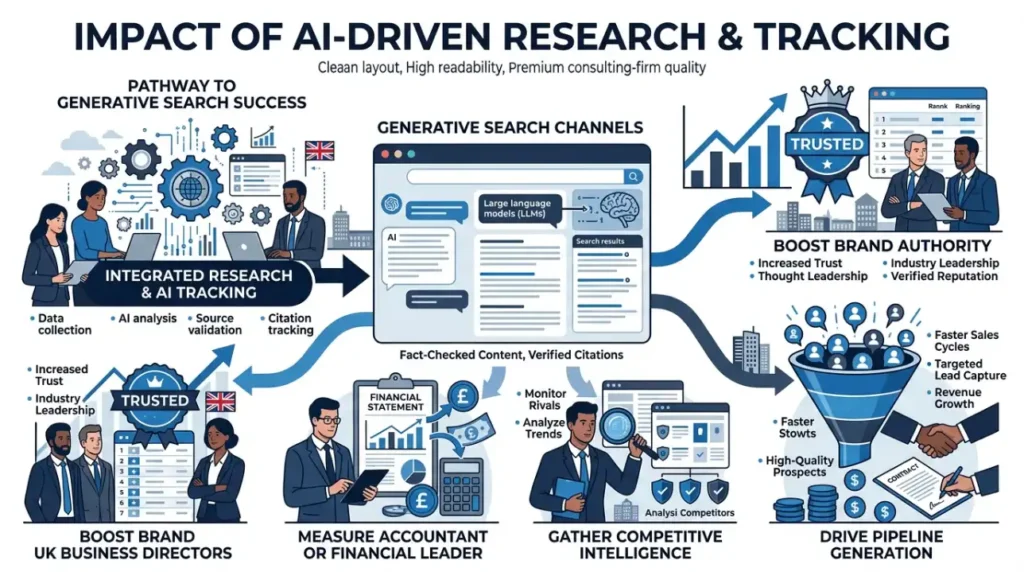
Deploying proprietary research combined with rigorous tracking yields distinct commercial advantages for organisations operating in competitive UK sectors such as fintech, healthcare, and professional services.
Establishing Market Authority and Trust
Publishing original data positions an enterprise as a primary source rather than a secondary commentator. When artificial intelligence models repeatedly cite a specific report as the definitive authority on a topic, brand trust increases among prospective clients who rely on generative tools for vendor evaluation.
Quantifying Generative Search ROI
Traditional marketing metrics fail to capture visibility generated inside closed generative chat interfaces. AI citation tracking converts invisible brand mentions into hard data points. Enterprises track the precise volume of citations earned per published report, directly connecting content creation budgets to digital PR outcomes.
Uncovering Competitor Intelligence
Tracking dashboards reveal which rival organisations receive citations alongside or instead of the brand. Analysts examine competitor methodologies, identify content gaps in the market, and commission targeted follow-up reports to capture lost generative share of voice.
How are organizations applying these services across different industries?
Organisations apply these integrated services across financial services, healthcare, and enterprise technology sectors to monitor regulatory compliance, track market research adoption, and measure thought leadership impact.
Different industry verticals utilize research reports and citation tracking to address distinct operational and marketing challenges.
Financial Services and FinTech
FinTech institutions publish quarterly reports on digital banking adoption and regulatory changes. Using AI citation tracking, compliance teams monitor how artificial intelligence models summarize financial regulations and investment data, ensuring that generative engines do not misquote statistics or misrepresent institutional advisory guidelines.
Healthcare and Pharmaceuticals
Pharmaceutical companies release clinical trial analyses and health economics research. Citation tracking measures how medical information retrieval systems reference clinical data, protecting brand reputation and ensuring accurate dissemination of medical findings to healthcare professionals.
Enterprise Software and B2B SaaS
SaaS providers publish benchmark reports on workplace productivity and software integration trends. Citation tracking measures how generative tools recommend specific software platforms based on published benchmark scores, providing direct visibility into modern enterprise software discovery pathways.