A booking platform ad is a paid promotional message placed on digital channels that sends users to a reservation flow and converts them into paid bookings. It uses targeting, creative, and conversion-tracking to move users from browsing to purchase.
A booking platform ad is an identifiable advertising unit. It appears on search results, social feeds, display networks, metasearch, and partner sites. It links directly to a booking engine, property page, or checkout flow. The ad’s objective is a tracked reservation event such as completed payment, confirmed booking, or voucher issuance. Entities involved include the advertiser (platform or property), ad network, booking engine, and payment processor. Each entity exposes measurable metrics: impressions, clicks, add-to-cart events, booking completions, and revenue.
Banner, native, video, sponsored listings, and metasearch entries. Banner and native ads present images, copy, and price or availability snippets. Metasearch entries show live rates and booking buttons. Ads integrate with tracking pixels, server-to-server APIs, and conversion tags to attribute reservations back to campaigns.
How do booking platform ads convert browsing intent into paid actions?
Conversion occurs when an ad captures intent, reduces friction, and triggers a tracked booking flow ending in payment confirmation. The process uses targeting, creative relevance, and optimised checkout steps.
Conversion starts with audience selection. Advertisers target by search queries, on-site behaviour, past interactions, demographics, and contextual signals. Ads then deliver relevant offers: price guarantees, short-term discounts, limited availability, or flexible cancellation. The landing page must show live availability and a clear booking CTA. Checkout requires pre-filled fields, guest information collection, and secure payment capture. Tracking records every step: view, click, session, booking initiation, payment attempt, and confirmation.
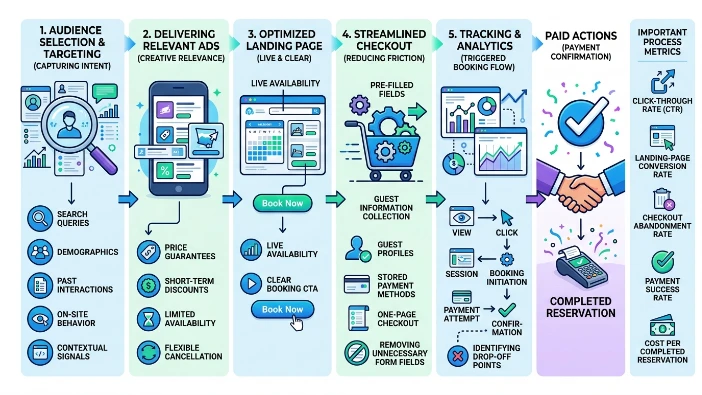
Important process metrics include click-through rate (CTR), landing-page conversion rate, checkout abandonment rate, payment success rate, and cost per completed reservation. A booking platform reduces friction by offering guest profiles, stored payment methods, and one-page checkout. Removing unnecessary form fields lowers abandonment. Implementing step-level analytics identifies drop-off points and enables targeted fixes.
What components make a high-performing booking platform ad campaign?
High-performing campaigns combine precise audience targeting, price-accurate creatives, live availability signals, and end-to-end conversion tracking. Each component aligns to reduce friction and increase completed reservations.
Targeting selects users with demonstrated travel intent. Use first-party signals, search intent, retargeting lists, and lookalike audiences. Price accuracy requires integration with real-time rate feeds. Creatives include clear price, dates, and guarantee statements. Ad creatives include thumbnails that match landing images to maintain continuity.
Conversion tracking must be server-to-server where possible. Attribution windows match the business model: 24 hours for flash sales, 7–30 days for standard bookings. Payment integration supports multiple payment methods used in the UK, including major cards and digital wallets. Fraud detection and 3D Secure are standard for payment success and chargeback reduction.
Measurement uses revenue per click (RPC), return on ad spend (ROAS), and bookings per 1,000 impressions. Example: a campaign with 100,000 impressions, 1,500 clicks (1.5% CTR), 300 booking starts (20% landing-to-start), and 180 completed bookings (60% checkout conversion) yields direct insight into where to optimize.
Which creative elements increase booking rates in ads?
Effective creative elements combine price clarity, date relevance, social proof, and a strong booking CTA to prompt immediate action. Use specific numbers and live availability details.
Price clarity shows a specific nightly rate, total price for the stay, or percentage savings. Date relevance displays available check-in and check-out dates. Social proof lists guest ratings with numeric scores and review counts. CTAs use action terms tied to booking: “Book now — pay securely,” “Reserve tonight,” or “Check live rates.” Visuals show room type, key amenities, and real photography rather than staged stock.
Real examples: show “£89 per night” instead of “Great rates.” Show “Available 12–14 July” rather than “Dates available.” Display review metrics like “4.6/5 from 3,200 reviews.” Live rate feeds ensure creative accuracy and prevent cancellations due to price mismatch.
How does retargeting with booking platform ads lift conversion at the decision stage?
Retargeting serves ads to users who interacted previously, delivering tailored offers and reminders that shorten the path to booking. It segments audiences by behaviour and serves specific messages to each segment.
Segment users who viewed property pages, checked availability, initiated checkout, or abandoned payment. Serve urgency-focused ads to users who abandoned checkout, and soft incentives such as free breakfast to users who viewed multiple properties. Use sequential messaging: awareness creatives for early-stage visitors, price-oriented creatives for mid-stage, and last-room reminders for late-stage visitors.
Retargeting uses frequency caps and time windows to avoid overexposure. For checkouts abandoned within 24 hours, show an immediate booking reminder with a recovery code. For users who searched 7–30 days earlier, serve price-decline alerts or extended-stay discounts. Measure recovery rate: bookings recovered divided by total abandoned checkouts targeted.
What technologies and integrations support high booking conversion rates?
Key technologies include real-time rate feeds, server-to-server conversion APIs, secure payment gateways, and audience-management platforms. Each integration improves accuracy and reduces friction.
Real-time rate feeds synchronise inventory and price between the booking engine and ad creatives. Server-to-server APIs send conversion events directly to ad platforms to avoid browser loss and ad-blocking. Payment gateways support PCI-DSS compliance and UK payment methods. Audience-management platforms unify first-party data for segmentation and retargeting.
Supplementary technologies include A/B testing tools to test creatives and flows, session replay and heatmaps to find UX issues, and attribution platforms to link bookings to touchpoints across channels. Implementing 3D Secure 2 reduces payment declines while keeping friction low for low-risk transactions.
What metrics prove an ad campaign turned browsers into paid reservations?
Proof uses event-level conversion metrics: booking completions, revenue attributed, return on ad spend (ROAS), and cost per acquisition (CPA). Combine these with funnel metrics to diagnose performance.
Event-level metrics list booking completions, net revenue, cancellations within a specified window, and net revenue after fees. Funnel metrics include impressions, clicks, landing conversions, booking starts, payment attempts, and payment success rate. Attribution metrics show touchpoint contributions over windows: last-click, time-decay, or data-driven models.
Metrics reporting 10,000 clicks produce 1,200 booking starts and 720 completed bookings. If total ad spend equals £9,000 and net revenue equals £43,200, ROAS equals 4.8. CPA equals £12.50 per completed booking. Cancellation within 14 days is 6%.
Get Detailed Information Here:
How Booking Platforms Increase Conversions Using Banner Campaigns
What are the legal and compliance requirements for booking platform ads in the UK?
Advertisers must comply with UK consumer protection, pricing transparency, data protection (UK GDPR), and payment regulations. They must disclose full price, terms, and privacy practices.
Price presentation must include mandatory fees and taxes clearly before checkout. Displayed availability must match actual inventory; false availability violates consumer protection law. Data collection requires lawful basis under UK GDPR and clear privacy notices. Payment flows must comply with PCI-DSS and Strong Customer Authentication (SCA) where required. Refund and cancellation policies must be accessible during ad and checkout flows.
Record retention policies must meet tax and auditing rules, retaining transaction records for required periods. Maintain logs of consent and cookie settings for 6–24 months as part of compliance evidence.
What business outcomes do booking platform ads deliver for operators?
Booking platform ads drive measurable outcomes increased direct revenue, higher occupancy, lower distribution fees, and improved yield control. Each outcome links to campaign and channel strategy.
Direct revenue increases when ads target high-intent users and reduce reliance on costly third-party channels. Occupancy improves through targeted promotions for off-peak dates. Lower distribution fees result when ads send users to platform-owned checkout rather than third-party marketplaces. Yield control improves via dynamic pricing integration with ads that display price bands or urgency signals.
Coastal Hotel uses targeted ads for midweek dates and increases midweek occupancy by 14% over 60 days, raising net revenue per available room (RevPAR) by 9%.
Explore More Expert Insights:
Destination Campaign Ads That Convert Interest Into Travel Itineraries
Travel Retargeting Ads That Turn Trip Consideration Into Final Bookings
How should teams structure campaigns to maximise the decision stage?
Last-click offers for ready-to-book users, retargeting for checkout abandoners, and lookalike prospecting for high-LTV audiences. Use separate creatives and budgets per segment.
Allocate budget by funnel position. Reserve 30–50% of ad spend for retargeting and high-intent search. Use dynamic creatives tied to inventory and price feeds. Implement campaign experiments focused on checkout friction points: guest fields, payment options, and promo codes. PA for acquisition campaigns, recovery rate for abandonment campaigns, and ROAS for revenue campaigns.
Check Out the Full Article:
How Booking Platforms Improve Travel Intent Using Retargeting Ads
How to choose between advertising formats for conversion performance?
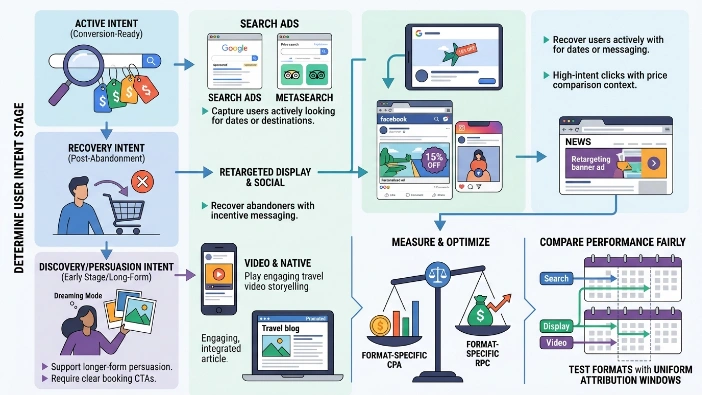
Metasearch and search for active intent, retargeted display and social for recovery, and native or video for rich storytelling tied to reservations. Measure format-specific CPA and RPC.
Metasearch yields high-intent clicks with price comparison context. Search ads capture users actively looking for dates or destinations. Retargeted display recovers abandoners with incentive messaging. Video and native support longer-form persuasion but require clear booking CTAs. Test formats with uniform attribution windows to compare performance fairly.