
Destination banner ads are visual web or mobile display creatives that promote a city, region, or attraction and link users to booking funnels; they use imagery, concise offers, and tracking pixels to measure clicks, impressions, and conversions.
Destination banner ads are defined as digital display units that focus on a travel destination rather than a single product. They appear on websites, apps, social feeds, and programmatic exchanges. Common ad sizes include 300×250, 728×90, and 320×50 pixels. Creatives combine destination photography, a value proposition (price, season, or experience), and a click-through URL. Ads include tracking tags: impression pixels, click trackers, and post-click conversion pixels for bookings. Ads run with frequency caps and audience targeting rules to control exposure.
Key performance indicators are click-through rate (CTR), view-through conversion (VTC), cost per click (CPC), and cost per acquisition (CPA). Campaign setups use attribution windows of 7, 14, or 30 days for conversion reporting.
Why do travel brands use destination banner ads to inspire bookings?
Brands use destination banner ads to generate demand, re-engage interested users, and move prospects through consideration by showcasing destination value and linking to booking paths.
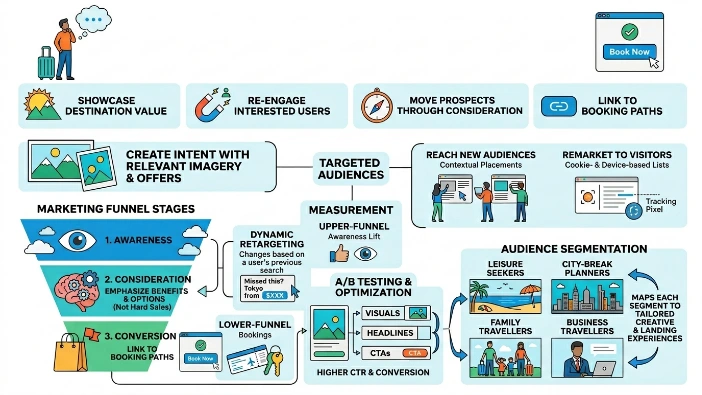
Destination banner ads create intent by showing relevant imagery and offers to targeted audiences. Ads reach new audiences via contextual placements and remarket to visitors via cookie- or device-based lists. Brands structure campaigns by funnel stage: awareness, consideration, and conversion. For the MOFU stage, creatives emphasise benefits and options rather than hard sales. Retargeting uses dynamic creatives that reflect previously viewed destinations or dates.
Measurement separates upper-funnel impact (engagement, awareness lift) from lower-funnel performance (bookings). Travel brands use A/B testing on visuals, headlines, and CTAs to isolate what drives higher CTR and conversion. Typical audience segments include leisure seekers, city-break planners, family travellers, and business travellers. Brands map each segment to tailored creative and landing experiences.
Which targeting methods work best for destination banner ads?
Effective targeting uses a mix of behavioural, contextual, geographic, and CRM-based lists to place destination banner ads in front of users who show intent or match desired traveller profiles.
Behavioral targeting selects users based on travel-related site visits, search history, or content consumption. Contextual targeting places ads on pages about similar destinations or travel advice. Geographic targeting serves ads to users in specific UK regions or feeder markets. CRM-based targeting uses email or hashed user IDs to retarget past bookers or newsletter subscribers.
Programmatic platforms enable lookalike audiences built from high-value bookers. Time-based targeting increases bids during known booking peaks, such as January sales and school holiday windows. Frequency caps ensure no single user sees the ad excessively. Measurement combines on-platform metrics with server-side conversion tracking for accurate booking attribution.
What creative elements increase engagement with destination banner ads?
High-performing creatives combine strong destination visuals, a clear 6–8-word headline, a single measurable offer, and a visible call-to-action that aligns with the landing experience.
Visuals drive initial attention. Use photos with a clear focal point, daylight scenes, and human presence when relevant. Headlines state a benefit: price, season, or experience. Specific price, percentage discounts, or dates. CTAs use action verbs and match the landing step, for example, “Check availability” for calendar-focused pages.
Ad variants should include static, animated (5–8 frames), and HTML5 interactive versions for richer engagement. Maintain file size limits: under 150 KB for display networks and under 200 KB for programmatic exchanges to preserve load speed. Include alt-text for accessibility where supported and implement expiry dates within creative to prevent stale messaging.
How do landing pages and funnels convert ad traffic into bookings?
Landing pages convert when they deliver fast load times, single-step value propositions, clear booking paths, and aligned messaging that reflects the ad creative and offer.
Booking funnels reduce friction by minimising form fields, using calendar pickers, offering flexible dates, and showing total price transparency. Progressive disclosure shows essential details first and optional extras later. Post-conversion pages confirm booking with reference numbers and tracking pixels to close the attribution loop.
Which metrics prove banner ads inspire bookings?
Use a combination of engagement, efficiency, and outcome metrics: CTR, view-through conversions, CPC, CPA, booking conversion rate, average booking value, and return on ad spend (ROAS).
CTR measures creative relevance. VTC captures cases where users convert without clicking the ad directly. CPA and ROAS link ad cost to revenue. Booking conversion rate equals bookings divided by landing page sessions. Average booking value quantifies revenue per conversion. Attribution models used include last-click, last-non-direct, and data-driven multi-touch models. Combine on-platform reports with server-side booking data for accurate revenue attribution.
Aim for CTR of 0.2–0.8% for standard display and 0.6–1.5% for targeted contextual placements. Target CPA depends on average booking value; maintain ROAS at or above the required margin for profitability.
Explore the Advanced Guide:
How Travel Brands Boost Bookings Through Banner Advertising
What targeting and creative strategies reduce wasted ad spend?
Apply sequential messaging, precise audience segments, frequency caps, and creative rotation to reduce waste and increase relevance over campaign life.
Sequential messaging shows introduction ads first, followed by experience-focused ads, then offer ads to ready prospects. Exclude converters from awareness buys via audience lists. Use scaled bids by audience value, raising bids on high-intent lists and lowering bids on cold prospects. Rotate creatives every 7–14 days to prevent ad fatigue and use impression capping to avoid oversaturation.
Use controlled A/B tests with single-variable changes to find winning messages. Consolidate low-performing placements and reallocate budget to high-performing channels. Regularly audit supply paths and exclude fraudulent or low-quality inventory.
What are common use cases and campaign structures for destination banner ads?
Campaigns run for product launches, seasonal promotions, retargeting past visitors, and cross-sell offers, each using tailored creatives, audiences, and KPIs.
Introduce a new destination or route with awareness and consideration ads. KPIs: impressions and engagement. Promote shoulder-season discounts or holiday windows. KPIs: CTR, booking conversion rate. Serve dynamic banners showing previously viewed dates or hotels. KPIs: CPA and ROAS.
Show local experiences or add-ons to previous bookers. KPIs: attach rate and incremental revenue. Awareness buys on contextual and open-web inventory, consideration buys with audience-focused placements, and conversion buys with remarketing and high-intent lists.
Explore More Expert Insights:
How Financial Institutions Guide Users Using Educational Campaign Ads
How Finance Companies Build Trust Using Security-Focused Banner Ads
How do privacy and data regulations affect destination banner ad campaigns?
Campaigns must follow GDPR requirements, use consented tracking or server-side measurement, and implement hashed identifiers for CRM matching; non-compliance risks fines and loss of audience access.
Collect explicit consent for marketing cookies for users in the UK. Use consent management platforms to record preferences. For CRM match, hash emails using SHA-256 and follow platform-specific hashing rules. Use server-to-server (S2S) conversion events to reduce reliance on third-party cookies. Implement granular data retention policies and document lawful basis for processing personal data. Run regular privacy audits and update privacy notices to reflect ad measurement practices.
Discover the Full Information:
Travel Banner Ads That Convert Trip Interest Into Confirmed Bookings
What technologies support scalable destination banner ad programs?
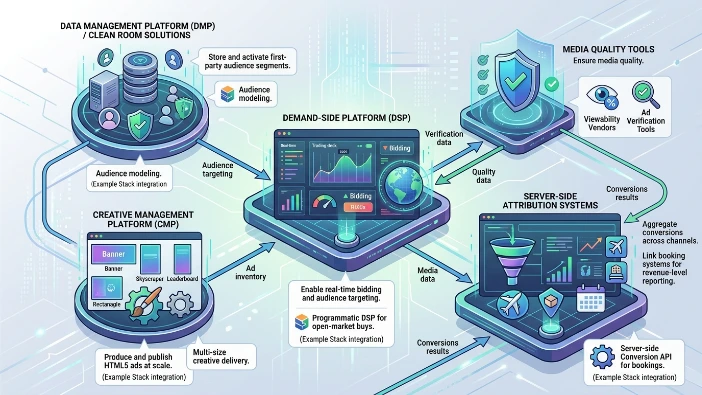
Key technologies include demand-side platforms (DSPs), data management platforms (DMPs) or clean-room equivalents, creative management platforms (CMPs), and server-side attribution systems.
DSPs enable real-time bidding and audience targeting. DMPs or clean-room solutions store and activate first-party audience segments. CMPs produce and publish HTML5 ads at scale. Server-side attribution aggregates conversions across channels and links booking systems for revenue-level reporting. Use viewability vendors and ad verification tools to ensure media quality.
Example stack: programmatic DSP for open-market buys, CMP for multi-size creative delivery, server-side conversion API for bookings, and a clean-room for audience modelling.