

Artificial intelligence is changing how event information becomes news coverage across the UK in 2026. AI tools support research, transcription, content organisation, image analysis, headline development, distribution workflows, and post-event reporting.
UK event coverage includes news articles, event reports, interviews, speaker summaries, photo stories, and announcements published by digital news organisations. AI is becoming part of the workflow behind these formats.
The change is not limited to writing. It affects how journalists process event information, identify newsworthy details, prepare supporting material, and publish stories across digital channels.
Understanding these changes helps event organisers, communications professionals, journalists, and media researchers understand how AI is reshaping the UK event news ecosystem.
What is AI-powered event news coverage?
AI-powered event news coverage uses artificial intelligence to process event information, identify relevant details, support editorial production, and accelerate publication while human journalists retain responsibility for accuracy, context, and editorial decisions.
AI-powered coverage combines artificial intelligence with established journalism processes. The technology processes structured and unstructured information from events.
Structured information includes event schedules, speaker names, session titles, dates, locations, and programme details. Unstructured information includes speeches, interviews, photographs, videos, transcripts, and audience discussions.
Natural language processing helps systems analyse written and spoken language. Speech recognition converts recorded speech into searchable text. Computer vision analyses visual information in photographs and video. Generative AI produces drafts, summaries, headlines, and content variations from supplied information.
Human editorial review remains a central part of professional news production. Journalists verify names, statistics, quotations, claims, dates, and context before publication.
Why is AI changing UK event coverage in 2026?
AI is changing UK event coverage by reducing manual processing time, increasing the volume of information journalists can analyse, accelerating content preparation, and supporting faster publication across digital news formats and media channels.
Traditional event reporting involves several sequential tasks. A journalist gathers information, records interviews, reviews notes, transcribes quotations, checks facts, writes an article, prepares headlines, selects images, and submits the story for publication.
AI tools automate parts of these processes. Automated transcription converts recordings into searchable text within minutes. Content analysis identifies repeated themes and important statements. Summarisation reduces long speeches into structured points for editorial review.
This creates a faster information-processing workflow.
For example, a journalist covering a technology conference in London can process several recorded panel discussions through automated transcription before selecting quotations for an article. The journalist then checks the transcript against the original recording.
AI therefore changes the speed and organisation of newsroom work without removing editorial accountability.
How does AI process information from UK events?
AI processes event information through stages that include data collection, transcription, classification, summarisation, verification, content preparation, and publication support, creating a structured workflow from live event material to publishable news content.
Data collection
The first stage involves collecting event information. Sources include press materials, event schedules, speaker biographies, recordings, photographs, videos, and interview notes.
AI systems process these materials in different formats. Text-based systems analyse documents. Speech recognition systems process audio. Computer vision systems analyse images and video frames.
Transcription and classification
Automated transcription converts speeches and interviews into text. Classification systems organise information according to topics, speakers, locations, or content types.
A business conference can generate several hours of discussions. Transcription creates a searchable text record that helps journalists locate specific statements.
Summarisation
AI summarisation extracts central points from lengthy material. It can organise a 45-minute panel discussion into key topics for editorial review.
Summaries do not replace source verification. Journalists compare important claims and quotations against original material.
Content preparation
AI assists with headlines, article structures, summaries, metadata, captions, and other publishing elements. Editorial teams then review the output for factual accuracy and relevance.
This process forms the foundation for faster event coverage.
Which AI technologies are used in event journalism?
Event journalism uses several AI technologies, including natural language processing, speech recognition, computer vision, generative AI, automated classification, semantic search, and recommendation systems for different stages of editorial production.
Natural language processing
Natural language processing enables computers to analyse human language. In event journalism, it supports topic identification, summarisation, entity recognition, sentiment analysis, and information extraction.
Named entity recognition identifies entities such as people, organisations, locations, dates, and products within event material.
Speech recognition
Speech recognition converts spoken language into text. Journalists use transcripts to search interviews, speeches, panel discussions, and question-and-answer sessions.
This reduces manual transcription work and creates searchable records.
Computer vision
Computer vision analyses visual content. It supports image classification, object detection, facial recognition in permitted contexts, and visual metadata creation.
For event coverage, computer vision can help organise large collections of event photographs.
Generative AI
Generative AI creates text and other content from prompts and source material. Newsroom applications include first-draft preparation, summaries, headline suggestions, captions, and content formatting.
Editorial review remains essential because generated text requires factual checking.
How does AI speed up event coverage across multiple news sites?
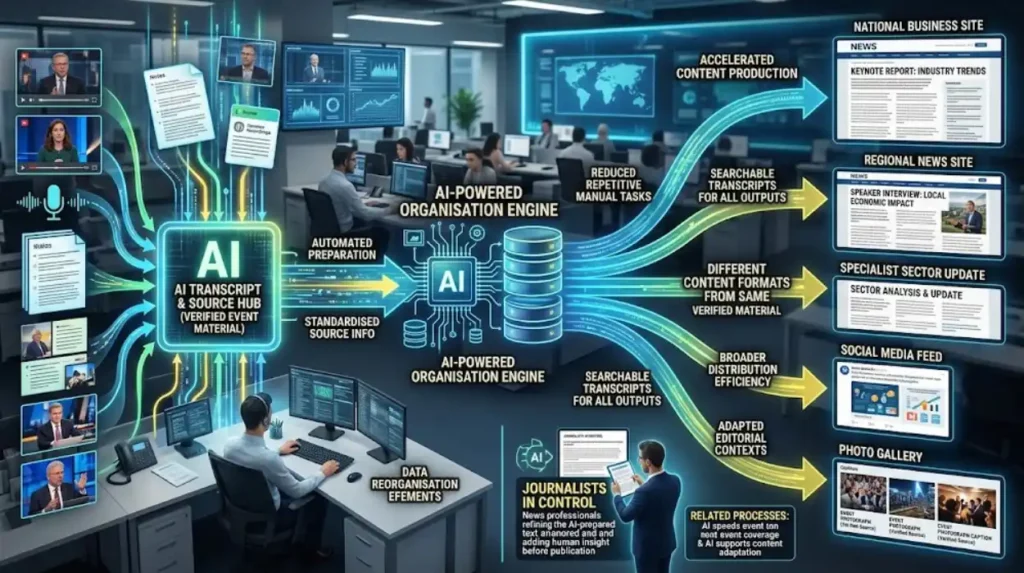
AI speeds multi-site event coverage by automating repetitive preparation tasks, standardising source information, accelerating content production, and enabling editorial teams to prepare different content formats from the same verified event material.
An event can generate multiple news angles. A business conference can produce a keynote report, speaker interview, sector update, local story, photograph caption, and short digital summary.
AI helps organise the source material behind these formats.
A central transcript, for example, provides searchable information for several editorial outputs. A verified speaker statement can support a longer article, a short news summary, and an event photograph caption.
This process supports broader distribution without requiring journalists to repeat the same manual preparation for every format.
The related process is explored further in:
AI also supports content adaptation. A national business story and a regional event report require different editorial contexts. AI tools can organise source information according to publication requirements while journalists control the final wording and relevance.
What benefits does AI bring to UK event journalism?
AI brings measurable workflow benefits to event journalism through faster transcription, quicker information retrieval, improved content organisation, automated repetitive tasks, and faster preparation of multiple editorial formats from verified source material.
Faster transcription
Automated transcription processes recorded speech faster than manual transcription. This gives journalists earlier access to searchable quotations and discussion points.
Faster information retrieval
Semantic search allows journalists to locate concepts rather than relying only on exact keywords. A search for workforce automation, for example, can identify related statements about artificial intelligence, employment, productivity, and skills.
Higher content-processing capacity
AI allows editorial teams to process larger quantities of event material. A full-day conference can produce recordings, photographs, documents, interviews, and presentations. Automated tools help organise this material.
Faster publishing workflows
When information is already transcribed and categorised, journalists spend less time on administrative preparation. More time becomes available for verification, analysis, interviewing, and editorial decision-making.
Consistent content organisation
AI-supported workflows apply consistent structures to repetitive content tasks. This assists with captions, summaries, metadata, and document classification.
How does AI affect accuracy and editorial standards?
AI affects accuracy by introducing faster information processing alongside new verification requirements, making source checking, quotation validation, human review, contextual accuracy, and transparent editorial controls essential to responsible event journalism.
AI-generated information can contain factual errors. These errors include incorrect names, altered quotations, inaccurate dates, fabricated details, and misunderstood context.
Event journalism requires precise factual reporting. Speaker names must match official records. Quotations require comparison with original recordings or transcripts. Statistics require verification against authoritative sources.
AI therefore changes the verification process rather than eliminating it.
Human verification
Journalists remain responsible for editorial accuracy. Human review checks whether generated material accurately represents the source.
Source comparison
Important claims require comparison with original materials. A transcript, official presentation, recording, or direct interview provides a stronger basis for verification than an AI-generated summary.
Context preservation
AI summaries can remove qualifying details from complex statements. Journalists review the surrounding context before using significant quotations or claims.
These controls protect editorial quality as AI adoption increases.
How is AI changing event coverage for different types of UK events?
AI supports different event coverage models by adapting information processing to conferences, exhibitions, corporate events, cultural programmes, sporting events, public forums, and virtual events with distinct editorial requirements.
Business conferences
AI processes keynote speeches, panel discussions, presentations, and interviews. Coverage focuses on business developments, executive statements, market trends, and sector issues.
Trade exhibitions
Exhibitions generate large volumes of product information and visual material. AI helps classify exhibitor information, transcribe interviews, and organise photographs.
Cultural events
Festivals, exhibitions, performances, and cultural programmes generate visual and descriptive content. AI assists with programme information, captions, transcripts, and event summaries.
Sporting events
Sports coverage involves structured information such as scores, fixtures, player names, statistics, interviews, and match reports. Automated systems organise large volumes of data for editorial use.
Virtual and hybrid events
Virtual events generate digital recordings, chat discussions, presentation files, and online interviews. These formats provide structured source material for AI-assisted processing.
Each event type creates a different information environment. AI tools process these sources according to the requirements of the editorial workflow.
What does the future of AI-driven UK event coverage look like?
The future of AI-driven UK event coverage centres on faster information processing, real-time transcription, automated content organisation, multimodal analysis, stronger verification systems, and increasingly structured workflows connecting live events with digital journalism.
AI development is moving event coverage toward multimodal workflows. These workflows process text, audio, images, video, and structured data within connected systems.
Real-time transcription gives journalists immediate searchable records of live discussions. Automated topic detection identifies developing themes during events. Image analysis organises visual material. Generative systems prepare structured editorial drafts from verified sources.
The role of journalists remains focused on reporting, verification, context, interviewing, editorial judgement, and accountability.
AI therefore reshapes the production process rather than redefining journalism as automated content generation.
For readers examining the practical application of these technologies across UK media,
What should readers understand about AI and UK event news coverage?
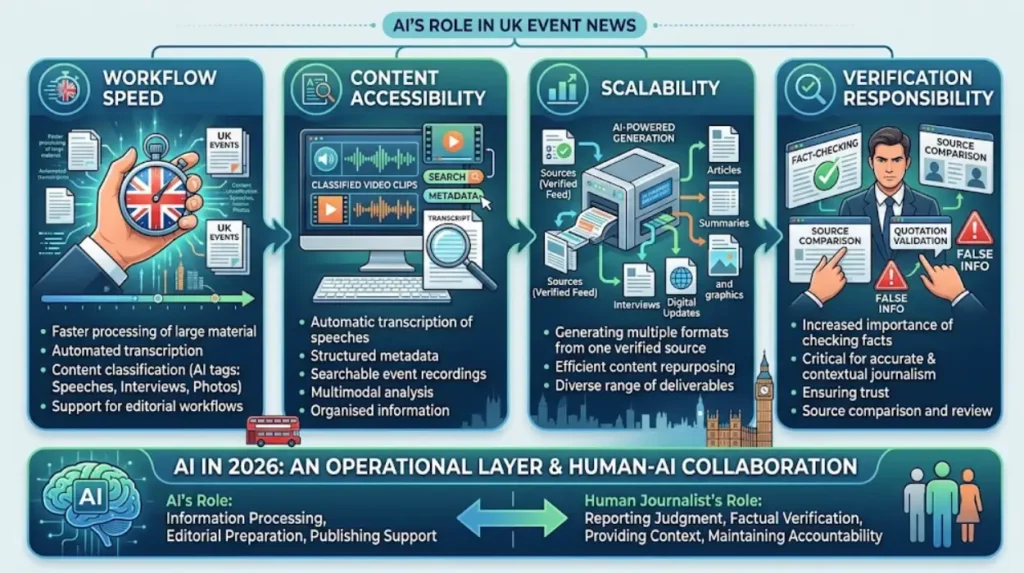
AI is reshaping UK event news coverage through faster processing, automated transcription, content classification, multimodal analysis, and editorial workflow support, while human verification remains central to accurate, contextual, and responsible journalism.
The most significant change is workflow speed. AI processes large volumes of event material rapidly and organises information for editorial use.
The second change is content accessibility. Transcripts, searchable recordings, structured metadata, and classified images make event information easier to retrieve.
The third change is scalability. One verified source set can support several editorial formats, including articles, summaries, captions, interviews, and digital updates.
The fourth change is verification responsibility. Faster production increases the importance of fact-checking, source comparison, quotation validation, and contextual review.
Explore More Expert Insights:
Why DEI Events Deserve Coverage on 15 News Sites
How ESG Events Attract Purpose-Driven News Coverage
In 2026, AI is becoming an operational layer within UK event journalism. Its role covers information processing, editorial preparation, and publishing support. Human journalists continue to provide reporting judgement, factual verification, context, and accountability.



