

AI speeds event coverage by automating research, transcription, content processing, fact organisation, image selection, and distribution workflows. This reduces repetitive production time while maintaining consistent information across 15 UK news sites during conferences, launches, exhibitions, awards, and corporate events.
Artificial intelligence (AI) refers to computer systems that analyse data, identify patterns, process language, and automate defined tasks. In event journalism, AI supports the production workflow from initial information gathering to publication preparation.
Event coverage involves multiple information sources. These include speaker remarks, press releases, event schedules, interviews, photographs, videos, statistics, and social posts. AI processes these sources at speed and organises them into usable information.
Coverage across 15 news sites also requires consistency. Each publication receives accurate event details, names, dates, locations, quotations, and key developments. Automated workflows reduce repeated manual processing between publications.
For organisations evaluating event media options, understanding:
AI-powered event coverage provides a foundation for comparing automated, semi-automated, and traditional editorial workflows.
What happens during an AI-assisted event coverage workflow?
An AI-assisted workflow collects event information, converts audio and visual material into structured data, identifies newsworthy details, prepares editorial content, checks factual elements, and organises publication assets for distribution across 15 UK news sites.
1. Event information is collected
The process begins with structured event information. This includes:
- Event name
- Date and location
- Organiser details
- Speaker names and roles
- Session schedules
- Press materials
- Interviews
- Photographs
- Video recordings
- Key announcements
AI tools process these inputs in digital formats. This creates a central information set for subsequent editorial tasks.
2. Audio becomes searchable text
Speech-to-text systems convert recorded interviews, keynote speeches, and panel discussions into written transcripts.
A 45-minute panel discussion produces a large volume of spoken information. Transcription software converts that discussion into searchable text. Editors then identify quotations and factual statements without manually replaying the entire recording.
3. Key information is identified
Natural language processing (NLP) identifies names, organisations, locations, dates, subjects, statements, and recurring themes.
For example, an announcement about a new £5 million technology investment can be identified as a central factual element. The system separates this information from less relevant discussion.
4. Editorial material is organised
AI-assisted systems group related information into story elements. A conference announcement, speaker quotation, market statistic, and product launch become separate content components.
This structure supports faster editorial review before material moves towards publication.
Which AI components make event coverage faster?
The main AI components are speech recognition, natural language processing, information extraction, automated summarisation, entity recognition, content classification, image analysis, and workflow automation. Together, these technologies reduce repetitive production tasks.
Speech recognition
Speech recognition converts spoken language into written text. It supports interviews, conference sessions, keynote speeches, and panel discussions.
The technology removes the need for manual transcription as the first stage of content processing.
Natural language processing
NLP analyses written and transcribed language. It identifies relationships between words, subjects, organisations, and statements.
For event coverage, NLP helps organise large amounts of unstructured information into editorially useful categories.
Entity recognition
Named entity recognition identifies specific entities such as people, organisations, locations, products, and dates.
For example, an event transcript mentioning a speaker from a London fintech company can be processed into identifiable people, companies, sectors, and locations.
Automated summarisation
Summarisation systems condense long transcripts and documents into shorter information sets.
An editor reviewing six interviews can use structured summaries to identify important statements before reading the complete transcripts.
Image analysis
Computer vision systems analyse photographs and visual files. They identify objects, faces, scenes, and visual characteristics.
This supports image organisation when an event generates hundreds of photographs.
Workflow automation
Automation connects individual tasks. A workflow can move information from transcription to classification, editorial review, asset organisation, and publication preparation.
The result is a shorter production chain.
How does AI improve coverage consistency across 15 UK news sites?
AI improves consistency by using structured source information across multiple publication workflows. Core facts remain aligned while editorial teams adapt headlines, summaries, formats, and contextual details to individual UK news sites and their publishing requirements.
Consistency is important when one event receives coverage across 15 publications.
The core event facts remain fixed. These facts include the event date, venue, speaker names, organisation names, announcement figures, and verified quotations.
AI-assisted systems can use one structured information set as the reference point. Editors then work from the same factual foundation.
Centralised facts
A centralised dataset reduces repeated manual entry. If an organisation name appears in 15 articles, the same verified spelling is used across the workflow.
This reduces inconsistencies such as different company names or incorrect speaker titles.
Controlled content variations
Consistency does not require identical articles.
A business publication can emphasise commercial implications. A technology publication can focus on innovation. A regional publication can emphasise the event’s local relevance.
The underlying facts remain consistent while editorial emphasis changes.
Readers exploring:
AI event coverage at the solution stage can also examine how AI-supported distribution structures event content across multiple publication environments.
How does AI reduce the time required for event reporting?
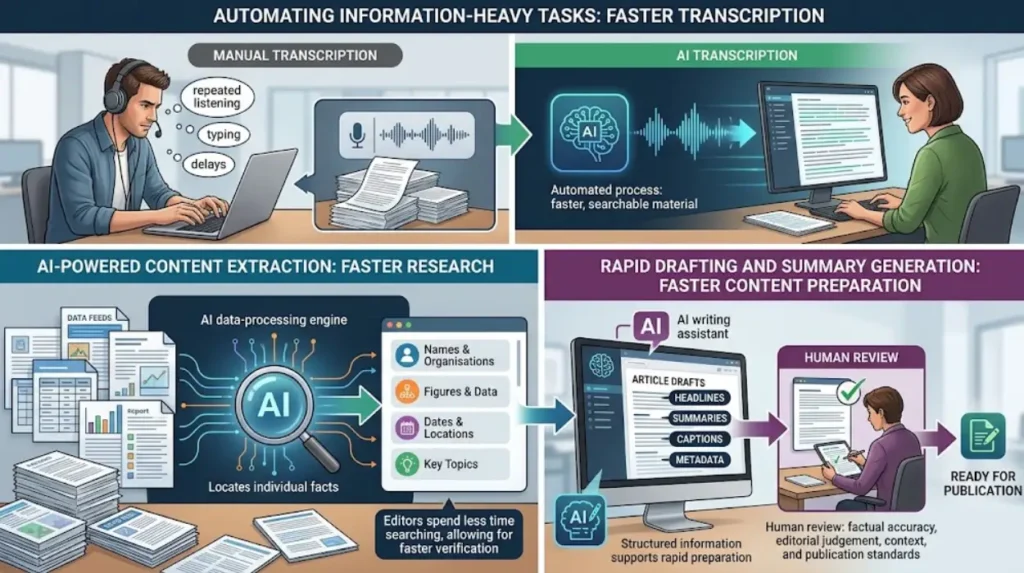
AI reduces reporting time by automating information-heavy tasks that traditionally require manual effort. Transcription, document review, content extraction, summarisation, tagging, and asset organisation become faster, allowing editors to concentrate on verification and editorial decisions.
Speed is particularly important for events where information loses relevance as time passes.
A product launch has greater news value when coverage follows the announcement closely. A conference session becomes less timely as discussions move into later stages.
Faster transcription
Manual transcription requires repeated listening and typing. Automated transcription processes recorded speech directly into text.
This gives editorial teams searchable material sooner.
Faster research
AI can extract names, organisations, figures, dates, and topics from large information sets.
Editors spend less time locating individual facts.
Faster content preparation
Structured information supports rapid preparation of article drafts, headlines, summaries, captions, and metadata.
Human review remains responsible for factual accuracy, editorial judgement, context, and publication standards.
How does AI support different types of UK events?
AI supports event coverage across conferences, exhibitions, corporate events, product launches, awards, trade shows, festivals, fintech events, healthcare events, and professional forums by processing different combinations of text, speech, images, and structured event data.
Conferences
Conference coverage often includes several speakers and parallel sessions. AI processes transcripts and separates information by speaker, session, and topic.
Product launches
Product launches generate structured facts such as product names, specifications, prices, launch dates, and company statements. AI organises these details for editorial review.
Awards events
Awards coverage requires accurate names, categories, winners, organisations, and quotations. Entity recognition helps organise these details.
Trade exhibitions
Exhibitions produce large volumes of company information, product announcements, interviews, and photographs. AI supports classification and asset management.
Regional events
UK regional events require location-specific context. An event in Manchester, Birmingham, Edinburgh, Cardiff, or Leeds contains different local relevance.
AI helps classify location information while editors determine its editorial significance.
What role does human editorial review play in AI event coverage?
Human editorial review verifies facts, evaluates newsworthiness, checks quotations, confirms context, removes errors, and applies publication standards. AI accelerates information processing, while editors retain responsibility for decisions that require judgement, accuracy, and journalistic context.
AI-generated information requires verification.
A transcription system can misidentify a person’s name. An automated summary can omit context. A speech recognition system can incorrectly process technical terminology.
Editors therefore verify critical information before publication.
Fact verification
Important figures, names, dates, quotations, and claims require source verification.
For example, a statement about a £10 million investment requires confirmation against the original announcement or verified event material.
Context verification
A quotation can change meaning when removed from the surrounding discussion. Editors review the original recording or transcript to confirm context.
Editorial judgement
AI identifies information. Editors determine its relevance, prominence, and presentation.
This distinction creates a human-led editorial workflow supported by automation.
How can organisations compare AI-powered and traditional event coverage?
Organisations can compare event coverage models by measuring production speed, editorial control, factual consistency, publication breadth, asset handling, reporting transparency, and human review. These criteria show where automation creates operational value without replacing essential editorial oversight.
A comparison needs measurable criteria rather than technology labels.
| Evaluation factor | Traditional workflow | AI-assisted workflow |
|---|---|---|
| Transcription | Manual processing | Automated processing |
| Information extraction | Manual review | Automated identification |
| Content organisation | Human-led | AI-assisted |
| Fact verification | Human-led | Human-led |
| Editorial judgement | Human-led | Human-led |
| Asset organisation | Manual or semi-automated | AI-assisted |
| Multi-site consistency | Repeated manual control | Structured workflow |
| Production speed | Dependent on manual tasks | Faster processing |
The comparison demonstrates that AI primarily changes operational efficiency. It does not remove the need for editorial standards.
For decision-stage readers evaluating a specific solution, AI-powered event coverage provides a more detailed view of how these capabilities translate into multi-site coverage.
What are the main benefits of AI-powered event coverage across 15 news sites?
The main benefits include faster information processing, consistent factual data, quicker transcription, organised media assets, scalable editorial workflows, reduced repetitive work, and faster preparation of event stories for publication across multiple UK news environments.
The benefits become more significant as event complexity increases.
A small event with one speaker produces limited information. A national conference with 20 speakers, six sessions, hundreds of photographs, and multiple announcements creates a larger processing requirement.
AI handles repetitive information tasks at scale.
Operational efficiency
Automated processing reduces manual work across transcription, tagging, classification, and information extraction.
Faster publication preparation
Editorial teams receive structured information sooner. This supports faster review and publishing decisions.
Greater consistency
A central factual source reduces duplicated data entry across 15 publication workflows.
Scalable coverage
The same workflow structure applies to different event sizes and formats.
What should organisations assess before choosing an AI event coverage solution?
Organisations should assess publication reach, editorial oversight, AI capabilities, verification procedures, turnaround processes, content formats, reporting, image handling, and multi-site consistency before selecting an AI-assisted event coverage approach for UK media distribution.
AI capability alone does not define an effective event coverage workflow.
Organisations need to evaluate how technology connects with editorial operations.
Key assessment areas include:
- Number of publication destinations
- UK media relevance
- Editorial review process
- Transcription capability
- Fact-checking procedures
- Image and video handling
- Content adaptation
- Publication turnaround
- Coverage reporting
- AI search visibility
- Data consistency across sites
These factors create a practical framework for comparing event coverage options.
How does AI change the future of multi-site event coverage?
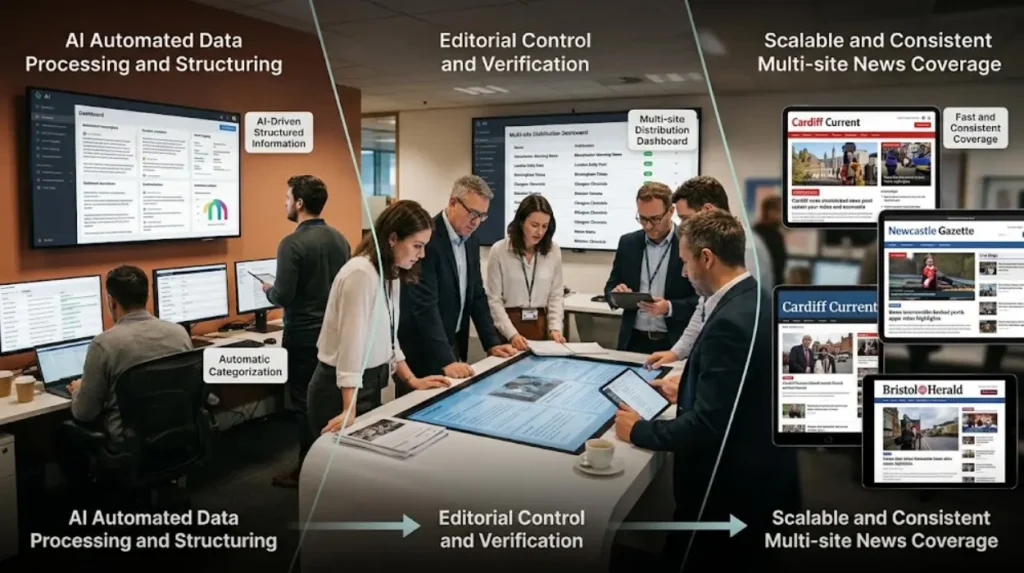
AI changes multi-site event coverage by moving repetitive information processing into automated workflows while keeping editorial verification and judgement under human control. The result is faster, more structured, and more scalable coverage across multiple UK news publications.
The central change is workflow efficiency.
Event teams generate increasing volumes of information through live sessions, interviews, video, photography, social updates, presentations, and digital documents. AI processes these materials into structured information faster than manual workflows.
For coverage across 15 news sites, this structure supports consistency and scale.
The most effective model combines automation with editorial control. AI handles transcription, classification, extraction, summarisation, and asset organisation. Human editors verify facts, assess news value, establish context, and approve publication.
Explore More Expert Insights:
How DEI Event Coverage Reaches 15 UK News Sites
How ESG Event Coverage Reaches Purpose-Driven UK Readers
This approach creates a defined path from event information to multi-site news coverage.
As UK event communications become more data-intensive, AI-assisted workflows provide a practical framework for processing information quickly while maintaining editorial accuracy and publication standards.



