

AI-powered event coverage uses artificial intelligence to accelerate research, content preparation, media distribution, and coverage monitoring across 15 UK news sites. It combines automated workflows with editorial review to publish accurate event stories faster while expanding national, regional, and sector visibility.
AI-powered event coverage is a structured media workflow for organisations that need event announcements, reports, interviews, and updates distributed across multiple UK publications. AI Is Reshaping UK Event News Coverage explains how artificial intelligence is changing the wider UK event news ecosystem.
A 15-site distribution model creates broader coverage than publishing on one website. It places an event story across relevant national, regional, business, technology, lifestyle, or specialist publications.
For organisations evaluating a coverage provider, the key requirement is not simply AI usage. The service needs a defined workflow, publication network, editorial controls, reporting process, and measurable delivery criteria.
This approach builds on the workflow explained in:
AI Speeds Up Event Coverage, where artificial intelligence supports faster event-content production and distribution.
How does AI-powered event coverage work across 15 UK publications?
AI-powered event coverage follows a defined sequence: event information is collected, content is structured, editorial material is prepared, publication targets are selected, stories are distributed, and resulting coverage is monitored across 15 UK news sites.
1. Event information is collected
The process starts with core event information. This includes the event name, organiser, date, location, speakers, agenda, audience, key announcements, quotations, and supporting facts.
AI tools organise these details into structured information. Editors then check the source material before content development begins.
2. Content is prepared
Artificial intelligence can accelerate first-draft preparation, headline variations, metadata generation, information extraction, and content classification.
Editorial teams verify every important fact. Names, dates, statistics, quotations, company information, and event details require source validation.
3. Media targets are selected
The distribution strategy identifies publications according to the event’s subject and audience.
A fintech conference can target financial and technology publications. A healthcare summit can target healthcare and business media. A regional business event can prioritise publications serving its location.
4. Stories are distributed
The approved material enters the distribution workflow. The objective is placement across 15 relevant UK news sites rather than indiscriminate publication.
The final network depends on the service, publication availability, editorial acceptance, content relevance, and campaign requirements.
5. Coverage is monitored
AI-assisted monitoring identifies published URLs, publication names, headlines, dates, and other campaign information.
A reporting system then consolidates the results. This creates a clear record of where the event received coverage.
Which AI technologies support faster event coverage?
Artificial intelligence supports event coverage through natural language processing, content classification, information extraction, automated monitoring, and workflow automation. These technologies reduce repetitive production tasks while allowing editorial teams to focus on accuracy, relevance, publication quality, and strategic media selection.
Natural language processing
Natural language processing analyses written language. In event coverage, it supports information extraction, topic classification, summarisation, and content structuring.
For example, an AI system can identify a speaker’s name, organisation, job title, presentation topic, and quoted statement from supplied event notes.
Content classification
AI classification tools categorise events according to subject and audience.
Common categories include:
- Finance
- Technology
- Healthcare
- Property
- Education
- Business
- Sustainability
- Entertainment
- Sports
Classification helps connect event content with relevant publication categories.
Automated monitoring
AI-powered monitoring scans publication environments for coverage. It identifies mentions, URLs, publication names, headlines, and publication dates.
This reduces manual checking across multiple websites.
Workflow automation
Automation connects repetitive tasks. Content preparation, data organisation, monitoring, reporting, and internal workflow notifications can operate within a structured process.
The result is a shorter operational cycle between event information and media reporting.
What does a 15-site event coverage service include?
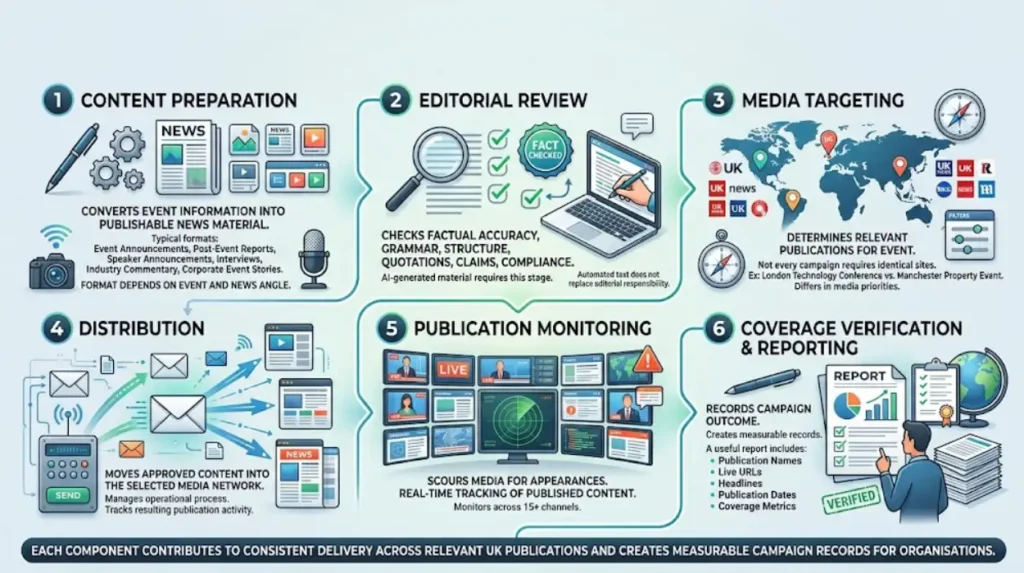
A complete 15-site event coverage service includes content preparation, editorial review, media targeting, distribution, publication monitoring, coverage verification, and reporting. Each component contributes to consistent delivery across relevant UK publications and creates measurable campaign records for organisations.
Content preparation
Content preparation converts event information into publishable news material. Typical formats include event announcements, post-event reports, speaker announcements, interviews, industry commentary, and corporate event stories.
The format depends on the event and the news angle.
Editorial review
Editorial review checks factual accuracy, grammar, structure, quotations, claims, and compliance with publication requirements.
AI-generated material requires this stage because automated text does not replace editorial responsibility.
Media targeting
Media targeting determines which publications are relevant. A 15-site campaign does not require identical publications for every event.
A London technology conference and a Manchester property event require different media priorities.
Distribution
Distribution moves approved content into the selected media network. The service provider manages the operational process and tracks resulting publication activity.
Coverage reporting
Reporting records the campaign outcome. A useful report includes publication names, live URLs, headlines, publication dates, and relevant coverage metrics.
This information supports internal PR reporting and campaign evaluation.
What benefits does AI-powered coverage provide for event organisers?
AI-powered event coverage provides faster content workflows, broader publication coordination, structured monitoring, and consolidated reporting. These benefits help event organisers manage multi-publication campaigns efficiently while maintaining editorial checks and creating measurable evidence of media coverage.
Faster content workflows
AI reduces repetitive preparation work. Teams spend less time organising raw event information and creating routine content variations.
The time saved supports faster movement from event details to editorial review.
Broader media coordination
Managing 15 publications manually creates multiple operational tasks. A structured AI-supported workflow centralises information and campaign tracking.
This improves consistency across the distribution process.
Faster coverage monitoring
Monitoring 15 websites individually takes significant manual effort. Automated systems identify coverage and organise results in one reporting workflow.
This gives campaign teams a faster view of publication activity.
Better reporting
A central report creates a single record of campaign outcomes.
Organisations can identify which publications carried the story, when each article appeared, and which content generated coverage.
Greater content consistency
Structured AI workflows maintain consistent core facts across content versions. Editorial review ensures that consistency does not compromise publication requirements or factual accuracy.
Which events benefit from AI-powered coverage across 15 UK news sites?
AI-powered multi-site coverage suits conferences, corporate events, product launches, exhibitions, industry summits, awards, webinars, and regional events that require coordinated UK media visibility, structured reporting, and faster content workflows across relevant publication audiences.
Conferences and industry summits
Conferences generate multiple news angles. These include keynote announcements, speaker interviews, research findings, panel discussions, awards, and industry announcements.
AI-assisted workflows organise these elements into structured coverage opportunities.
Corporate events
Corporate events often involve announcements, partnerships, leadership updates, milestones, and stakeholder activity.
A multi-site distribution campaign connects these announcements with relevant business and industry publications.
Product launches
Product launches require clear information about the product, organisation, market, launch date, and relevant announcement.
AI-assisted content workflows help organise these details for editorial preparation.
Awards and recognition events
Awards events generate names, categories, winners, judging information, and quotations. Structured information extraction helps manage these details across coverage materials.
Regional events
Regional events benefit from geographically relevant publication targeting.
For example, an event in Birmingham requires different local media priorities from an event in Edinburgh. A 15-site strategy can combine regional relevance with wider UK business or sector coverage.
How do you evaluate an AI-powered event coverage provider?
Evaluate an AI-powered event coverage provider by checking its publication network, editorial review process, distribution scope, monitoring system, reporting detail, turnaround process, content requirements, and campaign deliverables. Confirm exactly what 15-site coverage means before purchasing the service.
Check the 15-site network
Ask for the types of publications included. Confirm whether the network contains national, regional, trade, business, or specialist media.
The number 15 alone does not define media value. Publication relevance is an essential evaluation factor.
Confirm editorial controls
Ask how AI-generated or AI-assisted content is reviewed. The process needs human fact checking and editorial validation.
Confirm who approves the final content before distribution.
Review distribution requirements
Determine whether the service distributes one approved story or produces multiple editorial variations.
Check word counts, image requirements, links, quotes, deadlines, and content restrictions.
Examine reporting
A professional report provides publication names and live URLs. It also records publication dates and relevant campaign information.
Ask whether the provider supplies a consolidated report after distribution.
Verify turnaround expectations
Event coverage often has a specific timing requirement. Confirm the standard processing schedule and the expected publication window before purchasing.
The agreement needs clear delivery criteria.
What results can organisations expect from 15-site AI-powered event coverage?
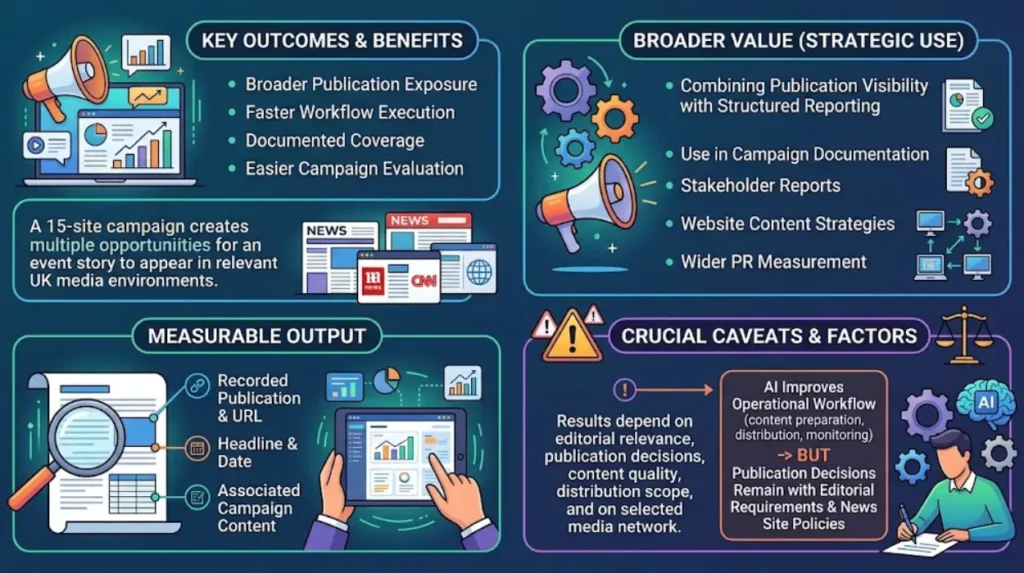
Organisations can expect a coordinated media campaign that produces broader publication exposure, faster workflow execution, documented coverage, and easier campaign evaluation. Results depend on editorial relevance, publication decisions, content quality, distribution scope, and the selected media network.
A 15-site campaign creates multiple opportunities for an event story to appear in relevant UK media environments.
The measurable output is the coverage itself. Organisations can record the publication, URL, headline, date, and campaign content associated with each placement.
The broader value comes from combining publication visibility with structured reporting. Marketing and communications teams can use the resulting coverage record within campaign documentation, stakeholder reports, website content strategies, and wider PR measurement.
AI does not guarantee editorial publication. It improves the operational workflow surrounding content preparation, distribution, and monitoring. Publication decisions remain subject to editorial requirements and the policies of individual news sites.
Why choose AI-powered event coverage for a 15-site UK campaign?
AI-powered event coverage provides a structured solution for organisations seeking coordinated distribution across 15 UK news sites. It combines automated workflow efficiency with editorial oversight, publication targeting, coverage monitoring, and measurable reporting for event-led communications campaigns.
For organisations comparing event PR options, the decision depends on campaign requirements.
A suitable service needs a defined publication network. It needs transparent deliverables. It needs editorial review. It needs reliable monitoring. It needs a clear final report.
AI adds operational efficiency to these components. It does not replace the publication network or editorial process.
Explore More Expert Insights:
DEI Event News Coverage Services Across 15 UK Sites
ESG Event News Coverage Across 15 Purpose-Driven UK Sites
The strongest buying criteria therefore combine AI capability, human editorial review, UK publication access, distribution scope, monitoring, and reporting.
For a campaign requiring 15 UK news sites, request the publication list, confirm the included deliverables, review the editorial workflow, and establish the reporting format before approval.
A clear service specification turns AI-powered event coverage from a technology claim into a measurable media-distribution process.



