
Mid-funnel travel ads target users who show planning intent and encourage them to move from consideration to booking with tailored messaging and measurable actions.
Mid-funnel travel ads sit between awareness and conversion. They address audiences who engaged with destination content, searched dates, or saved itineraries. These ads present concrete choices: specific routes, dates, package types, or limited-time incentives. They use intent signals from previous site visits, search queries, and app activity. Common channels include display networks, social feeds with dynamic creative, connected-TV, and programmatic native placements. Campaigns use frequency capping, sequential messaging, and creative personalisation to reduce friction toward booking.
How do mid-funnel travel ads work?
Mid-funnel travel ads use audience segments, contextual signals, and creative variations to deliver relevant offers that increase booking-ready intent and measurable conversion actions.
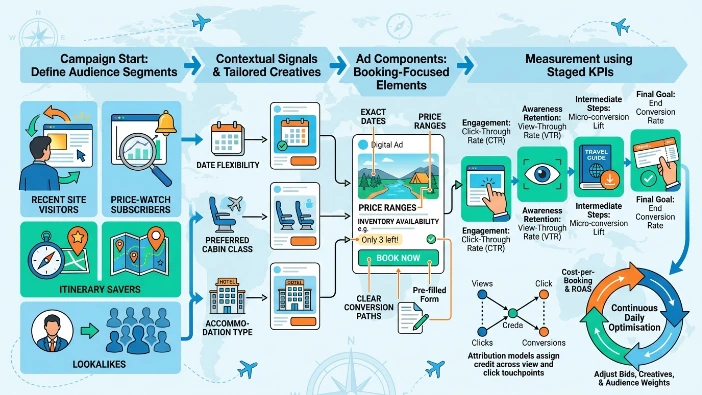
Campaigns start by defining audience segments: recent site visitors, price-watch subscribers, itinerary savers, and lookalikes. Segments receive tailored creatives based on the recorded intent: date flexibility, preferred cabin class, or accommodation type.
Ads include booking-focused elements: exact dates, price ranges, inventory availability, and clear conversion paths such as booking links or pre-filled forms. Measurement uses staged KPIs: click-through rate (CTR) for engagement, view-through rate (VTR) for awareness retention, micro-conversion lift (e.g., travel-guide downloads), and end conversion rate for bookings. Attribution models assign credit across view and click touchpoints. Optimisation runs daily to adjust bids, creatives, and audience weights based on cost-per-booking and return-on-ad-spend.
Which audience signals indicate planning intent?
Planning intent signals include site searches for dates, repeated destination page views, saved itineraries, price alerts, and map or calendar interactions.
Digital platforms record specific actions that indicate intent. User who searched multiple date ranges for London, viewed available flights three times, and set a price alert. Another example: a user who added hotels in Edinburgh to a wishlist and then viewed transport options. Platforms combine these signals into a recency-weighted score. Scores feed into segment definitions for mid-funnel targeting. Signals used for targeting must respect privacy guidelines and first-party data best practices. Advertisers prioritise high-intent segments with recent interactions within 7–30 days, depending on travel lead time.
What creative elements drive booking intent?
Creative elements that drive booking intent include clear price displays, exact travel dates, inventory indicators, strong visual proof of experience, and one-click booking actions.
Ads present concrete booking information. Exact prices and fare classes reduce cognitive load. Date-specific creatives show availability for target travel windows. Inventory indicators such as “5 seats left” increase urgency with factual transparency. Images and short video clips feature the destination, accommodation room, or transport interior with descriptive captions. Call-to-action (CTA) elements link directly to pre-filled booking pages or a quick reservation widget. Dynamic creative optimisation (DCO) selects variants—image, headline, price—based on the viewer’s segment. Example: a dynamic banner that swaps in train times for users who searched rail travel and hotel combos for those who searched accommodation.
What targeting and bidding strategies perform best?
Best-performing strategies combine weighted audience segments, bid adjustments by intent score, conversion-focused bidding, and time-based delivery aligned to booking windows.
Advertisers allocate higher bids to segments with stronger intent scores. Bid adjustments reflect lead time: higher bids for near-term travel within 7–30 days, moderate bids for travel 31–90 days ahead. Conversion-focused bidding uses target cost-per-acquisition (tCPA) or target return-on-ad-spend (tROAS) where available. Dayparting concentrates impressions during peak planning hours identified for the audience: evenings and weekends for leisure, weekday mornings for business. Frequency caps prevent ad fatigue while sequence caps enforce message progression: initial planning ad → offer ad → booking reminder. Platforms with cross-device identity resolution maintain consistent exposure across desktop, mobile, and connected-TV.
How do advertisers measure mid-funnel success?
Measure mid-funnel success with engagement metrics (CTR, VTR), micro-conversions (itinerary saves, form fills), assisted conversions, and final booking conversion rates attributed across touchpoints.
Metrics map to stages in the funnel. Engagement metrics indicate relevance. Micro-conversions show progress toward booking: email signups, price alerts set, fare calendar views. Assisted conversions quantify how mid-funnel ads contribute to later bookings via multi-touch attribution or data-driven attribution. Cost efficiency metrics include cost-per-micro-conversion and cost-per-booking attributed to the mid-funnel channel. For decision-making, compare lift in booking probability among exposed versus control groups using holdout experiments. Use server-side event tracking and UTM parameters to ensure clean data across channels. Report outcomes at weekly cadence and optimize based on cost-per-booking and booking rate uplift.
What components belong in a mid-funnel ad tech stack?
A mid-funnel ad tech stack includes a customer data platform (CDP), demand-side platform (DSP), creative management platform, attribution solution, and a booking-tracking system.
CDP centralises first-party signals: site events, CRM records, and email engagement. DSP executes programmatic buying across display, native, and video inventory with audience targeting. Creative management platforms enable dynamic creative optimisation and template-based assembly. Attribution solutions handle multi-touch and incrementality testing. Booking-tracking systems pass confirmed bookings back to the marketing stack for full-funnel ROI calculations. Complementary tools include analytics for cohort analysis and tag managers for consistent event capture. Integration between each component ensures real-time audience activation and conversion reporting.
Read the Full Blog Here:
How Travel Companies Promote Deals Using Display Advertising
What benefits do mid-funnel travel ads deliver?
Mid-funnel travel ads increase booking conversion probability, improve cost-efficiency of ad spend, and shorten the time from planning interest to confirmed purchase.
Targeted messaging converts higher-intent users at lower incremental cost than broad awareness campaigns. Personalised creatives increase engagement rates and micro-conversion rates. Sequential and frequency-controlled delivery reduces wasted impressions. Measured outcomes show higher return-on-ad-spend when mid-funnel spend replaces untargeted display impressions. Campaigns provide actionable insights into traveler preferences: popular routes, preferred price bands, and common booking lead times. These insights refine inventory and pricing strategies across sales channels.
What use cases show clear ROI from mid-funnel ads?
High-ROI use cases include last-minute inventory sales, seasonal package promotions, abandoned booking recovery, and cross-sell of ancillaries like transfers or experiences.
Last-minute inventory sales drive immediate bookings with time-limited offers combined with urgency messaging. Seasonal package promotions target users who previously viewed the destination in the same season. Abandoned booking recovery reaches users who started checkout but left; ads show the exact itinerary with a direct booking link. Cross-sell campaigns present ancillaries car hire, transfers, tours after users confirm flights or hotels. Example: a campaign that retargets abandoned checkouts with an offer reduced by a fixed percentage produces measurable lift in completed bookings within 48 hours.
Explore More Expert Insights:
Resort Experience Ads That Convert Visual Interest Into Paid Stays
Booking Platform Ads That Turn Browsing Users Into Paid Reservations
How do privacy rules influence mid-funnel campaigns?
Privacy rules require reliance on first-party data, consented identifiers, aggregated measurement, and server-side event forwarding to maintain tracking and optimisation.
Regulations and platform policies limit third-party cookie usage and require explicit consent for personal data. Advertisers prioritise first-party signals collected from site interactions and logged-in users. Implement server-side event forwarding to preserve data fidelity. Use aggregated measurement and privacy-safe attribution models when user-level tracking is unavailable. Maintain transparent consent notices and data retention policies aligned with local law. Update targeting windows and models when identity signals are constrained.
Explore the Complete Guide:
How Travel Companies Inspire Planning Using Mid-Funnel Advertising
How should travel teams set next steps for conversion-focused mid-funnel campaigns?
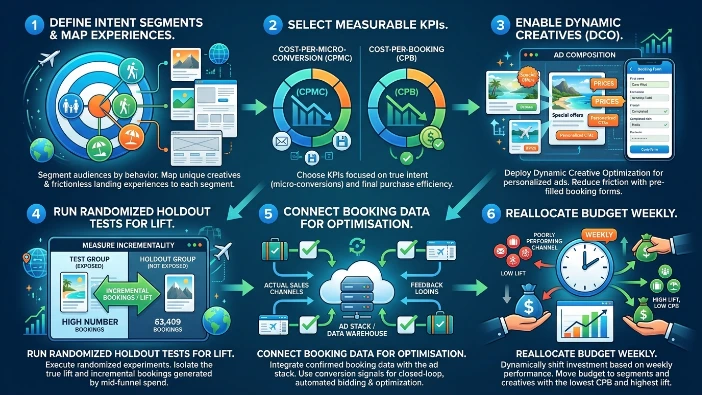
Define intent segments, select measurable KPIs, enable dynamic creatives, run holdout tests for lift, and connect booking data for optimisation and reporting.
Teams map segment definitions to creatives and landing experiences. Set KPIs such as cost-per-micro-conversion and cost-per-booking. Implement DCO for personalised ads and pre-filled landing pages that reduce friction. Run randomised holdout experiments to measure incremental bookings attributable to mid-funnel spend. Integrate confirmed booking data into the ad stack for closed-loop optimisation. Reallocate budget weekly toward segments and creatives with the lowest cost-per-booking and highest lift.