
A converting TV channel ad is a targeted broadcast message designed to move viewers from awareness to a measurable action, such as tuning in, subscribing, or downloading a companion app, using tracking, clear calls-to-action, and cross-channel measurement.
A converting TV channel ad defines the target audience by demographics, viewing habits, and program affinity. It presents a single, measurable objective: tune-in, live streaming, on-demand view, subscription sign-up, or app install. Conversion measurement uses set-top-box data, digital ad tags, unique promo codes, QR codes, and mobile or web analytics.
Channels design ads for specific dayparts and program lead-ins to maximise immediate response. Creative elements include a one-line value proposition, a visual prompt, time/date details, and a unique conversion token. Legal and regulatory compliance follows Ofcom rules for advertising content and audience protection.
How do TV channels plan ads to drive conversions?
Channels plan ad campaigns by defining the conversion goal, selecting audience segments, scheduling around program flow, and allocating measurement methods and budgets for each placement.
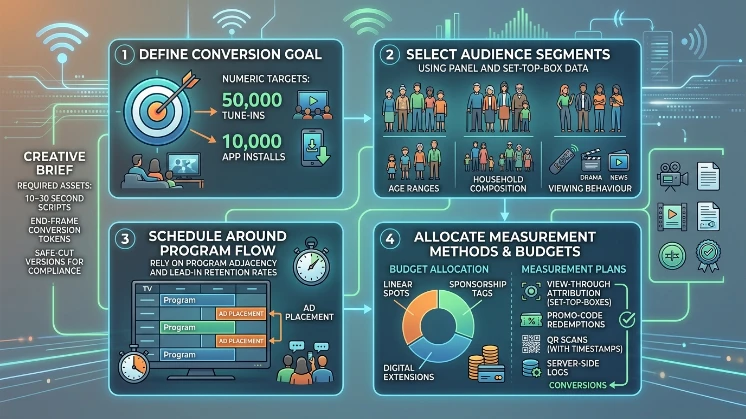
Planning begins with a conversion goal expressed as a numeric target, for example 50,000 tune-ins or 10,000 app installs. Audience segmentation uses age ranges, household composition, and viewing behaviour from panel and set-top-box data. Schedule decisions rely on program adjacency and lead-in retention rates. Budget allocation splits spend across linear spots, sponsorship tags, and digital extensions.
Measurement plans specify which tracking methods will report conversions: view-through attribution from set-top-boxes, promo-code redemptions, QR scans linked to timestamps, and server-side logs. A creative brief lists required assets: 10–30 second scripts, end-frame conversion tokens, and safe-cut versions for compliance.
What are the core components of a converting TV ad?
A converting TV ad contains a clear conversion objective, a single call-to-action, a measurable token (QR, code, URL), audience-tailored creative, and time-aligned placements.
Define the objective tune-in, stream, subscribe, or register. Create one call-to-action expressed in 3–6 words and placed on-screen for at least 3 seconds. Include a measurable token: a unique promo code, a short URL, or a QR code that maps to the campaign landing page. Tailor visuals and language to the chosen demographic and program context. Time-align the ad with program start, commercial breaks, or post-show recaps to capture peak intent. Ensure audio and on-screen text repeat the call-to-action to support viewers in noisy environments. Include legal small-print as required by broadcast rules.
How do channels measure whether ads convert viewers?
Channels measure conversions using set-top-box viewing logs, server-side event tracking, promo-code redemptions, QR scans, and third-party attribution panels to link ad exposures to actions.
Set-top-box logs provide household-level exposure timestamps and allow counting households that tuned in within a defined window after exposure. Server logs record landing-page visits and registrations associated with unique URLs or promo codes. QR scans include time and device data that maps to broadcast timings. Third-party panels validate causation with control groups and uplift models. Measurement applies specific attribution windows: 0–30 minutes for immediate tune-ins, 1–7 days for catch-up streams, and 7–30 days for subscriptions. Report metrics include exposure-to-action rate, incremental reach, cost per conversion, and return on ad spend (ROAS). Results feed back into planning to adjust schedule, creative, or offer value.
Which creative tactics increase conversion rates in TV ads?
Effective tactics focus on immediate clarity: a single CTA, visible on-screen token for 3+ seconds, time-limited offers, and contextual messaging tied to the program.
Use concise copy and large, legible on-screen text for the CTA. Position the conversion token in the lower third with high contrast. Employ time-limited incentives such as “first 5,000 free streams” with an expiry date. Mention exact start times, channels, and how to act: scan QR, enter code, or visit short URL. Repeat the CTA at least twice in the mid-spot and end-frame. Use program-tied language that references characters or themes to increase relevance. Test two creative variants A/B across similar dayparts and compare conversion rates using identical measurement windows.
What attribution windows and KPIs work best for these ads?
Use an attribution window matched to the conversion type: 0–30 minutes for live tune-ins, 1–7 days for on-demand views, and 7–30 days for subscriptions; measure exposure-to-action rate, incremental reach, cost per conversion, and ROAS.
Set immediate tune-in attribution to 0–30 minutes after exposure. For catch-up or VOD actions, apply a 1–7 day window. For subscription or app-install conversions, apply a 7–30 day window. Calculate exposure-to-action rate as conversions divided by exposed households. Define incremental reach using a control-exposed comparison group. Cost per conversion equals campaign spend divided by measured conversions. ROAS equals revenue attributed to conversions divided by spend. Consistently apply the same windows across comparable campaigns to maintain data integrity.
How do channels integrate TV ads with digital extensions to improve conversions?
Channels extend broadcast ads with synchronised digital touchpoints: companion banners, social countdowns, landing pages with unique tokens, and push notifications linked by timestamps and codes.
Create a dedicated landing page for each campaign with the same visual identity and the promo token displayed in the ad. Launch companion display banners and social posts at the same time as the first TV spot. Use URL timestamps and campaign parameters to link digital traffic back to broadcast exposure windows. Enable programmatic retargeting for users who visited the landing page without converting, using a 24–72 hour retargeting window. Send push notifications to app users when the program begins, referencing the same code shown on-screen. Track combined conversions across platforms in a unified dashboard.
What are the legal and compliance considerations for conversion-focused TV ads?
Ads must follow Ofcom advertising codes, protect children, identify commercial content, and present transparent terms for offers and data collection.
Disclose material conditions for time-limited offers on-screen in legible text. Avoid promoting products restricted by broadcast rules during family viewing hours. If targeting children, adhere to strict content constraints and avoid direct persuasion. Identify sponsored content and paid placements clearly. Obtain user consent where required before storing or processing personal data collected via digital landing pages. Retain evidence of ad broadcast times and creative versions to support compliance audits.
What practical use cases show measurable results?
Use cases include tune-in campaigns for live sports, series premiere subscriptions, app-install pushes during program breaks, and on-demand promotions after episode finales; each shows measured lift via set-top-box logs and server analytics.
A sports channel runs a 14-day campaign with live-match tune-in goals. Set-top-box logs show a 12% lift in households tuning in within 15 minutes after exposure. A drama series launch uses a unique promo code, landing-page registrations total 24,800 in 10 days with a 4.2% exposure-to-action rate. An entertainment channel promotes an app install with a QR code; server logs record 18,500 installs within 72 hours. A documentary channel runs a post-finale on-demand offer; catch-up viewing increases by 9% within seven days.
Explore More Expert Insights:
Streaming Display Ads That Convert Watch Intent Into Active Users
OTT Campaign Ads That Turn Show Viewers Into Paying Subscribers
How should teams allocate budget and resources for conversion campaigns?
Allocate budget by objective, 40% to prime-time linear spots, 30% to program-adjacent placements, 20% to digital extensions, and 10% to measurement and testing.
Assign the largest share to dayparts and programs with highest historical retention rates. Reserve program-adjacent spend for sponsorship and bumpers that reinforce the CTA. Invest in landing-page development, QR code generation, and digital banner buys for the digital extension. Dedicate 10% of the budget to measurement tools, A/B testing, and third-party validation panels. Staff roles include campaign planner, creative producer, data analyst, and compliance officer. Track weekly reporting cycles and adjust spend toward placements that show lower cost per conversion.
Explore the Advanced Guide:
How TV Channels Boost Viewership Using Display Campaigns
What steps turn viewer interest into repeat conversions?
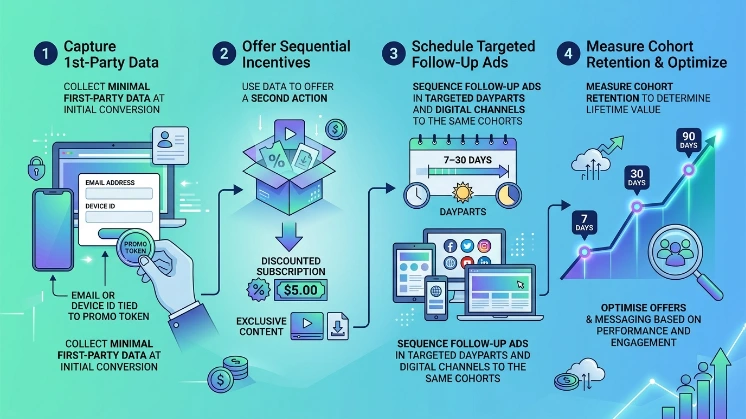
Drive repeat conversions by capturing first-party data at initial conversion, offering sequential incentives, scheduling targeted follow-up ads, and measuring cohort retention over 30–90 days.
Collect minimal first-party data at conversion, email or device ID tied to the promo token. Use that data to offer a second action such as a discounted subscription or exclusive content. Sequence follow-up ads in targeted dayparts and digital channels to the same cohorts for 7–30 days. Measure cohort retention at 7, 30, and 90 days to determine lifetime value. Optimise offers and messaging based on cohort performance and observed engagement patterns.
This article defined converting TV channel ads, explained planning and measurement, listed core components and creative tactics, and described attribution windows, digital integration, compliance, practical use cases, budget allocation, and steps to secure repeat conversions.
For awareness-stage detail on program interest building, see:
How TV Channels Build Program Interest Using Banner Advertising