

Events media coverage pricing is a structured set of fees that organisers pay to secure different levels of editorial, digital, and broadcast exposure for an event across UK media channels.
Pricing defines the cost for specific deliverables: press release distribution, journalist attendance, bespoke articles, video coverage, paid placements, and syndication. Fees vary by outlet reach, production complexity, and exclusivity terms. Pricing frameworks group services into tiers—basic, standard, premium—with each tier listing measurable outputs. Clear pricing enables budget planning and vendor comparison.
Coverage tiers are defined by reach, content format, production hours, and exclusivity; typical UK tiers are basic, standard, and premium with ascending deliverables and costs.
The basic tier includes press release distribution and one plain article placement with text and a single image. The standard tier adds journalist attendance, edited coverage, two multimedia assets, and social amplification. The premium tier includes exclusive features, on-site video packages, multiple bespoke articles, broadcast segments, and guaranteed prominence on partner platforms. Each tier specifies delivery timelines and revision limits. Contracts list exact outlets and audience reach estimates.
What cost ranges do organisers pay for each tier?
Organisers in the UK typically pay £300–£1,000 for basic, £1,000–£5,000 for standard, and £5,000–£30,000+ for premium coverage depending on outlets and production requirements.
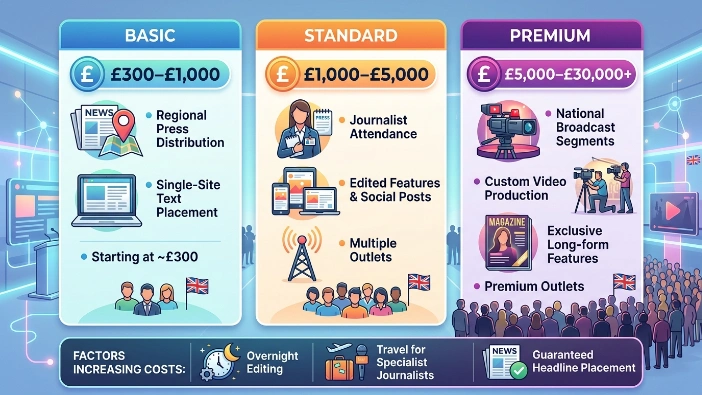
Basic packages start at about £300 for regional press distribution and single-site text placement. Standard packages range from £1,000 to £5,000 and include journalist attendance, edited features, and social posts across multiple outlets. Premium packages begin at £5,000 and scale to £30,000+ when national broadcast segments, custom video production, and exclusive long-form features are included. Factors that push cost higher include overnight editing, travel for specialist journalists, and guaranteed headline placement.
What components determine final pricing?
Final pricing depends on journalism costs, production costs, distribution fees, exclusivity, and additional services such as analytics and syndication.
Journalism costs cover reporter time, travel, and editorial fees. Production costs include videography, editing, and graphic design. Distribution fees pay for access to press networks and paid placements. Exclusivity clauses that prevent outlets from publishing competing content increase costs by 10–40 percent. Analytics and reporting add fixed fees or percentage-based charges, with detailed measurement services usually costing £300–£1,200 per event.
How do organisers evaluate return on investment?
Organisers evaluate ROI using press pickup count, estimated audience reach, referral traffic, lead generation, and attributable revenue over a defined post-event window.
Press pickup count measures the number of unique outlets that publish event coverage. Estimated audience reach aggregates outlet circulation and digital audience metrics. Referral traffic tracks visits from media links to the organiser’s site. Lead generation counts qualified contacts and sponsor inquiries attributed to media coverage. Attributable revenue measures direct sales or sponsorship renewals linked to coverage within a 30- to 90-day window. Benchmarking against previous events provides comparative ROI figures.
When is paid coverage necessary versus earned coverage?
Paid coverage is necessary when organisers require guaranteed placement, specific multimedia production, or targeted reach; earned coverage suits organic storylines and specialist editorial interest.
Earned coverage relies on newsworthiness: product launches, policy announcements, or high-profile speakers. Paid coverage secures placement when editorial interest is insufficient or timing is critical. Paid options provide control over format and distribution schedule. Combining paid and earned approaches increases the chance of national pickup and amplifies owned assets.
Who provides media coverage services and what roles do they perform?
Providers include PR agencies, media-for-hire platforms, freelance journalists, production companies, and press distribution services; roles cover pitching, reporting, production, and analytics.
PR agencies handle strategy, journalist relations, and press coordination. Media-for-hire platforms sell pre-packaged placements and journalist attendance. Freelance journalists produce on-site reporting and features. Production companies create video and photo assets. Press distribution services syndicate releases to local and national lists. Providers usually itemise roles and hours in quotes to ensure clarity on deliverables.
How do exclusivity and rights affect pricing?
Exclusivity and rights increase pricing because they restrict outlet use and grant usage rights for produced content, with exclusivity premiums ranging from 10% to 40%.
Exclusive rights to a story prevent competing outlets from publishing equivalent coverage within a set timeframe. Usage rights for photos and videos determine how organisers may reuse assets across channels; full ownership costs more than limited editorial use. Contracts specify duration, geographic scope, and permitted formats. Clear rights definitions prevent later disputes and add predictable value to the coverage package.
How should organisers compare quotes and select a package?
Organisers should compare quotes by aligning deliverables, verifying outlet reach, checking production samples, and assessing measurement methods.
Start by matching each quote to a standard checklist of deliverables, including number of articles, multimedia assets, journalist days, and distribution lists. Verify claimed outlet reach with independent circulation or digital audience figures. Review recent samples of published work and video quality. Confirm analytics scope: coverage tracking, reach estimates, referral reporting, and lead attribution. Select the package that offers clear metrics and matched reach for the event’s objectives.
What negotiation levers reduce costs or increase value?
Negotiation levers include flexible timing, bundled services, multi-event contracts, limiting exclusivity, and accepting agency-hosted distribution to reduce headline fees.
Flexible timing lets providers use off-peak slots with lower rates. Bundling several services—PR, production, and distribution—reduces per-service cost through package discounts. Committing to multi-event contracts secures volume pricing. Limiting exclusivity or shortening exclusivity windows reduces premiums. Accepting agency-hosted distribution instead of guaranteed top-tier slots lowers cost while preserving reach across partner lists.
What measurement and reporting should be included in contracts?
Contracts should include press pickup logs, outlet URLs, audience reach estimates, referral traffic reports, social engagement metrics, and a final ROI summary within 14–30 days.
A press pickup log lists each article and link. Audience reach estimates show circulation and unique digital visitors. Referral traffic reports show visitor counts and time-on-page from media links. Social engagement metrics list shares, comments, and impressions tied to coverage. The final ROI summary synthesises all metrics and connects coverage to leads or revenue where possible. Contracts should set delivery deadlines for each report.
Explore More Expert Insights:
Event Coverage Across 10 UK News Sites: Audience Reach and Engagement Data
In-House Event PR vs Managed Media Coverage: A Real Cost Analysis for UK Teams
What are real-world pricing examples for common UK event types?
For regional business conferences, organisers typically spend £1,000–£5,000; trade expos spend £5,000–£15,000; national summits with broadcast elements spend £15,000–£60,000.
A regional business conference with local outlets, one journalist, and basic video can fit a £1,000–£5,000 budget. A trade expo requiring multiple journalist days, booth walkthrough videos, and sector press coverage typically needs £5,000–£15,000. A national summit that demands broadcast segments, national feature articles, and a full media production team starts at £15,000 and scales with broadcast airtime and production complexity.
Discover the Full Information:
Why UK Conference Organisers Are Losing Brand Value Without Multi-Channel Coverage
What contractual terms protect organisers?
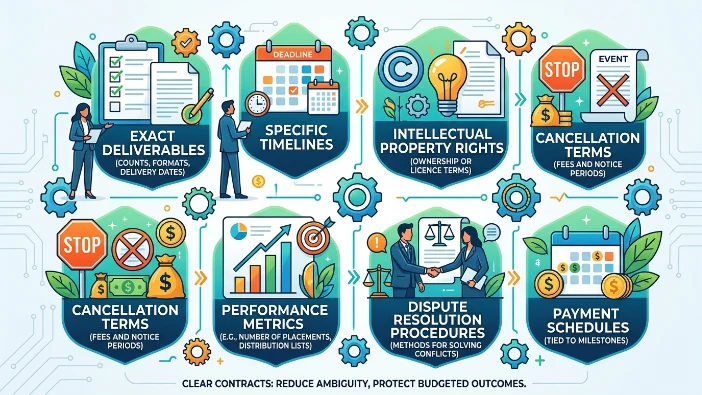
Contracts should specify deliverables, timelines, intellectual property rights, cancellation terms, performance metrics, and dispute resolution procedures.
Define exact deliverables with counts, formats, and delivery dates. State ownership or licence terms for produced assets. Include cancellation fees and notice periods. Set minimum performance metrics such as number of placements or distribution lists. Include dispute resolution methods and payment schedules tied to milestones. Clear contracts reduce ambiguity and protect budgeted outcomes.
Get the Full Insights Here:
Post-Event Wrap-Up Reports: How to Keep Your UK Brand in the News for 2 More Weeks



