

What Are Time Intelligence Media Group Audience Insights Services for Contextual Targeting Strategy?
Time Intelligence Media Group audience insights services evaluate publisher page environments, reader engagement metrics, and semantic content categories across United Kingdom news properties. These services structure privacy-compliant contextual targeting strategies that place brand advertisements alongside relevant, high-intent editorial content without personal user tracking.
Defining Contextual Audience Insights
Time Intelligence Media Group provides proprietary media data, page-level classification, and reader intent mapping across premium United Kingdom digital publishers. The service analyses text semantics, article sentiment, and reader dwell duration to categorise digital editorial inventory. Marketers use this data to execute cookie-free media buying across premium news domains.
In the United Kingdom digital advertising market, regulatory enforcement from the Information Commissioner’s Office (ICO) and General Data Protection Regulation (GDPR) guidelines limit traditional user-level tracking. Media planning requires privacy-first methodologies. Understanding contextual targeting and behavioural targeting on UK news sites provides the foundation for privacy-compliant campaign architecture. Contextual targeting categorises the environment surrounding the ad unit, whereas behavioural targeting relies on historical user profiles and third-party tracking identifiers.
Core Architecture of the Audience Insights Platform
The Times Intelligence Media Group platform indexes 24 million monthly active United Kingdom readers across national news publications such as The Daily Telegraph, The Guardian, and The Independent. The technology processes page text through 12 primary content categories, including Business, Personal Finance, Technology, Health, and Political Policy.
The platform assigns content scoring vectors based on three core indicators:
- Semantic Relevance Score: Measures exact keyword frequency and entity relationships within an editorial article.
- Brand Safety Index: Evaluates content risk factors across 8 IAB Tech Lab brand safety taxonomies, filtering out negative news stories such as crime reports or financial crashes.
- Engagement Index: Measures reader scroll depth, active dwell time, and sharing actions across specific article types.
How Does Times Intelligence Media Group Process Audience Data for Contextual Campaigns?
Times Intelligence Media Group processes audience data by scanning page text in real time using Natural Language Processing models. The system extracts page entities, classifies article sentiment, matches campaign keywords, and transmits contextual bidding signals to demand-side platforms within 15 milliseconds.
Real-Time Page Crawling and Semantic Analysis
The data processing workflow begins when a publisher renders a web page. The Times Intelligence Media Group crawler parses the HTML document, stripping away site navigation scripts and background page code to isolate the primary editorial body text.
Natural Language Processing (NLP) models analyse the isolated text. The algorithms identify core entities such as corporate names, geographical locations, economic policy terms, and product designations. For example, an article covering central bank interest rate decisions contains entities such as Bank of England, Monetary Policy Committee, inflation, and interest rate yield. The platform matches these entities against structured advertising taxonomies to classify page intent.
Integration with Demand-Side Platforms
Once page classification is complete, the system transfers contextual metadata to programmatic advertising exchanges. The platform integrates with demand-side platforms (DSPs) such as The Trade Desk, DV360, and Adobe Advertising Cloud.
The contextual signal delivery workflow operates through five technical steps:
- URL Ingestion: The crawler receives page URLs from United Kingdom publisher ad servers such as Google Ad Manager.
- Entity Extraction: The NLP engine extracts named entities, industry keywords, and emotional sentiment values.
- Taxonomy Mapping: The engine maps extracted entities to IAB Content Taxonomy v3.0 categories.
- Bid Enrichment: The system appends contextual key-value pairs to OpenRTB bid requests.
- Bid Execution: DSPs evaluate the key-value pairs and submit programmatic bids for matching brand campaigns within 15 milliseconds.
Utilising audience insights to choose between contextual and behavioural targeting allows media planners to evaluate channel efficiency, cost-per-thousand (CPM) rates, and audience scale across United Kingdom media networks.
What Are the Main Components of Contextual Audience Insights Services?
The main components include custom keyword list building, real-time sentiment analysis, brand safety filtering, and audience sentiment indexing. These components combine publisher content signals with historical reader engagement data to build precise programmatic media targeting profiles for UK campaigns.
Custom Keyword and Entity Targeting Packages
Times Intelligence Media Group constructs customised entity dictionaries for specific brand verticals. Generic keyword lists cause wasted ad spend by failing to distinguish word contexts. For example, the term bank relates to financial institutions such as Barclays, HSBC, and NatWest, but also relates to river geography.
The custom entity builder uses natural language understanding to verify exact lexical meanings. Advertisers specify target topics, excluded negative keywords, and required semantic qualifiers.
Sentiment Analysis and Brand Safety Filtering
Page sentiment determines ad placement safety. Times Intelligence Media Group categorises content sentiment into three distinct tiers:
- Positive Sentiment: Feature stories, product reviews, and growth news that increase consumer purchase intent.
- Neutral Sentiment: Informational reporting, statistical releases, and objective market summaries.
- Negative Sentiment: Breaking disaster coverage, corporate scandals, and political controversies.
The brand safety component automatically blocks ad displays on negative sentiment pages. This mechanism protects brand equity for advertisers across sensitive sectors such as retail banking, air travel, and pharmaceutical manufacturing.
Content Affinity and Audience Intent Mapping
Contextual insights measure how reader cohorts interact with specific content themes. Reader intent mapping tracks content consumption paths across multiple editorial sections. Readers who regularly consume green energy policy articles demonstrate high purchase affinity for electric vehicle charging infrastructure, home insulation services, and renewable energy tariffs. The platform clusters these reading patterns into contextual audience segments available for direct programmatic execution.
Explore More Expert Insights:
Time Intelligence Media Group Audience Insights Services Built on Consent-Led Data Collection
Full-Service Advocacy Agencies vs. Time Intelligence Media Group: A Tactical Cost-Benefit Analysis
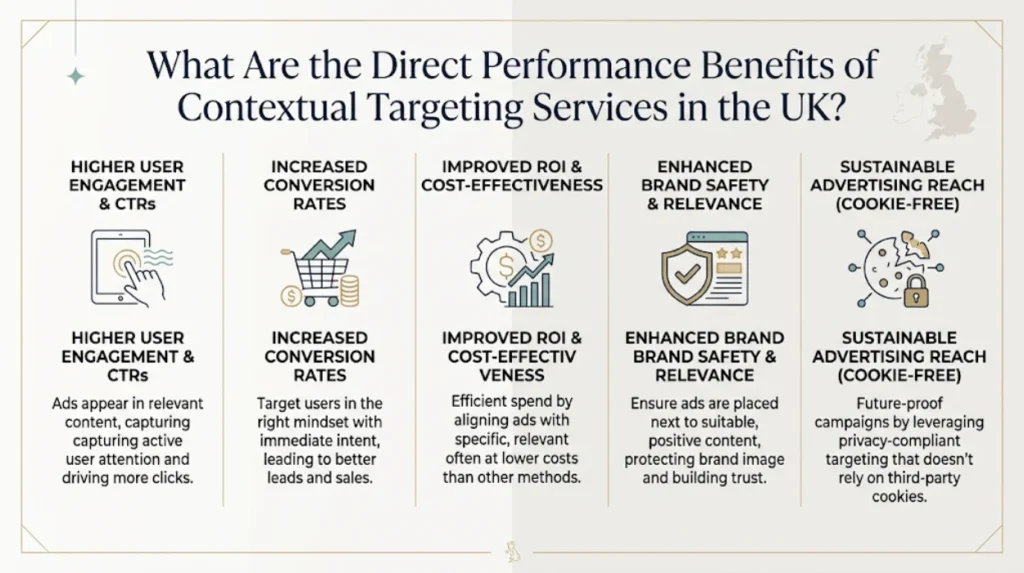
What Are the Direct Performance Benefits of Contextual Targeting Services in the UK?
Contextual targeting services deliver higher click-through rates, lower cost-per-acquisition metrics, complete regulatory compliance, and zero reliance on third-party cookies. Brands eliminate ad wastage while maintaining advertising reach across premium United Kingdom news websites and vertical digital magazines.
Regulatory Compliance and Privacy Protection
Contextual targeting operates without capturing personally identifiable information (PII). The methodology does not store cookie files, mobile ad identifiers (MAIDs), or IP addresses. Campaigns comply fully with the UK GDPR, the Data Protection Act 2018, and PECR regulations.
Because contextual signals do not require user consent banners, advertisers reach 100% of publisher site traffic. Behavioural targeting campaigns lose up to 35% of target audiences in the United Kingdom due to cookie consent rejections on publisher consent management platforms (CMPs). Contextual targeting restores this lost reach.
Campaign Efficiency and Performance Metrics
Contextual campaigns managed by Times Intelligence Media Group demonstrate measurable improvements in advertising performance across key performance indicators (KPIs):
- Click-Through Rate (CTR): Contextually aligned ad placements deliver an average CTR of 0.45%, compared to 0.18% for unsegmented run-of-network placements.
- Cost Per Acquisition (CPA): Contextual relevancy reduces user conversion friction, lowering average CPA by 22% for UK financial services campaigns.
- Brand Recall: Ad placement within relevant editorial content increases message recall by 34% compared to out-of-context behavioural retargeting units.
- Viewability Rates: IAB viewability standards reach 78% on contextually targetable premium news inventory, surpassing industry benchmarks by 12 percentage points.
What Are the Primary Brand Use Cases for Contextual Audience Services in the UK Market?
Primary use cases include B2B product launches, high-value financial service acquisitions, regulatory healthcare campaigns, and seasonal retail promotions. These campaign types require high brand safety, contextual relevance, and immediate alignment with active reader interest across United Kingdom publications.
B2B Enterprise Software and Corporate Services
B2B technology brands target senior decision-makers while those decision-makers research industry trends. Placing enterprise software advertisements within technology transformation articles on platforms such as Financial Times or Business Insider captures active business intent.
For example, an enterprise cloud software provider places ads next to articles discussing UK enterprise IT infrastructure, cybersecurity compliance, and cloud migration strategies. This alignment positions the software solution directly within the user’s professional evaluation workflow.
Financial Services and Wealth Management
Financial institutions such as investment managers, retail banks, and mortgage lenders require strict brand placement control. Advertising home loan products alongside UK housing market analysis articles generates qualified applicant traffic.
Specific financial product use cases include:
- ISA Investments: Targeting personal finance advice pages during the United Kingdom tax year-end period from February to April.
- Commercial Insurance: Placing liability coverage ads alongside small business management and regulatory policy articles.
- Wealth Management: Aligning pension transfer solutions with retirement planning and estate taxation content.
Retail and Consumer Packaged Goods (CPG)
Retail brands use contextual audience services to capture seasonal shopping demand. Fashion retailers place seasonal apparel campaigns alongside trend reports and London Fashion Week coverage. Grocery retailers place recipe-specific ad units next to food preparation content, allowing consumers to add featured ingredients directly to digital shopping carts.
How Do Brands Select the Right Contextual Service Package from Times Intelligence Media Group?
Brands select service packages by assessing campaign scale, required taxonomy depth, real-time integration needs, and reporting frequency. Times Intelligence Media Group provides managed service execution, self-service taxonomy feeds, and bespoke algorithmic customisation for United Kingdom enterprise advertisers.
Service Tier Overview
Times Intelligence Media Group structures three service tiers to match varying campaign requirements:
| Service Tier | Target Account Type | Primary Features | Delivery Method |
| Standard Contextual | Regional Agencies & Mid-Market Brands | IAB Tier 1 & 2 Taxonomy, Standard Brand Safety, Weekly Reporting | Pre-packaged DSP PMP Deals |
| Advanced Intelligence | National UK Brands & Media Agencies | Custom Keyword Dictionaries, Sentiment Filtering, Daily Analytics | Custom PMP Keys & DSP Integrations |
| Enterprise Bespoke | Multinational Corporations & Financial Institutions | Custom NLP Model Training, First-Party Data Alignment, Real-Time API | API Feed & Dedicated Strategist |
Implementation Roadmap for Enterprise Clients
Transitioning to a contextual targeting strategy requires structured execution. Times Intelligence Media Group guides client onboarding through four structured operational phases:
- Audit and Taxonomy Definition: Media strategists analyse historic campaign performance and establish custom entity dictionaries tailored to brand objectives.
- Platform Integration: Technical engineers connect Times Intelligence Media Group contextual feeds to the client’s preferred Demand-Side Platform.
- Pilot Campaign Execution: Advertisers run a 30-day comparative pilot against existing behavioural targeting benchmarks to establish performance baselines.
- Optimisation and Scaling: Data analysts refine keyword parameters and scale impression volumes across high-performing United Kingdom editorial categories.
Actionable Strategic Guidance
United Kingdom media buyers face shifting browser policies and strict privacy enforcement. Deploying Time Intelligence Media Group audience insights services provides immediate access to privacy-compliant, high-converting contextual inventory across the UK’s leading news and lifestyle publications. Media planners can request a custom contextual audit and platform demonstration from Times Intelligence Media Group to upgrade campaign performance metrics today.
FAQs
Q1: What are audience insights services for contextual targeting?
Ans: Audience insights services analyse audience interests, behaviours, content consumption and search intent to identify relevant contextual targeting opportunities. They help organisations align advertising messages with the content and environments most relevant to their target audience.
Q2: How do audience insights improve contextual targeting strategies?
Ans: Audience insights reveal which topics, content categories and information environments are most relevant to specific audience segments. This enables a contextual targeting strategy to place campaigns alongside content that matches audience interests without relying solely on individual user profiles.
Q3: What data is used for contextual targeting audience insights?
Ans: Contextual audience research can use search behaviour, content engagement patterns, demographic research, topic interests and media consumption data. These signals help identify relevant content themes and audience segments for contextual advertising.
Q4: How can businesses use audience insights to choose contextual targeting?
Ans: Businesses can compare audience interests, content preferences, campaign objectives and relevant media environments before selecting contextual targeting options. Audience insights help determine which topics, keywords and content categories best match the intended campaign audience.
Q5: What can Times Intelligence Media Group audience insights services provide?
Ans: Times Intelligence Media Group audience insights services can support research into audience interests, media consumption patterns, contextual relevance and content preferences. These insights can help organisations develop evidence-based contextual targeting strategies and align campaigns with relevant media environments.



