What Is Sponsored Content and How Do Agencies Use It for Clients?
Sponsored content is a paid promotional asset created and published by a media outlet or publisher to mirror the publisher’s native editorial format while promoting a brand’s specific message, campaign, product, or thought leadership initiative to a target audience.
Sponsored content functions as a hybrid between traditional public relations and paid media advertising. In the United Kingdom, agencies execute sponsored content campaigns to secure guaranteed placement across digital news sites, niche industry publications, and trade journals. Unlike organic earned media, where journalists maintain complete editorial control and can reject pitch angles, sponsored content guarantees publication date, message framing, link inclusion, and visual layout.
Agencies purchase sponsored content on behalf of clients to achieve distinct strategic goals:
- Brand Visibility: Agencies place messaging directly in front of established publisher audiences without relying on organic media algorithms.
- Search Engine Optimisation: Agencies secure high-authority backlinks, such as contextual dofollow or nofollow links depending on publisher policy, to improve client domain authority.
- Thought Leadership: Agencies position client executives as industry experts through long-form advertorials, opinion pieces, and sponsored white paper summaries.
- Lead Generation: Agencies embed direct calls to action, gating downloadable assets or directing referral traffic to specific campaign landing pages.
How Do PR and Digital Marketing Agencies Buy Sponsored Content Step by Step?
Agencies buy sponsored content through a structured procurement process that involves publisher identification, commercial negotiation, editorial alignment, content creation, compliance review, and performance tracking across direct publisher sales desks or programmatic media platforms.
Step 1: Publisher Identification and Audience Vetting
Agencies begin by evaluating target publisher networks based on third-party metrics and audience demographic match. Key parameters evaluated during vetting include domain authority, monthly organic traffic, domain geographic distribution, target audience alignment, and backlink policies.
Step 2: Pitching, Rate Negotiation, and Media Contracting
Agencies contact publisher commercial teams or account directors to request media kits and rate cards. Negotiation covers insertion order terms, pricing models (such as flat-fee sponsored posts, cost-per-thousand impressions, or cost-per-click), content tenure (guaranteed host duration, such as 12 months or permanent), link attributes, and social media amplification rights.
Step 3: Briefing, Content Creation, and Editorial Review
Agencies draft comprehensive creative briefs specifying target keywords, tone of voice, required outbound links, target buyer personas, and mandatory legal disclaimers. Agencies either produce copy in-house or brief the publisher’s native content studio. The content undergoes editorial review to ensure it matches the host publication’s stylistic standards while fulfilling client strategic objectives.
Step 4: Publication, Indexing, and Campaign Tracking
Once approved, the publisher schedules the piece for publication. Agencies verify proper disclosure tags, live hyperlink functionality, correct target landing page UTM parameters, and search engine indexability before compiling performance metrics for client review.
To execute this entire workflow efficiently across multiple accounts, agency account managers rely on systematic frameworks to brief, book and report on sponsored content placements.
What Commercial Models Do Agencies Use to Purchase Sponsored Content?
Agencies purchase sponsored content using flat-fee article fees, cost-per-thousand impressions pricing, cost-per-click models, performance-based lead pricing, dynamic programmatic guaranteed rates, or bundled multi-channel publisher packages depending on publisher requirements and campaign objectives.
– Guaranteed tenure
– Permanent placement
– CPC (Per click)
– CPL (Per lead)
– Cross-platform packages
– Guaranteed inventory
Selecting the correct pricing structure determines campaign cost efficiency and return on investment.
Flat-Fee Single Article Pricing
Under a flat-fee structure, the agency pays a fixed lump sum for a single sponsored article. Flat-fee arrangements typically guarantee that the piece remains live on the publisher’s domain for a minimum period, such as 12 months, or permanently. Flat fees are standard among high-authority national news portals and specialized business-to-business industry journals.
Cost-Per-Thousand Impressions (CPM) and Performance Pricing
Digital native publishers and large media networks often price sponsored content using impression-based metrics:
- Cost-Per-Thousand (CPM): Agencies pay based on total article views or page impressions delivered by the host site.
- Cost-Per-Click (CPC): Agencies pay only when a reader clicks on a outbound promotional link embedded within the sponsored article.
- Cost-Per-Lead (CPL): Agencies pay based on the volume of form submissions or gated asset downloads generated directly by the piece.
Multi-Channel Bundles and Programmatic Buying
Agencies frequently purchase sponsored content as part of a wider media package. These packages combine a sponsored article with newsletter inclusions, dedicated social media posts, display advertising banners, and podcast audio sponsorships. Modern agencies also utilize programmatic guaranteed buying platforms to programmatically reserve sponsored advertorial space across large publishing networks at scale.
Explore More Expert Insights:
What Is Recency, Frequency and Volume Scoring and How Does It Identify Loyal Readers?
Why Are Supply Chain and Logistics Research Reports Valuable to UK Procurement Teams?
What Are the Key Legal and Regulatory Requirements for Buying Sponsored Content in the UK?
Agencies buying sponsored content in the United Kingdom must comply with Advertising Standards Authority regulations and Competition and Markets Authority guidelines by enforcing clear, prominent labels such as Paid Promotion or Sponsored Item.
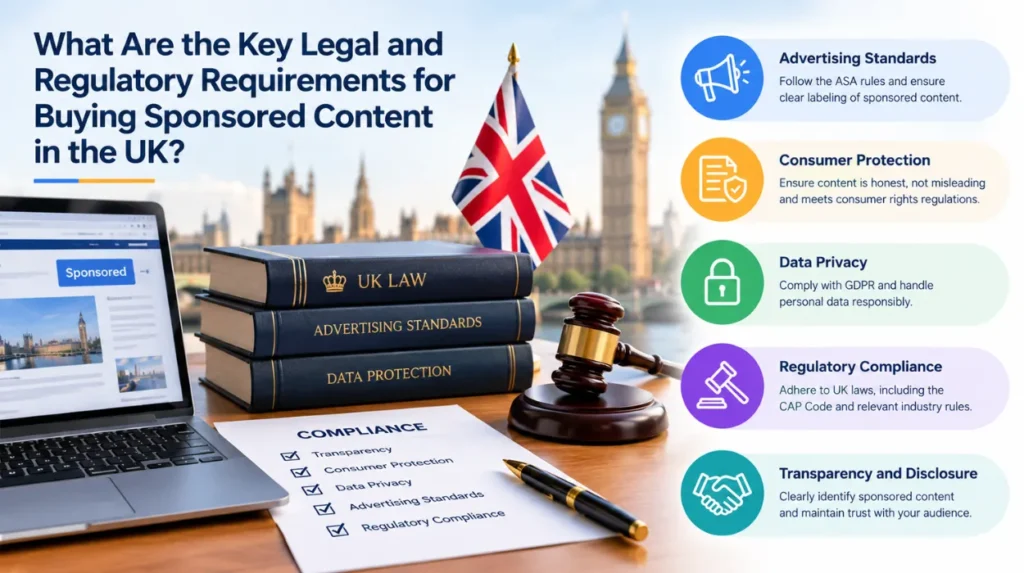
Compliance protects both client brand reputation and publishing partners from regulatory penalties and consumer deception charges.
Advertising Standards Authority (ASA) and CAP Code Standards
The ASA enforces the UK Code of Non-broadcast Advertising and Direct & Promotional Marketing (CAP Code). The CAP Code dictates that sponsored content must be instantly recognizable as a commercial promotion before a user clicks or reads the asset.
Mandatory disclosure rules include:
- Prominent Labelling: The article title and header must feature clear labels such as “Sponsored Content”, “Paid Promotion”, “Advertisement Feature”, or “Ad”. Vague terms such as “In Association With”, “Supported By”, or “Partner Content” are deemed ambiguous under CAP Code guidelines.
- Visual Distinction: The layout must visually distinguish sponsored pieces from native editorial content using distinct background shading, clear font variations, or explicit border lines.
- Disclosure Placement: Identifiers must appear above the fold and at the very start of social media promotion posts, audio reads, or video introductions.
Competition and Markets Authority (CMA) Guidelines
The CMA enforces consumer protection law in the UK. Failing to disclose that money, products, or services were provided in exchange for media endorsement constitutes an unfair commercial practice. Agencies are legally responsible for ensuring that publishers apply explicit disclosures to all paid content workflows.
What Are the Main Benefits and Strategic Use Cases for Agency Sponsored Content?
Sponsored content provides agencies with guaranteed media placement, full message control, authoritative SEO link acquisition, precise niche audience targeting, enhanced search engine visibility, and measurable referral traffic generation for client digital campaigns.
– Fixed publish date
– Increased domain score
– Regional positioning
Guaranteed Coverage and Total Message Control
Unlike traditional press release pitching or media relations campaigns, sponsored content eliminates editorial rejection risks. Agencies retain total control over key messaging points, product features, executive quotes, brand terminology, and call-to-action phrasing.
Search Engine Optimisation and Authority Building
High-authority publisher backlinks pass contextual search engine domain metrics. When an agency secures a sponsored post on an authoritative media portal, the embedded target link enhances search visibility for designated keyword clusters, provided the publisher follows search engine link attribute guidelines.
Highly Targeted Industry Distribution
Sponsored content enables hyper-specific audience segmentation across diverse vertical industries:
- Business-to-Business (B2B) Tech: Placing thought leadership articles in trade journals targeting Chief Technology Officers.
- Financial Services: Publishing market commentary pieces on national corporate finance news outlets.
- Consumer Goods: Running product feature stories on specialized lifestyle, beauty, or regional news platforms.
- Healthcare and Pharma: Publishing educational awareness pieces on peer-reviewed medical news networks.
PR and digital marketing agencies buy sponsored content to secure predictable, high-impact media placements across digital publishing networks on behalf of their clients. By identifying target publisher audiences, negotiating transparent commercial models, enforcing regulatory compliance, and managing strategic creative briefs, agencies execute sponsored content campaigns that drive brand visibility, search engine performance, and targeted lead generation. Understanding the structural, legal, and operational mechanics of buying sponsored content ensures agencies maximize client marketing return on investment across every campaign deployment.
FAQs
Q1: How do PR agencies buy sponsored content for their clients?
Ans: PR agencies typically identify suitable publishers, review sponsored content opportunities, negotiate pricing and placement terms, and manage publication on behalf of their clients. They also check audience relevance, editorial requirements, disclosure rules, and link policies before purchasing sponsored content.
Q2: What is the process for buying sponsored content through a digital marketing agency?
Ans: A digital marketing agency usually defines the campaign objectives, researches relevant publishers, compares sponsored content packages, and coordinates content submission and publication. The process also includes reviewing audience fit, website authority, traffic quality, and compliance requirements.
Q3: Why do PR agencies use sponsored content for clients?
Ans: PR agencies use sponsored content to place brand messages within relevant publisher environments and reach specific audiences. It can support brand awareness, referral traffic, thought leadership, and broader digital PR campaigns when the placement matches the client’s objectives.
Q4: How do agencies choose publishers for sponsored content?
Ans: Agencies evaluate publishers based on audience relevance, topical authority, geographic reach, website quality, traffic patterns, editorial standards, and campaign requirements. The strongest publisher selection prioritises genuine audience alignment rather than relying only on domain metrics.
Q5: What should agencies check before purchasing sponsored content?
Ans: Agencies should check the publisher’s audience, content standards, pricing, disclosure requirements, publication terms, link attributes, and reputation before purchasing sponsored content. They should also confirm that the placement complies with applicable search engine and advertising guidelines.