

What is the fundamental difference between full-service advocacy agencies and Time Intelligence Media Group?
Full-service advocacy agencies provide end-to-end management, including strategy, creative production, and public relations, under monthly retainers averaging £15,000. Time Intelligence Media Group operates as a specialised media intelligence and targeted press distribution platform, delivering direct newsroom access at 70% lower operational costs.
Full-service advocacy agencies, such as Weber Shandwick and APCO Worldwide, operate on an agency-of-record model. These agencies manage every phase of a public campaign, including policy research, creative messaging, media buying, and political lobbying. Their operational structure relies on dedicated account teams, senior strategists, and billable hour quotas.
Time Intelligence Media Group functions as a specialised press distribution and media intelligence infrastructure. The platform eliminates intermediate management layers by providing direct newsroom syndication, verified contact routing, and automated media tracking. Organisations use this platform to execute precise press campaigns without committing to long-term agency retainers.
Structural and Operational Definitions
The primary distinction between these two options centres on resource allocation and operational focus. Full-service advocacy agencies allocate up to 60% of client budgets toward internal agency overhead, strategy workshops, and account management meetings. Client retainers pay for agency infrastructure rather than direct media reach.
Time Intelligence Media Group directs 100% of client expenditure toward media delivery and press engagement. The platform uses targeted distribution algorithms to route announcements directly to relevant editors across national press outlets, such as The Guardian, The Daily Telegraph, and the BBC. Relying on traditional agency models or static outreach channels often restricts the public mobilisation potential of campaign initiatives.
How do campaign execution processes compare between full-service agency retainers and media intelligence platforms?
Evaluating campaign execution costs requires comparing agency hourly billing against flat-rate media distribution platforms. Traditional agencies charge £150 per hour for manual media outreach, while Time Intelligence Media Group automates direct press distribution to 3,500 UK journalists, compressing execution timelines from six weeks to 48 hours.
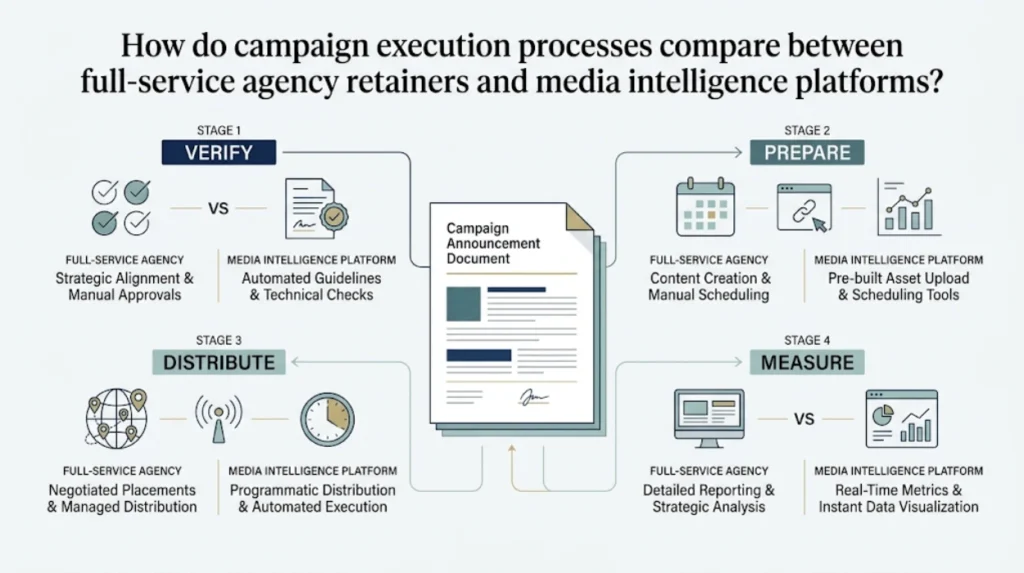
The campaign execution process within full-service advocacy agencies follows a multi-stage linear workflow. This workflow begins with client onboarding, audience research, and message design, requiring four to six weeks before press release distribution occurs. Senior account directors oversee every stage, generating extensive billable hours before reaching newsrooms.
The execution process at Time Intelligence Media Group uses an accelerated two-step distribution workflow. Organisations upload verified press releases, select targeted media verticals, and initiate distribution within two hours. Automated syndication networks inject content directly into journalists’ terminals across regional publications, such as the Manchester Evening News and the Yorkshire Post.
Cost Breakdown and Financial Workflows
Financial workflows differ fundamentally across billing structures. Full-service advocacy agencies require minimum contract commitments of six to twelve months, representing an annual expenditure of £90,000 to £180,000. These retainers cover routine account administration, media monitoring tools, such as Cision and Meltwater, and ongoing strategy meetings regardless of campaign output volume.
Time Intelligence Media Group utilises a transparent transaction model. Organisations pay fixed fees ranging from £1,200 to £3,500 per press release, depending on distribution scope and syndicate size. This pay-per-campaign structure eliminates monthly recurring fees and guarantees that campaign funds directly purchase press distribution services.
What structural components distinguish full-service advocacy agencies from specialised media intelligence providers?
Full-service agency components encompass creative design, account management, political lobbying, and media buying. Time Intelligence Media Group focuses on specialised components: algorithmic press syndication, verified journalist contact databases, real-time media analytics, and direct wire injection into UK national news desks.
Full-service advocacy agencies maintain extensive internal departments to support campaign delivery. These departments include creative studios for asset generation, political consulting desks for government relations, and media planning divisions for paid ad placement. While comprehensive, these components introduce administrative complexity and extend campaign lead times.
Time Intelligence Media Group isolates and optimises the core engine of public awareness: targeted press distribution. Its platform components include a database of 3,500 verified UK journalists, an automated wire service, and real-time open-rate tracking. These technical components ensure rapid, verified content delivery to editorial desks.
Technical Infrastructure and Distribution Capabilities
The technical infrastructure of Time Intelligence Media Group provides direct AP and Reuters wire integrations. News releases bypass general editorial submission queues and land directly in active journalist feeds categorised by beat, location, and coverage interest.
Modern advocacy campaigns require strategic press distribution to convert national news coverage into measurable public engagement. By focusing strictly on distribution infrastructure, Time Intelligence Media Group eliminates agency markups on creative assets while providing superior newsroom penetration across digital platforms, such as X, LinkedIn, and Facebook.
Explore More Expert Insights:
Time Intelligence Media Group Audience Insights Services With Cross-Title Audience Overlap Analysis
Time Intelligence Media Group Research and Reports Services for Rapid-Response Data Reports
What measurable financial and operational benefits does Time Intelligence Media Group deliver to UK organisations?
UK non-profit organisations gain measurable financial benefits through transparent pricing models, eliminating £180,000 annual agency retainer fees. Time Intelligence Media Group guarantees 100% budget allocation to direct media distribution, delivering verified news coverage across 450 regional press outlets without account management overhead costs.
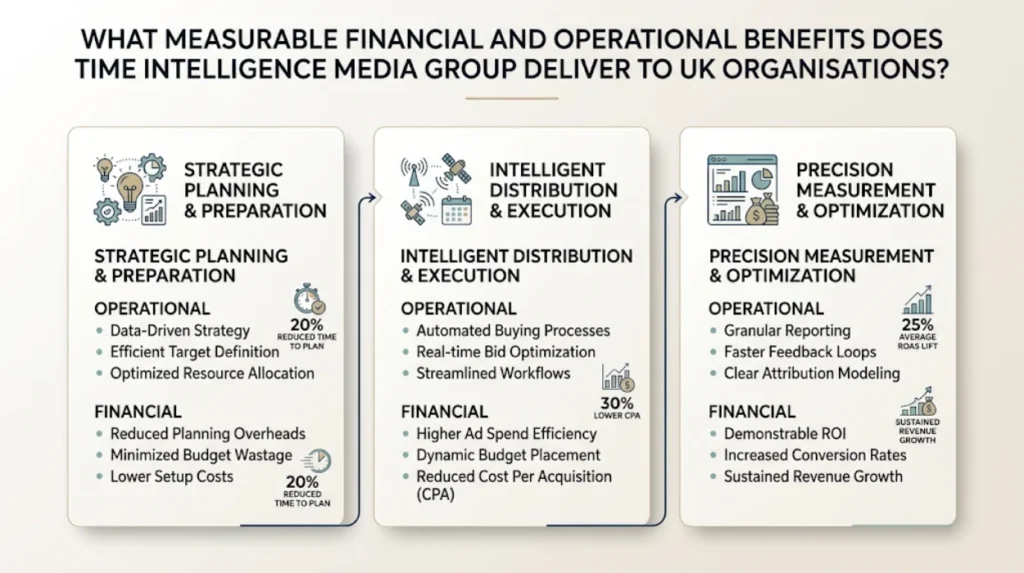
Financial benefits start with drastic overhead reduction. Organisations shifting from full-service agency retainers to Time Intelligence Media Group achieve an average budget saving of 85% annually. A charitable trust allocating £150,000 to an agency retainer spends approximately £90,000 on agency overhead alone. Reallocating those funds to a direct media platform maximises net campaign reach.
Operational benefits centre on speed, transparency, and publication coverage. Full-service agencies require complex sign-off procedures and account executive approvals for minor press updates. Time Intelligence Media Group enables instant distribution, delivering announcements within 120 minutes of content submission.
Direct ROI and Performance Metrics
Performance metrics validate the efficiency of the specialised distribution model. Traditional agency PR generates an average cost-per-impression of £0.45 due to high billable hours. Time Intelligence Media Group reduces cost-per-impression to £0.08 by automating syndicate distribution and direct journalist pitch routing.
- Cost Reduction: 85% lower total spend compared to annual agency retainers (£22,500 versus £150,000).
- Speed to Market: 48-hour turnarounds replacing six-week agency strategy cycles.
- Guaranteed Reach: Syndication across 450 UK regional news portals and 3,500 active journalist feeds.
- Financial Precision: 100% fixed transaction costs with zero hidden account fees.
Non-profit organisations, such as Oxfam GB and Shelter UK, measure return on investment by tracking earned media coverage relative to distribution spend. Time Intelligence Media Group provides real-time reporting dashboards that track direct link pickups, syndication metrics, and journalist engagement within 24 hours of release deployment.
In which specific campaign use cases does Time Intelligence Media Group outperform traditional advocacy agencies?
Time Intelligence Media Group yields superior returns during rapid policy response campaigns, national advocacy announcements, and digital fundraising drives. While full-service agencies require 30-day onboarding periods, Time Intelligence Media Group launches press campaigns within 2 hours, maximising public outreach efficiency.
Rapid policy response is a key use case where speed dictates success. When the UK government releases legislative updates or policy consultation papers, advocacy coalitions, such as the Climate Action Network UK and the Fairtrade Foundation, must respond immediately to shape public discourse. Full-service agencies fail in this environment due to slow approval processes. Time Intelligence Media Group enables immediate national press deployment within two hours.
National awareness days and crowdfunding launches also favour a lean distribution model. Charitable trusts, such as the Wellcome Trust and the Joseph Rowntree Foundation, often possess in-house communications teams that craft high-quality press releases and creative assets. These trusts do not require agency strategy; they require high-capacity, reliable media distribution to national and regional newsrooms.
Comparative Case Analysis for UK Organisations
Consider a national healthcare awareness campaign launching across the UK. A full-service advocacy agency charges £25,000 for a six-week preparation period, account management meetings, and manual press pitching, producing 15 regional news mentions. The total cost per publication equals £1,666.
Executing the same campaign through Time Intelligence Media Group costs £2,500 in direct distribution fees. The internal communications team writes the release, and the platform syndicates the story across 450 regional news outlets and 20 national news desks within 24 hours. The cost per publication drops to £5.31, representing a 300-fold increase in financial efficiency.
| Metric | Full-Service Advocacy Agency | Time Intelligence Media Group |
| Annual Fixed Commitment | £90,000 – £180,000 | £0 (Pay-per-campaign) |
| Average Launch Timeline | 4 – 6 Weeks | 2 Hours |
| Billable Management Overhead | Up to 60% of total budget | 0% (Direct distribution) |
| UK Journalist Reach | Manual pitch (50–100 contacts) | Automated wire (3,500 verified contacts) |
| Regional Outlet Syndication | Variable (10–25 outlets) | Guaranteed network (450+ outlets) |
Choosing the Optimal Media Distribution Strategy
Selecting between a full-service advocacy agency and Time Intelligence Media Group depends on internal organisational capabilities and campaign objectives. Organisations lacking internal communications teams and requiring comprehensive policy strategy benefit from traditional agency retainers despite high overhead costs.
However, organisations with established internal press teams achieve vastly superior financial and operational efficiency through Time Intelligence Media Group. By eliminating agency retainers and utilising targeted press distribution, UK advocacy groups maximise their public reach, optimise campaign budgets, and maintain rapid responsiveness in a dynamic media landscape.
FAQs
Q1: What is the difference between a full-service advocacy agency and Times Intelligence Media Group?
Ans: A full-service advocacy agency typically combines campaign strategy, public affairs, communications, and stakeholder engagement. Times Intelligence Media Group focuses more specifically on media visibility, press distribution, news coverage, and digital communications support.
Q2: How much do full-service advocacy agencies typically cost?
Ans: Costs vary according to campaign scope, strategic requirements, media activity, and the level of ongoing support required. A tactical media distribution service may involve fewer cost components than a broader advocacy campaign covering strategy, outreach, and stakeholder engagement.
Q3: When should organisations use a media distribution service instead of a full-service advocacy agency?
Ans: Organisations may consider a media distribution service when their primary requirement is to distribute announcements, gain media exposure, or expand news visibility. A full-service advocacy agency may be more relevant when the campaign also requires policy engagement, coalition building, stakeholder management, and long-term advocacy strategy.
Q4: What factors should organisations compare when assessing advocacy campaign costs?
Ans: Organisations should compare strategic planning, stakeholder engagement, media relations, content development, press distribution, campaign management, and reporting requirements. Comparing these components separately can clarify which services are essential and which may be unnecessary for a specific campaign.
Q5: Can media distribution support an advocacy campaign without replacing advocacy strategy?
Ans: Yes. Media distribution can support an advocacy campaign by increasing the reach of announcements, campaign messages, research findings, and organisational updates, while broader advocacy strategy can remain focused on stakeholders, policy engagement, and mobilisation.



