

What is search demand revealed by reader questions?
Reader questions reveal search demand by showing the exact information people seek, the language they use, and the problems they want solved through search results, content, definitions, comparisons, and practical guidance.
Search demand describes the information users actively seek through search engines. Reader questions provide direct evidence of that demand because each question identifies an information need.
A question such as how to improve employee retention indicates demand around employee retention methods. A question such as what is employee retention identifies definitional demand. A question such as which employee retention metrics matter identifies measurement demand.
These questions create distinct search intents. Search intent describes the reason behind a search query.
What types of search intent appear in reader questions?
Reader questions commonly reveal four search intent categories:
- Informational intent: The reader wants an explanation or definition.
- Navigational intent: The reader wants to find a specific resource, organisation, or page.
- Commercial investigation: The reader compares options before taking action.
- Transactional intent: The reader wants to complete an action, purchase, register, or request something.
For example, what is content marketing has informational intent. Best content marketing tools has commercial investigation intent. Buy content marketing software has transactional intent.
Question patterns become useful when they are grouped by topic, intent, terminology, and user need.
How do reader questions reveal topics with measurable search demand?
Reader questions reveal measurable search demand when repeated questions correspond with recurring search queries, related keywords, search volumes, search results, and identifiable information needs across a defined audience.
A single question identifies one information need. Repeated questions identify a broader topic pattern.
Consider questions about employee onboarding:
- What is employee onboarding?
- How does employee onboarding work?
- What should an onboarding process include?
- How long should employee onboarding take?
- What are common onboarding mistakes?
These questions represent different queries within the same topical area. They cover definition, process, components, duration, and problems.
Search demand becomes clearer when these questions are connected to keyword data and search result analysis. Keyword research identifies phrases people enter into search engines. Search volume measures the number of searches associated with a query during a defined period.
Why does question frequency matter?
Repeated questions indicate recurring information requirements. Frequency alone does not establish search volume, but it identifies subjects that require further search-demand validation.
A publisher analysing questions from customer support records, comments, interviews, forums, surveys, and search data can identify recurring themes. Those themes then become candidates for keyword research.
This process separates isolated questions from broader information needs.
How can brands turn reader questions into search topics?
Brands turn reader questions into search topics by extracting the central subject, identifying search intent, grouping related wording, validating demand, and mapping each information need to a distinct content opportunity.
The first step is question extraction. Every question contains entities, actions, problems, or concepts.
For example, the question ” How does a payroll system handle international employees contains the entities payroll system and international employees. The action handle identifies the process being investigated.
The second step is intent classification. The question asks for an explanation of a process rather than a product comparison.
The third step is query expansion. Related searches include international payroll process, international payroll compliance, payroll for global employees, and international payroll requirements.
The fourth step is demand validation through keyword research and search engine results.
How does query expansion identify related search demand?
Query expansion develops a larger keyword set from one reader question. It includes synonyms, related entities, modifiers, subtopics, and question variations.
For example, a question about measuring employee engagement can expand into:
- employee engagement metrics
- employee engagement survey metrics
- employee engagement measurement
- employee engagement KPIs
- how to measure employee engagement
The expanded set reveals the semantic field surrounding the original question.
Semantic relevance connects related concepts that search engines associate with the same subject. It helps content address a topic comprehensively rather than targeting one isolated phrase.
What patterns in reader questions indicate content gaps?
Content gaps appear when recurring reader questions lack accurate, complete, current, or directly relevant answers across existing search results and competing content covering the same topic.
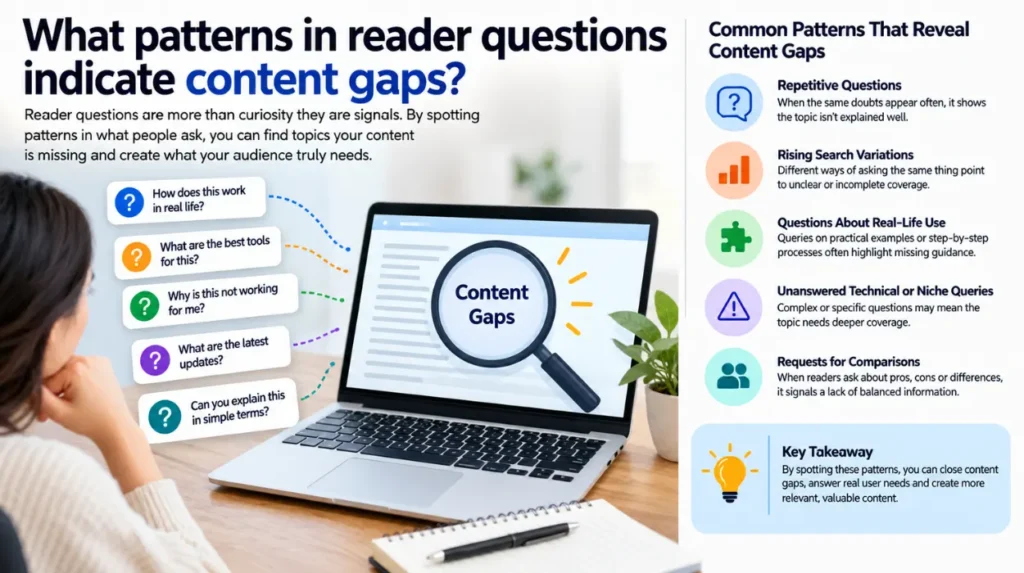
A content gap is an unmet information requirement within an existing search landscape.
For example, several pages can explain employee engagement. None can directly explain how to calculate employee engagement survey response quality. That missing subject represents a potential content gap.
Question analysis identifies gaps by comparing user questions with existing search results.
Which content gaps are most visible through question analysis?
Four common gaps appear through reader-question analysis:
- Missing topic gaps: A relevant question has no dedicated answer.
- Depth gaps: Existing pages mention a topic but provide limited detail.
- Intent gaps: Existing content answers a different user intent.
- Freshness gaps: Existing information does not reflect current requirements or practices.
A page answering what employee engagement is does not fully address how to measure employee engagement. Both belong to the same topical area but satisfy different intents.
Question analysis therefore distinguishes topic coverage from intent coverage.
How do search questions help identify the structure of a topic?
Search questions identify topic structure by exposing definitions, processes, components, problems, comparisons, measurements, requirements, and use cases that collectively describe how users understand a subject.
A topic consists of connected entities and subtopics. Reader questions expose those relationships.
For example, digital transformation questions can cover:
- What is digital transformation?
- Why does digital transformation matter?
- What does digital transformation include?
- How is digital transformation implemented?
- What are digital transformation challenges?
- How is digital transformation measured?
These questions create a logical topical structure.
What entities belong in a complete topic structure?
Important entities include:
- Core entity: The primary subject.
- Supporting entities: Concepts directly related to the subject.
- Processes: Actions used to achieve an outcome.
- Attributes: Characteristics, requirements, or measurements.
- Problems: Risks, barriers, and common failures.
- Outcomes: Results associated with implementation or use.
Entity relationships help determine which questions belong together and which require separate content.
How can reader questions improve topical coverage?
Reader questions improve topical coverage by exposing subtopics that a single keyword does not identify, allowing content creators to address definitions, processes, components, problems, measurements, and related entities within one subject area.
A single keyword such as employee engagement provides limited information about the reader’s exact requirement.
Reader questions provide greater context.
For example, the keyword employee engagement contains several possible intents. Questions reveal whether the user wants a definition, strategy, survey method, KPI framework, measurement process, or retention connection.
This distinction supports more precise content planning.
Why is topical coverage important for search visibility?
Topical coverage helps a page address multiple related information needs. Search engines evaluate content within broader semantic contexts rather than treating every query as an isolated phrase.
A comprehensive article about employee engagement can cover employee surveys, engagement metrics, recognition, communication, retention, productivity, and measurement methods when those subjects directly support the primary topic.
Coverage remains useful only when each section serves a defined information need. Unrelated additions reduce topical focus.
How do question patterns distinguish content that needs separate pages?
Question patterns distinguish separate content opportunities when questions represent different search intents, distinct user needs, substantial subtopics, or independent entities that require more detail than one page can provide.
Not every related question belongs on the same page.
What is employee retention and how to improve employee retention share a topic but have different information requirements. The first requires a definition. The second requires processes, strategies, implementation details, and measurement.
A separate page becomes relevant when the search intent changes significantly.
What signals indicate separate content requirements?
Useful signals include:
- Different primary search intent
- Different target audiences
- Different core entities
- Different conversion stages
- Different levels of required detail
- Separate search result patterns
- Distinct keyword clusters
For example, employee retention strategies and employee retention metrics address different requirements. One focuses on actions. The other focuses on measurement.
This separation creates clearer information architecture.
How can reader questions support a topical map?
Reader questions support a topical map by grouping related queries into connected clusters and assigning each cluster to an appropriate page, creating a structured framework for comprehensive topic coverage and internal content relationships.
A topical map represents the relationship between a central subject and its connected subtopics.
Reader questions provide the raw material for this map.
A central topic such as performance management can connect to performance reviews, KPIs, goal setting, feedback, performance measurement, appraisal processes, and employee development.
Each cluster contains questions with closely related intent.
How are questions grouped into topical clusters?
Questions are grouped according to shared entities, intent, subject matter, and required answer type.
For example:
Performance management definition
- What is performance management?
- What does performance management include?
Performance measurement
- How is employee performance measured?
- Which performance metrics matter?
Performance reviews
- What is a performance review?
- How often should performance reviews occur?
These clusters create clearer content boundaries and reveal relationships between pages.
For a deeper progression from question patterns into structured topical coverage, topical map development can be used as the next-stage framework.
Explore More Expert Insights:
What Is the Difference Between Contextual Targeting and Behavioural Targeting on UK News Sites?
What Do UK GDPR and PECR Mean for the Way Audience Data Is Collected From News Readers?
How do reader questions reveal opportunities competitors have not covered?
Reader questions reveal competitor content gaps by comparing recurring information needs with the subjects, depth, formats, entities, and intents already addressed by pages ranking for relevant searches.
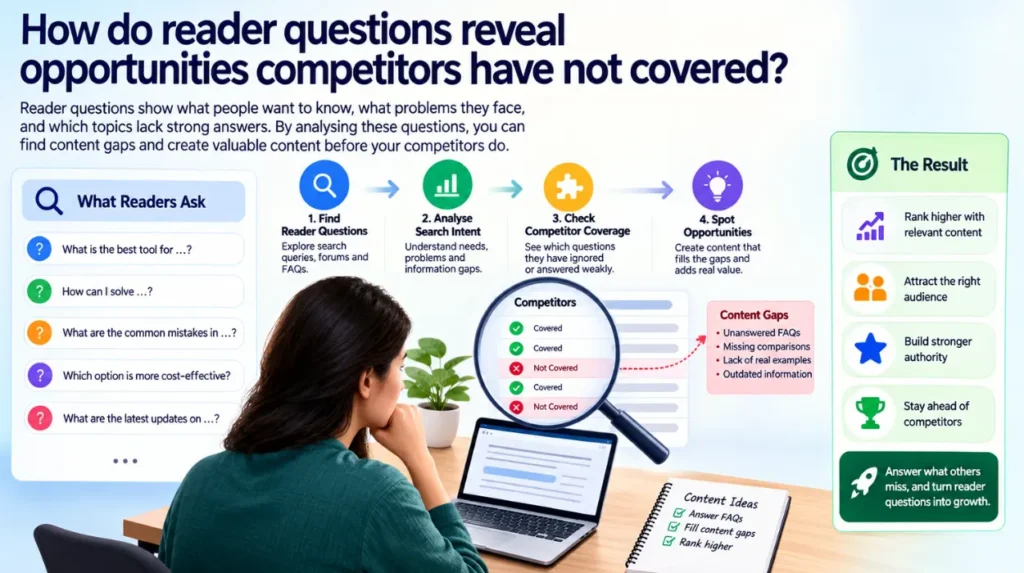
Competitor analysis identifies what existing pages cover. Question analysis identifies what users continue to ask.
The difference between those two datasets exposes potential gaps.
For example, five ranking articles can explain international payroll. Four discuss compliance and payment processing. None addresses international payroll data reconciliation. Repeated reader questions about reconciliation identify a specific uncovered requirement.
What should competitor question analysis compare?
A structured comparison examines:
- Questions answered
- Questions ignored
- Topic depth
- Entity coverage
- Search intent
- Content freshness
- Evidence and source quality
- Practical detail
- Content format
This process identifies gaps based on observable content differences rather than assumptions about competitor performance.
How can brands prioritise reader questions for content development?
Reader questions can be prioritised by evaluating search demand, relevance, intent, topical importance, content gaps, audience value, and the relationship between individual questions and broader search clusters.
Prioritisation prevents content planning from treating every question equally.
A high-value question connects directly to the core topic, represents a recurring information need, has identifiable search demand, and supports a broader topical cluster.
A narrow question with limited relevance belongs lower in the publishing sequence.
What factors determine content priority?
A practical prioritisation framework includes:
- Search demand: Evidence of recurring search activity.
- Topical relevance: Direct connection to the primary subject.
- Intent clarity: A clearly defined information requirement.
- Content gap: Limited existing coverage.
- Cluster importance: Relationship with other relevant queries.
- Audience relevance: Alignment with the defined reader population.
This framework turns reader questions into structured editorial decisions.
How can reader questions become a long-term content strategy?
Reader questions become a long-term content strategy when recurring queries are continuously collected, categorised, validated, mapped to topics, compared with existing coverage, and updated as search behaviour and information requirements change.
Search demand changes as industries, technologies, regulations, terminology, and user priorities change.
A question database therefore requires ongoing analysis.
New questions can reveal emerging topics. Changes in existing questions can reveal shifts in terminology or user intent. Repeated unanswered questions can expose persistent content gaps.
Question-led content planning creates a direct connection between information needs and editorial coverage.
The process remains structured:
Reader questions → search intent → keyword research → topic clusters → content gaps → topical map → content development → performance analysis → question refinement.
This framework turns real user questions into evidence-based search demand signals and creates a clear foundation for broader topical coverage.
FAQs
Q1: How can reader questions reveal search demand?
Ans: Reader questions reveal the specific topics, problems, and information gaps people actively want answered. Brands can analyse recurring questions to identify search demand and develop content that matches real user intent.
Q2: How can brands turn audience questions into content ideas?
Ans: Brands can group audience questions by topic, search intent, and recurring themes to create relevant content ideas. These questions can inform blog posts, guides, FAQs, landing pages, and other search-focused content.
Q3: Why are reader questions useful for SEO content strategy?
Ans: Reader questions provide direct insight into the language and concerns used by an audience. Using these insights in an SEO content strategy can improve topical relevance and help content address specific search queries.
Q4: How do audience questions help identify content gaps?
Ans: Repeated questions can indicate that existing search results do not fully address a reader’s needs. Brands can use these gaps to create more complete, specific, and useful content around underserved search topics.
Q5: How can Times Intelligence Media Group use reader questions to understand search intent?
Ans: Times Intelligence Media Group can analyse reader questions to identify informational, commercial, navigational, and problem-solving search intent. This helps map audience demand to relevant topics and content formats without relying only on keyword volume.



