

Executing a digital advertising campaign in the United Kingdom requires strategic alignment between audience data and media placement mechanics. The UK digital advertising market generates over £30 billion annually, with programmatic channels accounting for 85% of display ad spend. Advertisers operating within this market navigate strict privacy frameworks, including the Data Protection Act 2018 and regulatory oversight from the Information Commissioner’s Office (ICO). Choosing between contextual targeting and behavioural targeting determines how ad impressions reach UK consumers across digital media properties. Audience insights provide the empirical data required to select the optimal targeting method for specific campaign performance goals.
What Are Audience Insights and How Do They Define Contextual and Behavioural Targeting in the UK?
Audience insights collect user demographics, content consumption habits, and intent signals across digital touchpoints. Contextual targeting aligns ad placements with real-time web page content, whereas behavioural targeting delivers ads based on past browsing histories, cross-site tracking, and user profile segments.
Understanding Audience Insights in Digital Advertising
Audience insights represent structured datasets collected from first-party analytics, third-party data providers, and publisher platforms. In the UK market, audience insights quantify user age brackets, income levels, geographic locations, device preferences, and content affinity metrics. Analytics platforms such as Google Analytics 4, Adobe Analytics, and Permutive process these data points to build actionable audience profiles. Media planners analyse these profiles to identify consumer motivations before committing budget to programmatic auctions.
Defining Contextual Targeting Mechanisms
Contextual targeting analyses the environment where an advertisement appears rather than the individual user viewing it. Web crawlers scan digital content for semantic keywords, sentiment, and topic categorisations defined by the Interactive Advertising Bureau UK (IAB UK). For example, an ad for an electric vehicle appears on an article discussing low-emission cars on national news sites such as The Guardian, The Independent, or The Daily Telegraph. The targeting decision occurs in real time based on page metadata, requiring zero user-tracking identifiers or cookie storage. Evaluating the difference between contextual targeting and behavioural targeting on UK news sites demonstrates how contextual mechanisms bypass user identity tracking entirely.
Defining Behavioural Targeting Mechanisms
Behavioural targeting tracks individual user actions across digital properties over extended periods. Tracking technologies, such as mobile advertising IDs (MAIDs) and persistent cookies, record search queries, page visits, and online purchases. Advertisers group users into specific behavioural cohorts, such as frequent travel bookers or mortgage applicants. An ad for a personal loan follows a user across lifestyle blogs, sports portals, and social media platforms regardless of page topic. In the UK, behavioural targeting requires explicit consent under the Privacy and Electronic Communications Regulations (PECR).
How Do Media Planners Evaluate Audience Insights to Select a Targeting Strategy?
Media planners evaluate audience insights by auditing first-party data, measuring privacy compliance thresholds, and mapping user intent stages. This evaluation identifies whether content context or historical user behaviour provides the highest engagement signals for specific campaign objectives in the United Kingdom.
Auditing First-Party Data Quality
The evaluation process begins with a comprehensive audit of brand-owned data assets. Media planners analyse customer relationship management (CRM) records from platforms such as Salesforce or HubSpot. If a UK brand possesses 100,000 verified email records with an active 90-day engagement rate above 45%, behavioural retargeting offers high efficiency. Conversely, if first-party data coverage falls below 10,000 profiles, contextual targeting provides broader scale without data degradation.
Mapping the Consumer Intent Funnel
Audience insights reveal consumer positions within the buying journey. Top-of-funnel (TOFU) audiences research broad topics, generating high contextual relevance signals across news and editorial publishers. Middle-of-funnel (MOFU) and bottom-of-funnel (BOFU) audiences display repeated interaction behaviours, such as adding items to e-commerce baskets on retail sites like Sainsbury’s, Tesco, or John Lewis. Planners map high-intent actions to behavioural cohorts while placing informational discovery campaigns within contextually aligned content environments.
Assessing Scale and Inventory Availability
Planners calculate available impression volumes across UK ad exchanges like OpenX, PubMatic, and Magnite. Behavioural segments suffer inventory shrinkage of 35% to 60% due to user cookie rejection rates on UK browser sessions. Contextual inventory maintains 100% addressability across Safari, Chrome, and Firefox browsers because page scanning requires no user-level consent prompts. Planners balance campaign scale requirements against targeting precision before committing ad spend.
Explore More Expert Insights:
How to Build a Consent-Led Audience Data Collection Process That Still Delivers Usable Insights
Integrating Strategic Press Distribution into Your National Crowdfunding and Awareness Checklist
What Key Data Components Determine the Choice Between Contextual and Behavioural Signals?
Data components include page sentiment, semantic keywords, page taxonomy, historical click-through rates, device identifiers, and consent management records. Contextual strategy relies on page metadata, while behavioural strategy depends on persistent user profiles, recency indicators, and audience segment attributes.
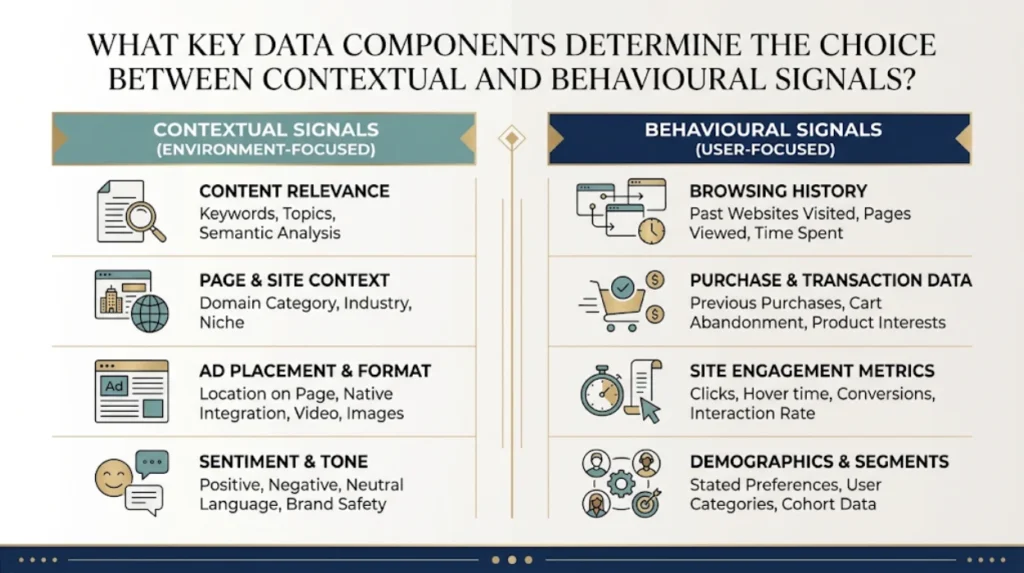
Contextual Data Signals and Metadata
Contextual targeting processes real-time page architecture signals. Key data components include:
- Semantic Keyword Density: Natural language processing (NLP) algorithms measure keyword frequency and co-occurrence within article copy.
- Page Taxonomy: Categorisation systems map articles to standard IAB Tier 3 content categories, such as Personal Finance or Automotive Repair.
- Brand Safety and Suitability Ratings: Safety tools from vendors such as Integral Ad Science (IAS) and DoubleVerify score page content for risk factors like violence, political controversy, or negative sentiment.
- URL Structure and Page Metadata: Header tags, meta descriptions, and image alt text provide instant signals regarding page relevance.
Behavioural Data Signals and User Attributes
Behavioural targeting processes historical user interactions across extended timelines. Primary data components include:
- Recency and Frequency Metrics: Timestamps measure whether a user visited a product category page 2 hours ago or 30 days ago.
- Cross-Domain Interaction Logs: Graph databases aggregate browsing sessions across financial comparison portals, retail outlets, and entertainment platforms.
- Consent Management Platform (CMP) Status: CMP tools like OneTrust or Usercentrics log valid consent strings under UK GDPR rules.
- Lookalike Modelling Attributes: Machine learning models calculate mathematical similarity between existing customer profiles and prospective user cohorts.
What Performance and Privacy Benefits Does Each Targeting Method Deliver for UK Advertisers?
Contextual targeting delivers total privacy compliance, zero reliance on third-party cookies, and immediate brand safety on premium publishing sites. Behavioural targeting offers hyper-specific audience reach, personalised creative messaging, and effective retargeting capabilities across multi-channel media environments.
Benefits of Contextual Targeting in the UK Market
Contextual strategies mitigate regulatory risks under ICO enforcement guidelines. Because contextual mechanisms collect no personally identifiable information (PII), advertisers eliminate legal exposure associated with data breaches or non-compliant tracking pixels. Performance benefits include lower effective Cost Per Mille (eCPM) rates, averaging 20% to 35% below behavioural CPMs on premium news networks like The Daily Mail or The Telegraph. Furthermore, contextual placement achieves immediate relevance, yielding Click-Through Rates (CTR) up to 1.8x higher when ads match immediate article topics.
Benefits of Behavioural Targeting for Direct Response
Behavioural strategies deliver high precision for direct-response digital campaigns. Reaching users based on confirmed historical interest reduces wasted impressions on non-prospects. Advertisers achieve higher conversion rates (CVR), exceeding 3.2% on retargeting campaigns compared to 0.8% on broad contextual campaigns. Dynamic Creative Optimisation (DCO) tools dynamically insert previously viewed products into display ad units, increasing return on ad spend (ROAS) for UK e-commerce operators.
| Campaign Objective | Preferred Strategy | Average UK CTR | Primary Compliance Requirement |
| Brand Awareness | Contextual Targeting | 0.45% – 0.75% | Standard Brand Safety Filtering |
| Product Consideration | Hybrid (Contextual + Behavioural) | 0.80% – 1.20% | Cookie Consent String Verification |
| Conversion / Retargeting | Behavioural Targeting | 1.50% – 3.40% | Full UK GDPR & PECR Explicit Consent |
Which UK Campaign Scenarios Require Contextual Targeting Versus Behavioural Targeting?
UK advertisers deploy contextual targeting for high-intent research, breaking news coverage, and strict regulatory compliance environments. Behavioural targeting suits conversion campaigns, customer retention efforts, and cross-device product retargeting where historical user browsing activity indicates explicit purchasing intent.
Financial Services and Healthcare Campaigns
Financial institutions, such as Barclays, HSBC, and NatWest, operate under strict regulations enforced by the Financial Conduct Authority (FCA) alongside ICO privacy rules. Promoting specialised financial products like ISA savings accounts or commercial mortgages requires high contextual relevance in business editorial sections. Placing ads on financial news portals delivers high intent without triggering invasive tracking concerns. Advertisers seeking advanced data integration utilise audience insights services for contextual targeting strategy to map high-value user cohorts without privacy friction.
Retail and Fast-Moving Consumer Goods (FMCG) Campaigns
FMCG brands advertising impulse purchases, such as soft drinks or packaged snacks, benefit from contextual placement adjacent to food recipes, entertainment news, and lifestyle content. Conversely, high-value retail brands, such as Burberry or End Clothing, rely on behavioural targeting to reach users who searched for specific luxury apparel items within the past 14 days. Retargeting these abandoned cart users across premium programmatic exchanges drives immediate sales recovery.
Automotive Launch Strategies
Automotive manufacturers launching new electric vehicles in the UK employ a two-tiered strategy. Initial awareness phases use contextual targeting across sustainability articles, motoring reviews, and green technology channels on platforms like Auto Trader or Top Gear. Subsequent lower-funnel phases deploy behavioural targeting to re-engage users who configured a vehicle on the manufacturer’s website, serving tailored test-drive booking offers.
How Do UK Brands Integrate Audience Insights for Maximum Campaign Return on Ad Spend?
UK brands maximise campaign efficiency by combining real-time page relevance with verified first-party audience data segments. Integrating audience insights ensures advertising spend concentrates on high-converting contextual environments while maintaining full compliance with UK General Data Protection Regulation guidelines.
Implementing a Unified Hybrid Targeting Model
Modern UK media planning relies on a hybrid framework rather than an isolated choice between targeting techniques. Media planners use first-party audience insights to define the contextual environments that target demographics visit most frequently. For example, if CRM data indicates that high-value customers spend 68% of their time reading technology and business news, planners prioritise contextual bidding on those specific publisher channels.
Continuous Optimisation and Data Validation
Maximising return on ad spend requires ongoing campaign optimisation. Advertisers measure key performance indicators (KPIs) every 48 hours, tracking Cost Per Acquisition (CPA), conversion rates, and viewability scores across programmatic demand-side platforms (DSPs) like Google Display & Video 360 and The Trade Desk. When cookie rejection rates cause behavioural segment CPMs to rise above £12.50, planners shift budget allocations toward contextual private marketplace (PMP) deals. This data-driven approach maintains campaign scale, protects user privacy, and delivers consistent media efficiency across the UK digital landscape.
FAQs
Q1: What is the difference between contextual and behavioural targeting?
Ans: Contextual targeting places advertising based on the content or topic of a webpage, while behavioural targeting uses audience data such as browsing activity and past interactions. The choice depends on campaign objectives, available data, privacy requirements and audience insights.
Q2: How can audience insights help choose a targeting strategy?
Ans: Audience insights reveal what people read, search for, engage with and respond to across digital channels. UK campaign teams can use these patterns to determine whether contextual targeting, behavioural targeting or a combination better matches audience intent.
Q3: Is contextual targeting better for privacy-conscious UK campaigns?
Ans: Contextual targeting can reduce reliance on individual-level behavioural data because it focuses on page content rather than a person’s browsing history. This makes it relevant for campaigns where data protection and consent requirements are important considerations.
Q4: When should a UK campaign use behavioural targeting?
Ans: Behavioural targeting can be useful when a campaign has appropriate consented audience data and needs to reach people based on demonstrated interests or online actions. It is commonly assessed alongside data quality, consent status, campaign objectives and measurement requirements.
Q5: Can contextual and behavioural targeting be used together?
Ans: Yes, campaigns can combine contextual and behavioural targeting to align ad placement with relevant content while using permitted audience signals. Audience insights can help determine how these targeting methods should be balanced across different campaign segments and channels.



