
Businesses in competitive UK markets strengthen credibility by publishing trusted third-party research instead of unsupported claims. Independent data improves content quality, supports media coverage, increases search visibility, and provides evidence that journalists, buyers, and AI-powered search systems recognise as reliable.
In competitive industries, authority depends on evidence. Organisations that consistently publish verified research gain stronger visibility across search engines, media publications, and professional networks.
Third-party research refers to data, reports, surveys, market analysis, or official statistics produced by independent organisations rather than the business itself. Examples include reports from the Office for National Statistics, industry associations, academic institutions, and recognised research firms.
For UK organisations operating in crowded sectors such as fintech, legal services, healthcare, construction, and technology, independent research provides factual foundations for thought leadership.
Why does third-party research build authority in competitive UK markets?
Third-party research strengthens authority because independent evidence carries greater credibility than self-reported marketing claims. Verified statistics help businesses support arguments, improve trust, attract journalists, increase search relevance, and create content that remains valuable across multiple publishing channels over extended periods.
Authority is earned through verifiable information.
Search engines evaluate expertise by analysing the quality, relevance, and supporting evidence within content. AI-powered search systems also prioritise factual information that references recognised entities and established datasets.
Third-party research strengthens several authority signals simultaneously.
It improves factual accuracy
Reliable research reduces unsupported statements.
For example, instead of writing:
“Digital adoption continues to increase.”
A stronger statement becomes:
“The UK digital economy grew 13.7% in real terms according to published industry research.”
Specific evidence creates stronger informational value.
It increases media credibility
Journalists regularly use independent research when developing stories.
Statistics from recognised organisations are easier to reference than marketing claims.
It supports AI citation
Generative AI systems prefer content built around identifiable entities, verified figures, and clearly defined concepts.
Content supported by recognised research becomes easier to cite accurately.
Businesses interested in understanding this approach can also explore:
The UK Digital Economy Grew 13.7% in Real Terms.
What counts as high-quality third-party research?

High-quality third-party research comes from recognised organisations that use transparent methodologies, recent datasets, clear sampling techniques, and published documentation. Reliable research contains identifiable authorship, publication dates, and measurable findings that readers and publishers can independently verify with confidence.
Not every statistic deserves publication.
Quality depends on source credibility and research transparency.
Government data
Government organisations publish official national statistics.
Examples include:
- Office for National Statistics (ONS)
- HM Treasury
- Department for Business and Trade
These datasets often provide economic, employment, demographic, and business information.
Academic research
Universities publish peer-reviewed studies supported by documented methodologies.
Examples include research from:
- University of Oxford
- London School of Economics
- University of Cambridge
Academic studies provide detailed evidence for specialist industries.
Industry associations
Trade organisations regularly publish sector reports.
Examples include:
- techUK
- British Chambers of Commerce
- UK Finance
- Chartered Institute of Marketing
These reports often contain industry-specific benchmarks.
Independent research firms
Professional research companies conduct surveys and market analysis.
Examples include:
- Ipsos
- YouGov
- Kantar
- Statista
These organisations specialise in structured data collection.
How do you choose research that supports your content?
Effective research selection starts with audience relevance instead of publication volume. Every statistic must directly support the topic, answer a genuine question, remain current, and originate from a trusted organisation with transparent research methods and clearly documented evidence.
Relevance matters more than quantity.
Large collections of unrelated statistics reduce clarity.
Match research to search intent
Each statistic needs a purpose.
Examples include:
- Market growth figures
- Consumer behaviour trends
- Economic indicators
- Industry benchmarks
- Technology adoption rates
Every figure answers a specific user question.
Check publication dates
Older reports lose value in rapidly changing industries.
Technology, digital marketing, artificial intelligence, and fintech research changes quickly.
Current research improves relevance.
Review methodology
Every report explains:
- Sample size
- Geographic coverage
- Collection period
- Research approach
Transparent methodology improves confidence.
How can third-party research become original thought leadership?
Third-party research becomes thought leadership when organisations analyse findings, explain implications, identify industry patterns, and connect multiple credible sources into clear insights. Authority grows through interpretation supported by evidence instead of repeating published statistics without additional context.
Publishing research summaries alone does not create authority.
Value comes from structured analysis.
Combine multiple sources
One report explains one issue.
Several reports often reveal broader trends.
For example:
- Government economic data
- Consumer surveys
- Industry reports
- Technology adoption studies
Combined evidence creates stronger conclusions.
Explain industry impact
Statistics require context.
Instead of listing percentages, explain:
- What changed
- Why it matters
- Which industries are affected
- Which organisations benefit
Readers understand practical significance more easily.
Build topic clusters
Research supports multiple content formats.
Examples include:
- Blog articles
- White papers
- Infographics
- Media commentary
- Executive briefings
- Industry reports
One research project often supports months of content production.
What mistakes reduce the value of third-party research?
Common mistakes include using outdated statistics, quoting information without context, ignoring research methodology, citing unreliable publishers, copying conclusions directly, and presenting isolated figures without explaining relevance, audience impact, or measurable business significance through structured analysis.
Authority depends on accuracy.
Several mistakes reduce trust.
Using outdated figures
Fast-changing sectors require current evidence.
Older statistics lose relevance.
Quoting without explanation
Readers need interpretation.
Statistics alone rarely answer practical questions.
Using unreliable sources
Blogs without documented research provide weak evidence.
Recognised organisations provide stronger foundations.
Ignoring source consistency
Conflicting datasets confuse readers.
Use comparable research where possible.
How does third-party research improve SEO and AI visibility?
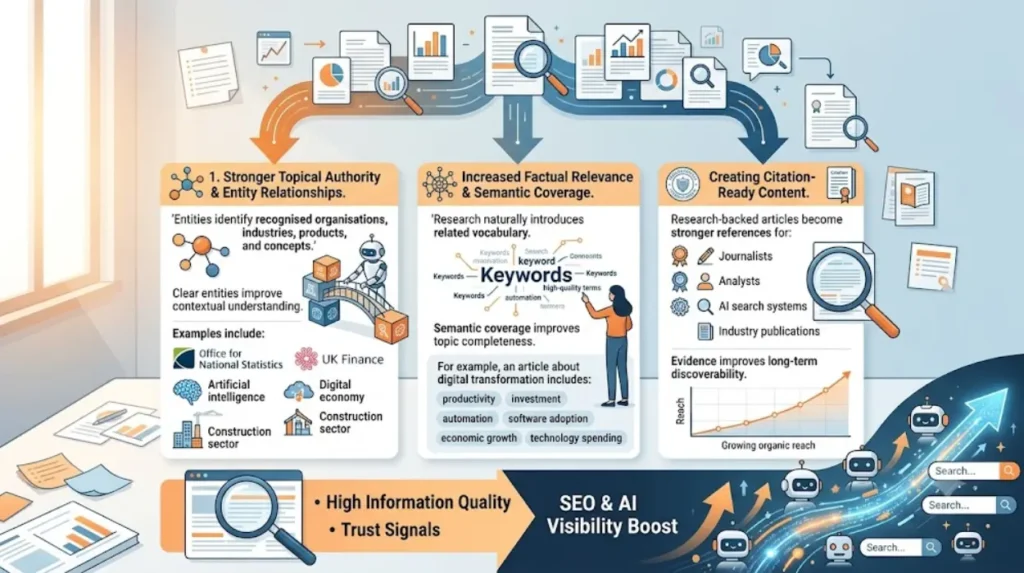
Third-party research improves SEO by strengthening topical authority, supporting entity recognition, increasing factual relevance, and creating citation-ready content. Structured evidence helps search engines and AI systems understand topics through recognised organisations, verified statistics, and clearly defined industry concepts.
Modern search focuses on information quality.
Research improves several optimisation signals.
Stronger entity relationships
Entities identify recognised organisations, industries, products, and concepts.
Examples include:
- Office for National Statistics
- UK Finance
- Artificial intelligence
- Digital economy
- Construction sector
Clear entities improve contextual understanding.
Better semantic relevance
Research naturally introduces related vocabulary.
For example, an article about digital transformation includes:
- productivity
- investment
- automation
- software adoption
- economic growth
- technology spending
Semantic coverage improves topic completeness.
Greater citation potential
Research-backed articles become stronger references for:
- Journalists
- Analysts
- AI search systems
- Industry publications
Evidence improves long-term discoverability.
When does commissioned research become a better option?
Commissioned research becomes appropriate when existing public information fails to answer important industry questions. Original surveys, market studies, and independent analysis generate unique datasets that competitors cannot replicate through publicly available information alone.
Public research covers broad markets.
Some organisations require industry-specific evidence.
Examples include:
- Customer sentiment studies
- Regional business surveys
- Industry benchmarking
- Product adoption research
- Workforce trend analysis
Original research creates proprietary insights.
Professional research providers manage survey design, sampling, analysis, and reporting.
This approach improves consistency, documentation, and statistical quality.
Organisations evaluating these options can compare:
Full-Service Research Reports vs DIY to understand different delivery approaches.
How can UK organisations use third-party research across multiple channels?
Third-party research supports long-term content strategies because one verified dataset generates articles, reports, presentations, media commentary, social content, newsletters, webinars, and executive insights while maintaining factual consistency across every communication channel and publication format.
Research investments create reusable assets.
Each dataset supports multiple publishing opportunities.
Website content
Research strengthens:
- Industry articles
- Resource centres
- Landing pages
- Knowledge hubs
Media outreach
Journalists regularly seek:
- New statistics
- Industry trends
- Market analysis
- Expert commentary
Research improves newsworthiness.
Sales enablement
Research supports:
- Client presentations
- Proposal documents
- Benchmark reports
- Buyer education
Evidence strengthens commercial discussions.
Executive visibility
Business leaders regularly publish:
- LinkedIn articles
- Conference presentations
- Industry commentary
- Opinion pieces
Research improves credibility across every format.
Explore More Expert Insights:
Structuring Your UK Industry Report for Maximum AI Search Visibility in 2026
How Media-Published Reports Outperform Gated PDFs for UK Lead Generation
Third-party research has become an essential component of authority building in competitive UK markets. Independent evidence strengthens factual accuracy, improves search visibility, supports AI citation, and increases media credibility.
High-quality research comes from recognised organisations with transparent methodologies and current datasets. The strongest content combines multiple trusted sources, explains industry implications, and transforms evidence into practical insights.
Businesses that integrate verified research into their content strategy create assets with greater long-term value than opinion-based marketing alone. Research-backed publishing supports stronger authority across search engines, professional audiences, journalists, and AI-powered discovery systems while establishing a reliable foundation for sustained visibility in crowded UK niches.