

A media-published report is a market or sector study distributed openly by a media outlet or publisher, with full access, metadata, and editorial attribution for public reading and indexing.
Media-published reports present research findings on a publisher-owned platform. Publishers host full-text pages, data tables, and visual assets without mandatory gated forms. They include author names, publication dates, and methodology summaries. Media-published reports use editorial processes such as fact-checking and source attribution. They rely on datasets from named sources like Office for National Statistics releases, industry panels, and commissioned surveys. Publishers publish reports in web-native formats for search indexing and social distribution.
How does a gated PDF differ from a media-published report?
A gated PDF requires user data capture before download, is typically hosted behind a lead form, and provides a single-file document rather than a web-native indexed resource.
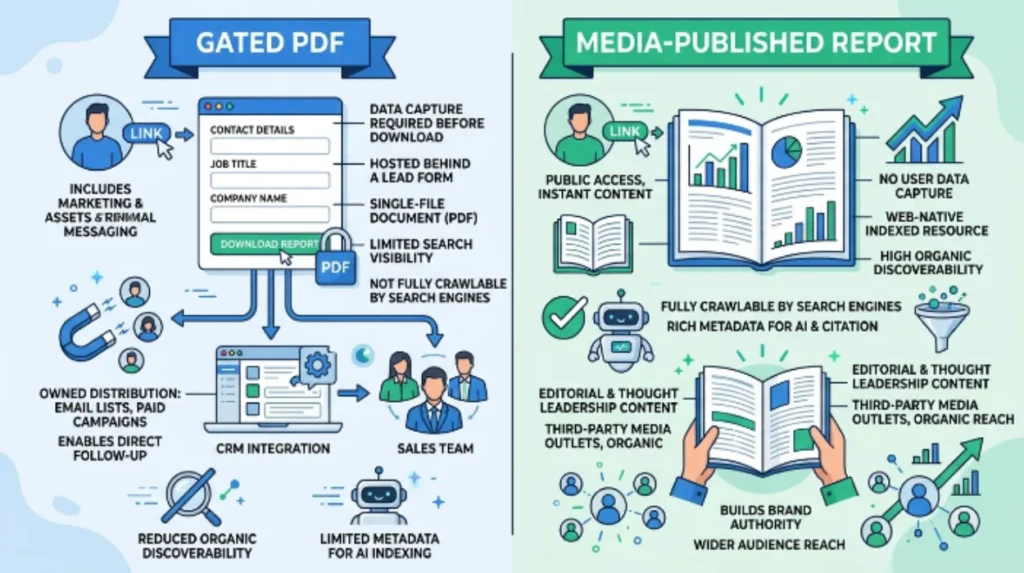
Gated PDFs handle access through forms that request contact details, job title, and company name. The file format is self-contained and not fully crawlable by search engines. Gated PDFs often include marketing assets such as brand logos and promotional messaging. Distribution depends on owned channels such as email lists and paid campaigns. Lead capture enables direct follow-up and CRM integration. The trade-off is reduced organic discoverability and limited metadata for AI indexing and citation.
Why do media-published reports generate higher organic visibility?
Open publication allows search engines to crawl full text, index headings and metadata, and serve report pages for relevant queries, increasing discovery without form friction.
Search engines index HTML content and structured metadata such as schema.org tags. Web-native reports expose headings, tables, and figure captions for indexing. Publishers can implement persistent URLs and canonical tags for stable access. Open pages attract backlinks from industry sites, trade associations, and academic blogs. Backlinks and indexed content increase domain signals and search rankings. Media houses benefit from social sharing and referral traffic that further amplifies visibility.
How do media-published reports improve lead quality compared with gated PDFs?
Open reports attract engaged audiences through contextual search and publisher trust, producing leads with clearer intent signals from page behavior and secondary interactions.
Readers who arrive via topical search queries demonstrate intent through search terms and session patterns. Publishers observe engagement metrics such as time on page, scroll depth, and article shares. These behavioral signals identify prospects with higher topical interest. Secondary interactions include newsletter sign-ups, webinar registrations, and comment participation, which provide voluntary contact moments. These signals integrate with audience segmentation systems to prioritize outreach based on demonstrated interest rather than form submission alone.
What measurement methods validate media-published report performance?
Performance validation uses organic traffic metrics, referral sources, engagement signals, backlink counts, citation instances, and assisted conversion paths in analytics platforms.
Organic traffic metrics show search-driven visits and keyword rankings. Referral source reports identify syndication and social amplification. Engagement signals include average session duration and scroll depth for the report page. Backlink counts measure external references from industry sites and blogs. Citation instances appear in white papers, procurement documents, and media mentions. Assisted conversion paths track how open-report visits contribute to later gated-content downloads or sales inquiries across sessions. These metrics together create a citation-friendly evidence base.
What audience segments respond best to media-published reports?
Decision-making audiences such as procurement managers, category leads, and policy analysts respond strongly when reports provide clear metrics, named data sources, and executive summaries.
Procurement managers use market size and supplier landscape metrics to set tender criteria. Category leads use trend data and buyer preference shares to define specifications. Policy analysts use regulatory impact sections and cited public datasets for briefings. Media-published reports serve all segments because they provide immediate access to evidence that supports research, procurement, and internal briefing processes. Named sources such as ONS publications increase trust among public-sector audiences.
How do media-published reports support mid-funnel engagement strategies?
Open reports support mid-funnel strategies by enabling content-to-action pathways such as embedded CTAs, gated follow-up assets, and invitation-only events without initial form friction.
Report pages can host contextual CTAs for deeper content such as dataset downloads, webinar registrations, or analyst Q&A sessions. Publishers place optional forms for dataset access rather than mandatory gating, reducing entry barriers. Follow-up assets remain available behind optional capture moments for users who progress farther in interest. Invitation-only events target engaged readers identified via behavior. This structure preserves discoverability while creating conversion paths tailored to engagement levels.
What are the practical production differences between media-published reports and gated PDFs?
Production differences include format preparation, metadata requirements, editorial processes, and distribution workflows tailored to web publishing versus single-file export.
Media-published reports require HTML preparation, responsive design for figures, structured metadata, and schema markup. Editorial processes emphasize headlines, subheadings, and inline citations for readability and indexability. Distribution workflows include RSS feeds, social cards, and syndication partnerships. Gated PDFs focus on single-file layout, print-ready visuals, and file hosting systems with access control. Production timelines for web-native reports allocate time for metadata and publisher review, while PDFs concentrate on visual design and brand placement.
Explore More Expert Insights:
The 8-Step Research Report Production Process for UK B2B Brands
How to Repurpose One Research Report Into 14 Separate UK Content Assets
When should organisations choose media publication over gating?
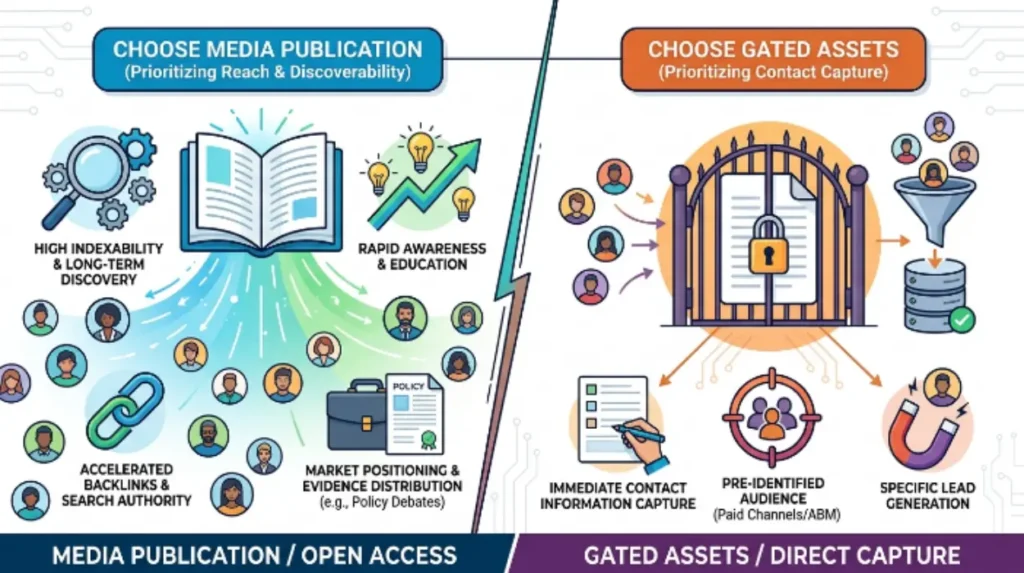
Organisations choose media publication when the priority is reach, indexability, and long-term discovery rather than immediate contact capture.
Open publication suits stages where audience education, market positioning, and citation visibility matter most. Media publication accelerates backlinks and search authority, which supports sustained lead flow over time. Organisations that need rapid evidence distribution for policy or procurement debates benefit from open access. Gated assets remain useful when direct lead capture is the primary goal and the audience is already known through paid channels or account-based outreach.
How do media-published reports interact with gated content in a layered strategy?
A layered strategy publishes the full report openly while offering deeper dataset exports, tailored briefings, or analyst sessions behind optional gates to capture high-intent contacts.
The open report functions as the discovery layer. Optional gated items include raw datasets in CSV, bespoke executive briefings, and private briefings with analysts. Analytics identify engaged users who access optional items for targeted outreach. This approach preserves SEO value and citation benefits while enabling structured lead capture for high-value prospects. The layered model produces a measurable funnel where open-page engagement precedes conversion events.
Discover the Full Information:
Industry Reports Are the Second-Most Trusted Content Format in UK B2B Buying
Media-published reports deliver stronger organic visibility, clearer citation metadata, and improved mid-funnel engagement compared with gated PDFs when the objective is awareness, trust-building, and audience qualification. Open, web-native reports provide indexable content, named data sources, and measurable behavioral signals that support layered conversion strategies. Organisations that balance open publication with optional gated follow-ups gain both discovery and lead capture capabilities in the UK B2B market.
Learn Everything About It Here:
Research Report Packages for UK Brands: Timelines, Inclusions and Investment Ranges



