
Businesses across the United Kingdom use research reports to support marketing, public relations, investment decisions, and thought leadership. Research quality directly affects credibility, media coverage, and audience trust. Many organisations compare full-service research reports with a do-it-yourself (DIY) approach before investing time and budget.
This comparison explains the differences in cost, quality, speed, accuracy, and business outcomes. It also helps UK teams identify the most effective option for their objectives.
What is the difference between a full-service research report and a DIY research report?
A full-service research report combines professional research, survey design, analysis, writing, and publication support into one managed process. A DIY research report relies on an internal team to complete every stage independently using available resources, software, and internal expertise.
A research report is a structured document that presents verified findings, analysis, and conclusions based on collected data.
A full-service research report includes professional planning, participant recruitment, statistical analysis, editorial review, graphic design, and publication preparation.
A DIY research report assigns every responsibility to an internal team. Staff manage research planning, collect responses, analyse results, write findings, and prepare the final document.
The choice depends on available expertise, available time, reporting standards, and business objectives.
Why do UK organisations compare these two research approaches?
UK organisations compare full-service and DIY research because cost, data quality, publication credibility, and delivery speed directly influence commercial results. The correct approach improves decision-making, strengthens authority, supports media outreach, and increases confidence among customers, investors, journalists, and stakeholders.
Research reports support several business activities.
Examples include:
- Industry benchmarking
- Market trend analysis
- Customer insight reports
- Annual business reports
- Investment reports
- Thought leadership publications
Many businesses begin with internal research before considering professional services. Organisations exploring evidence-based authority building can also review:
What does a full-service research report include?
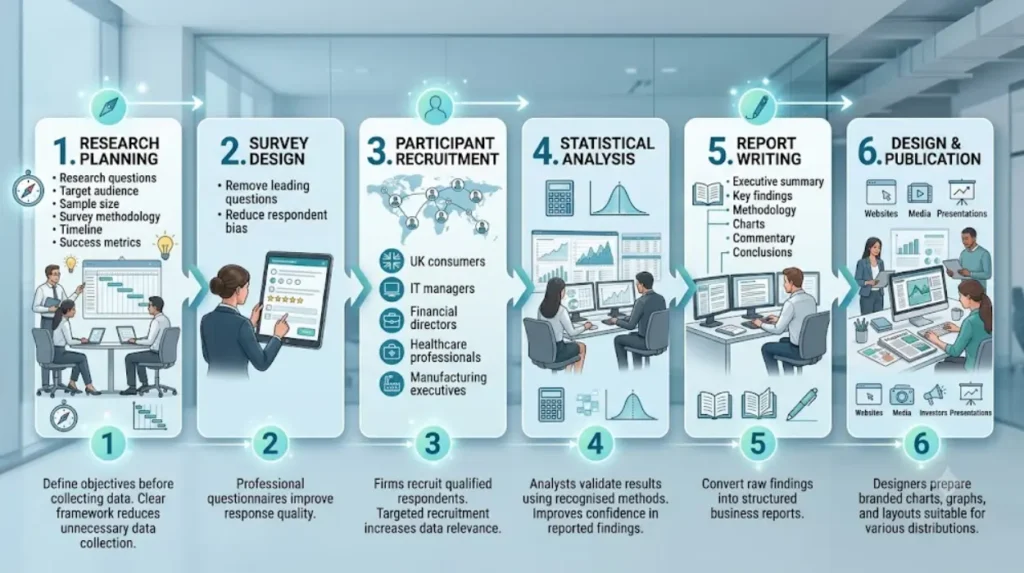
A full-service research report covers every stage from planning to publication. Professional researchers manage methodology, collect reliable data, analyse findings, write the report, create visuals, and prepare publication-ready documents suitable for business and media distribution.
Research planning
Researchers define objectives before collecting data.
This stage includes:
- Research questions
- Target audience
- Sample size
- Survey methodology
- Timeline
- Success metrics
A clear research framework reduces unnecessary data collection.
Survey design
Professional questionnaires improve response quality.
They remove leading questions and reduce respondent bias.
Participant recruitment
Research firms recruit qualified respondents.
Examples include:
- UK consumers
- IT managers
- Financial directors
- Healthcare professionals
- Manufacturing executives
Targeted recruitment increases data relevance.
Statistical analysis
Professional analysts validate results using recognised statistical methods.
This improves confidence in reported findings.
Report writing
Editors convert raw findings into structured business reports.
Reports include:
- Executive summary
- Key findings
- Methodology
- Charts
- Commentary
- Conclusions
Design and publication
Designers prepare branded charts, graphs, and layouts suitable for websites, media, investors, and presentations.
What does a DIY research project involve?
DIY research requires internal staff to manage planning, surveys, data collection, analysis, report writing, editing, and publishing without external research specialists. The organisation controls every activity while accepting greater responsibility for quality and project management.
Internal teams typically use online survey platforms.
Common responsibilities include:
- Questionnaire creation
- Survey distribution
- Data cleaning
- Spreadsheet analysis
- Writing conclusions
- Creating charts
- Final editing
DIY projects reduce supplier costs but increase staff workload.
Internal capability determines the final quality.
How do costs compare between full-service and DIY research?
DIY research reduces direct supplier expenses but increases internal labour costs. Full-service research has higher upfront pricing while reducing project management time, improving research quality, and delivering publication-ready reports without additional internal production work.
Cost comparisons include more than supplier invoices.
Businesses also evaluate:
- Staff salaries
- Project management hours
- Software licences
- Survey platform subscriptions
- Data analysis tools
- Graphic design
- Editorial review
For example, a marketing manager spending 80 hours on research creates an internal labour cost alongside software expenses.
A professional research provider delivers those activities through a dedicated project team.
Total project cost includes both direct and indirect expenditure.
How does report quality differ?

Professional research delivers stronger methodology, cleaner datasets, clearer analysis, and higher editorial standards. DIY research quality depends entirely on internal expertise, available resources, and the team’s experience with research design and statistical reporting.
Quality begins with methodology.
Professional researchers follow structured research processes.
These include:
- Representative sampling
- Response validation
- Bias reduction
- Statistical testing
- Editorial review
DIY projects often face challenges.
Examples include:
- Small sample sizes
- Inconsistent survey wording
- Missing demographic balance
- Weak statistical interpretation
Professional editing also improves readability.
Business audiences prefer concise findings supported by verified evidence.
Which option delivers faster results?
Full-service research follows dedicated production schedules managed by specialist teams. DIY research competes with existing internal responsibilities, extending delivery timelines when employees balance research alongside operational work and client commitments.
Professional providers assign separate specialists to each stage.
This parallel workflow improves efficiency.
For example:
- Researchers collect responses.
- Analysts process data.
- Writers prepare content.
- Designers create graphics.
Internal teams usually complete these stages sequentially.
Business priorities often delay research projects.
Faster delivery supports product launches, annual reports, investor announcements, and media campaigns.
Which approach creates greater credibility?
Independent research reports strengthen external credibility because structured methodologies, verified data, and professional reporting increase confidence among journalists, investors, decision-makers, and industry audiences seeking reliable evidence before making business decisions or citing published research.
Credibility depends on transparency.
Professional reports document:
- Sample size
- Data collection period
- Research methodology
- Statistical process
- Participant profile
These details support verification.
Journalists frequently reference reports that explain methodology clearly.
Businesses publishing independent industry research also strengthen thought leadership.
For background on trusted industry evidence, review:
The UK Digital Economy Grew 13.7% in Real Terms.
When is DIY research the right choice?
DIY research fits projects with limited budgets, internal research expertise, smaller audiences, and operational reporting requirements where external publication, media visibility, and large-scale statistical confidence are not primary objectives for the organisation.
Suitable situations include:
- Internal employee surveys
- Customer satisfaction tracking
- Department performance reviews
- Training feedback
- Small operational studies
These projects often involve known audiences.
Internal teams already have access to participants.
The reporting audience remains inside the organisation.
When is a full-service research report the better investment?
Full-service research delivers stronger commercial value when organisations publish industry reports, support public relations campaigns, attract media coverage, engage investors, generate leads, or establish recognised authority within competitive UK markets through verified research.
Professional research supports high-impact objectives.
Examples include:
- Industry trend reports
- National market surveys
- Annual benchmark reports
- Investor publications
- White papers
- Executive research reports
Businesses publishing original research often create assets that remain valuable throughout the year.
These reports support marketing, sales, public relations, and search visibility simultaneously.
Professional research also reduces project risk by applying experienced quality controls.
How can UK teams choose the right research partner?
The strongest research partner demonstrates proven methodology, transparent pricing, experienced analysts, editorial quality, clear project management, and successful delivery of publication-ready reports aligned with measurable commercial objectives across United Kingdom industries.
Evaluation criteria include:
- Research methodology
- UK respondent recruitment capability
- Statistical expertise
- Editorial standards
- Report design quality
- Delivery timelines
- Project communication
- Pricing transparency
- Case studies
- Data validation processes
Decision-makers also review previous reports before awarding projects.
Published examples demonstrate consistency and reporting quality.
A provider offering end-to-end research, professional writing, and publication support reduces coordination across multiple suppliers.
Explore More Expert Insights:
Why B2B Brands That Publish Annual UK Reports See 28% Higher Renewal Rates
Research Report Packages for UK Brands: Timelines, Inclusions and Investment Ranges
Choosing between full-service research reports and DIY research depends on business objectives, available expertise, internal capacity, and expected outcomes.
DIY research works well for internal reporting and smaller operational projects where speed, simplicity, and budget control take priority.
Full-service research provides stronger methodology, higher editorial standards, greater credibility, and publication-ready outputs for organisations seeking industry authority, media coverage, investor confidence, or long-term commercial value.
For UK businesses investing in thought leadership and market visibility, professionally managed research reports provide a structured, evidence-based asset that supports decision-making and strengthens competitive positioning.