
The UK digital economy has become one of the country’s fastest-growing sectors. Official figures showing that the UK digital economy grew 13.7% in real terms attracted attention from policymakers, journalists, businesses, investors, and researchers. Growth statistics alone, however, rarely become widely known without organisations collecting, analysing, publishing, and explaining the evidence.
Understanding who publishes these stories helps readers evaluate information quality, identify trusted sources, and recognise how research shapes public discussion. It also explains why evidence-based reporting receives greater attention than unsupported claims.
What does it mean that the UK digital economy grew 13.7% in real terms?
The statement means digital industries produced 13.7% more economic value after adjusting for inflation. Real-term growth removes price changes and measures genuine increases in output, productivity, and economic activity across digital sectors within the United Kingdom during the measured period.
Real-term growth measures economic expansion after inflation adjustments. This provides a clearer picture of actual production rather than changes caused by rising prices.
The digital economy includes businesses whose products or services depend primarily on digital technology.
Examples include:
- Software development
- Cybersecurity services
- Cloud computing
- Artificial intelligence
- Digital advertising
- Online retail platforms
- Financial technology
- Data analytics
Government statistical agencies calculate growth using nationally recognised accounting methods. These methods compare production across different years while controlling for inflation.
The figure demonstrates that digital industries expanded faster than many traditional sectors over the measured period.
Who publishes statistics about the UK digital economy?
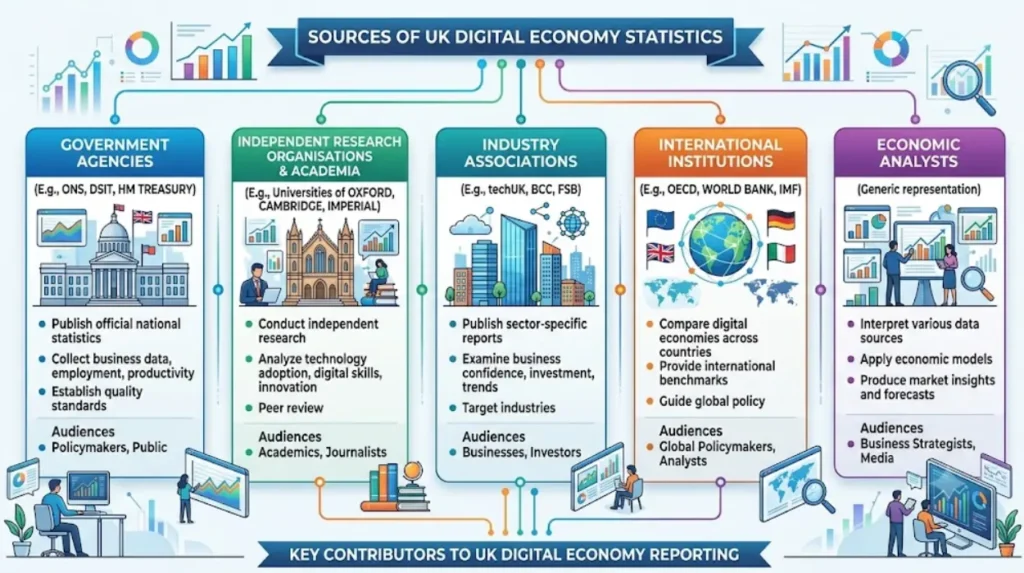
Government agencies, independent research organisations, universities, industry associations, international institutions, and economic analysts publish digital economy statistics. Each organisation collects different datasets, applies defined research methods, and serves distinct audiences including policymakers, businesses, academics, journalists, and the public.
Several organisations contribute to digital economy reporting.
Government statistical agencies
Government agencies publish official national statistics.
Examples include:
- Office for National Statistics (ONS)
- Department for Science, Innovation and Technology
- HM Treasury
These organisations collect business data, employment figures, productivity measurements, and national accounts.
Official statistics follow established quality assurance standards.
Universities
Universities conduct independent research.
Examples include:
- University of Oxford
- University of Cambridge
- Imperial College London
Academic researchers analyse technology adoption, digital skills, innovation, and economic performance.
Peer review strengthens research credibility.
Industry associations
Industry bodies publish sector-specific reports.
Examples include:
- techUK
- British Chambers of Commerce
- Federation of Small Businesses
These reports often examine business confidence, investment, workforce trends, and sector performance.
International organisations
Global institutions compare digital economies across countries.
Examples include:
- OECD
- World Bank
- International Monetary Fund
International comparisons help policymakers benchmark national performance.
How are digital economy growth figures calculated?
Researchers combine national accounts, business surveys, employment records, productivity measurements, and industry classifications. Statistical methods convert raw economic information into consistent indicators that measure digital sector performance over time using internationally recognised accounting standards and inflation adjustments.
Economic measurement follows structured processes.
National accounts
National accounts measure total economic output.
Researchers identify digital industries using standard industrial classifications.
Each industry’s contribution is calculated separately.
Business surveys
Businesses provide operational information.
Examples include:
- Revenue
- Employment
- Investment
- Production
- Technology adoption
Large datasets improve statistical reliability.
Inflation adjustment
Real-term growth removes inflation.
This adjustment allows direct comparisons across multiple years.
Without inflation adjustment, economic growth figures become less meaningful.
Data validation
Researchers compare multiple data sources.
Validation identifies inconsistencies before publication.
Independent review improves statistical accuracy.
Why do journalists report digital economy research?
Journalists publish digital economy research because verified statistics explain economic change, support evidence-based reporting, inform policy discussions, and help readers understand technology trends. Reliable research strengthens news accuracy through measurable facts rather than unsupported claims or speculation.
Economic reporting depends heavily on credible evidence.
Research provides factual context for news stories.
Examples include:
- Employment growth
- Technology investment
- Business formation
- Productivity improvement
- Export performance
Journalists frequently combine official statistics with expert interviews.
This creates balanced reporting supported by evidence.
Research also helps explain long-term trends rather than isolated events.
What makes one research report more trustworthy than another?
Trustworthy research uses transparent methods, reliable data sources, clear definitions, documented calculations, independent verification, and consistent reporting standards. Readers evaluate credibility by examining methodology, publication date, sample size, author expertise, and supporting evidence throughout the report.
Readers benefit from evaluating research quality before accepting conclusions.
Transparent methodology
Reliable reports explain how information was collected.
Methodology includes:
- Sample selection
- Survey design
- Statistical analysis
- Data processing
Transparency enables independent assessment.
Clearly defined terms
Reliable reports define important concepts.
Examples include:
- Digital economy
- Real-term growth
- Gross value added
- Productivity
Definitions prevent misunderstanding.
Verifiable sources
Good reports reference original datasets.
Examples include government statistics, financial records, and recognised surveys.
Readers can confirm published findings independently.
Consistent publication
Organisations publishing regular reports create comparable historical datasets.
Trend analysis becomes easier across multiple years.
How does published research influence public discussion?

Published research shapes public discussion by providing measurable evidence for policy debates, investment decisions, media reporting, academic studies, and business planning. Well-documented statistics create shared reference points that improve factual consistency across different audiences and sectors.
Evidence influences many decisions.
Government departments analyse research before developing policies.
Businesses examine market trends before investing.
Investors evaluate industry performance.
Universities identify new research topics.
Media organisations explain economic developments using published statistics.
Shared datasets improve consistency across discussions.
Different organisations interpret findings differently, but the underlying evidence remains consistent.
Why do organisations publish original research instead of only reporting existing statistics?
Original research answers specific questions that existing datasets do not address. Organisations investigate customer behaviour, market trends, technology adoption, industry challenges, workforce development, and regional performance through structured surveys, interviews, and independent data analysis.
Official statistics answer broad economic questions.
Many organisations require more specialised information.
Examples include:
- Customer purchasing behaviour
- Artificial intelligence adoption
- Regional technology investment
- Skills shortages
- Supply chain challenges
Original research fills these information gaps.
Researchers design surveys for clearly defined objectives.
They collect primary data directly from participants.
This creates new evidence rather than summarising existing publications.
Readers interested in this topic can continue with:
Third-Party Research Authority to understand how independently published research strengthens credibility within competitive industries.
How can readers interpret digital economy statistics correctly?
Readers interpret digital economy statistics by identifying original sources, understanding measurement methods, comparing multiple reports, checking publication dates, recognising definitions, and separating factual findings from interpretation. Context improves accurate understanding of every published economic statistic and trend.
Statistics become more meaningful when interpreted carefully.
Several practical steps improve understanding.
- Identify the original publisher.
- Read the methodology summary.
- Check the reporting period.
- Compare multiple trusted sources.
- Understand whether figures represent nominal or real growth.
- Examine industry definitions.
- Review historical trends.
Single statistics rarely explain an entire economy.
Multiple indicators create a fuller picture.
For example, employment growth, productivity, exports, investment, and business creation together provide stronger evidence than one measurement alone.
Readers seeking deeper understanding of professional research production and publication processes can explore:
Full-Service Research Reports vs DIY for additional educational context about different research approaches.
What is the broader significance of publishing digital economy research?
Publishing digital economy research improves public knowledge, supports evidence-based policymaking, strengthens academic understanding, informs investment decisions, and documents technological change through measurable data. High-quality research creates reliable historical records that support long-term economic analysis and informed public debate.
Economic research serves many audiences simultaneously.
Governments evaluate national performance.
Businesses identify market opportunities.
Researchers expand academic knowledge.
Journalists explain complex developments.
Investors assess industry direction.
Educational institutions analyse workforce needs.
Together, these activities create a stronger understanding of how digital industries evolve over time.
The reported 13.7% real-term growth illustrates more than economic expansion. It demonstrates the importance of systematic data collection, transparent statistical methods, and credible publication practices. Without organisations producing reliable research, significant economic developments would remain difficult to measure, compare, and communicate accurately.
Explore More Expert Insights:
How Thought Leadership Built on Research Generates Leads Whilst You Sleep
Industry Reports Are the Second-Most Trusted Content Format in UK B2B Buying
Publishing trusted research transforms raw data into accessible knowledge. That process enables informed discussion, supports better decision-making, and provides an evidence-based record of how the UK’s digital economy continues to develop.