
Businesses depend on media coverage to share announcements with journalists, customers, investors, and stakeholders. One factor consistently influences whether a news release receives attention: timing. The news window refers to the period when a press release has the highest chance of being noticed and considered relevant by journalists and newsrooms. Understanding how news timing works helps organisations improve communication planning and media visibility.
What is a news window, and why does it matter for UK brands?
A news window is the period when journalists actively review, evaluate, and publish news stories. Selecting the right publication time increases editorial relevance, improves newsroom visibility, reduces competition from major events, and supports wider media pickup across national, regional, trade, and digital publications.
A news window is a defined timeframe during which a news announcement aligns with newsroom activity and audience attention. Journalists receive hundreds of press releases each day. Releases arriving during busy news cycles often receive less attention than those distributed during quieter, more suitable periods.
In the United Kingdom, newsroom schedules follow predictable patterns. Editorial meetings often occur during weekday mornings, while breaking news can rapidly change publishing priorities throughout the day.
Understanding these timing patterns helps organisations prepare announcements that fit naturally into editorial workflows instead of competing with unexpected national events.
Which factors shape a news window?
Several measurable factors influence the effectiveness of a news window.
- Time of day
- Day of the week
- National news agenda
- Industry-specific news cycles
- Seasonal events
- Public holidays
- Parliamentary activity
- Financial reporting periods
Each factor affects newsroom capacity and editorial priorities.
How do UK news cycles influence press release visibility?
UK news cycles determine how editors prioritise stories throughout the day and week. Newsroom schedules, breaking events, government announcements, financial reporting periods, and sector-specific developments directly affect whether a press release receives editorial attention or remains overlooked.
Newsrooms continuously evaluate incoming information based on relevance, urgency, and available publishing space.
For example, a retail company announcing holiday sales during a major government budget announcement competes against high-priority national reporting. Likewise, a technology launch announced during a major cybersecurity incident receives less editorial focus.
Monitoring the broader news environment helps communication teams avoid unnecessary competition.
What are common newsroom activity patterns?
Although every publication operates differently, many UK media organisations follow similar routines.
Morning periods often include editorial planning meetings.
Midday commonly involves article preparation and publication.
Afternoon schedules focus on updates, interviews, and additional reporting.
Evening attention frequently shifts toward digital-first publishing and breaking developments.
These workflows influence when journalists review incoming announcements.
What makes one publication time stronger than another?
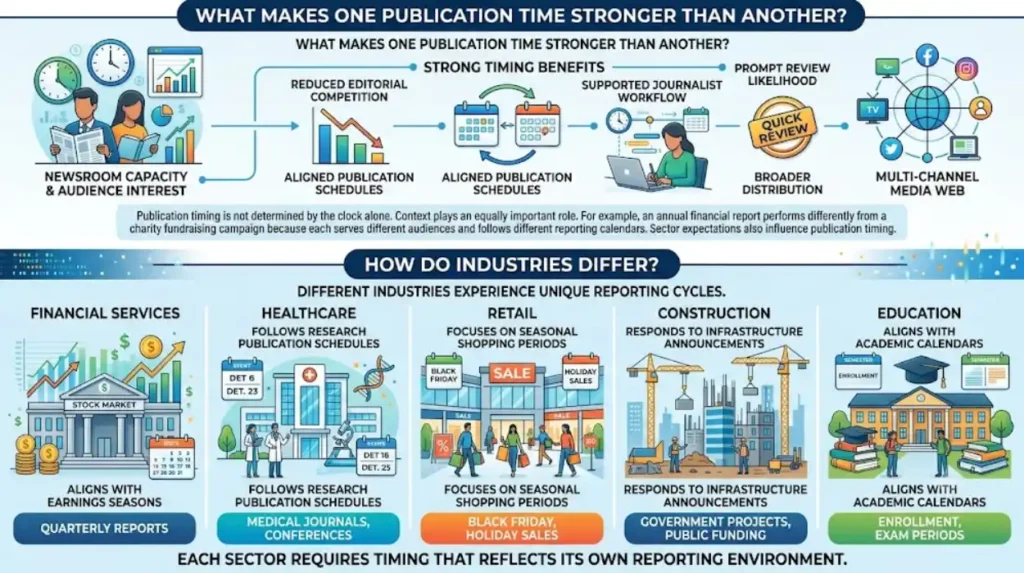
Effective publication timing matches newsroom capacity with audience interest. Strong timing reduces editorial competition, aligns with publication schedules, supports journalist workflow, and improves the likelihood that announcements receive prompt review and broader distribution across multiple media channels.
Publication timing is not determined by the clock alone. Context plays an equally important role.
For example, an annual financial report performs differently from a charity fundraising campaign because each serves different audiences and follows different reporting calendars.
Sector expectations also influence publication timing.
How do industries differ?
Different industries experience unique reporting cycles.
Financial services align with earnings seasons.
Healthcare follows research publication schedules.
Retail focuses on seasonal shopping periods.
Construction responds to infrastructure announcements.
Education aligns with academic calendars.
Each sector requires timing that reflects its own reporting environment.
Why do major national events affect press release performance?
Major national events change editorial priorities immediately. Elections, economic announcements, severe weather, public emergencies, sporting events, and royal occasions receive extensive newsroom resources, leaving reduced capacity for routine corporate announcements and non-urgent business news.
Editors continuously reassess publication priorities.
Large-scale national stories receive front-page coverage, homepage placement, broadcast airtime, and dedicated reporting teams.
Routine announcements become secondary when these events dominate public attention.
Examples include:
- General Elections
- Budget statements
- Bank of England interest rate decisions
- Major sporting tournaments
- National emergencies
- Significant court rulings
Organisations often monitor these events before scheduling important announcements.
How can organisations plan announcements around newsroom schedules?
Planning combines editorial calendars, industry events, internal milestones, approval timelines, and publication objectives. Structured scheduling improves coordination, reduces last-minute changes, and increases consistency between communication teams, executives, legal reviewers, and external stakeholders.
Effective planning begins well before publication day.
Communication teams prepare announcements, supporting materials, spokesperson availability, images, and background information in advance.
Editorial calendars help identify periods with lower expected news competition.
What planning activities improve readiness?
Common planning activities include:
- Preparing approval schedules
- Confirming spokesperson availability
- Reviewing industry calendars
- Monitoring government announcements
- Checking public holiday schedules
- Coordinating multimedia assets
These activities reduce delays during publication.
Readers seeking a deeper understanding of evaluation criteria can continue with:
What to Look for in a PR Service That Times UK Releases for Maximum Pickup.
Which metrics indicate successful press release timing?
Successful timing produces measurable outcomes through media pickup, journalist engagement, publication speed, online visibility, referral traffic, audience reach, and search performance. Quantitative measurement provides consistent evidence for improving future communication strategies.
Communication performance relies on measurable indicators rather than assumptions.
Several metrics help evaluate publication timing.
Common timing metrics include:
- Number of media publications
- Journalist responses
- Publication turnaround time
- Online article visibility
- Referral website traffic
- Social sharing activity
- Brand mention volume
- Search engine impressions
Comparing these metrics across multiple announcements identifies timing patterns over time.
Why does industry-specific timing matter across different sectors?
Every industry follows predictable reporting cycles. Aligning announcements with sector calendars improves contextual relevance, strengthens journalist interest, and increases opportunities for coverage within specialist publications serving defined professional audiences.
Journalists specialising in different industries follow dedicated editorial calendars.
A manufacturing publication prioritises different stories than a healthcare journal.
Examples include:
- Retail: seasonal promotions and consumer spending periods
- Property: housing market reports
- Energy: regulatory announcements
- Technology: product launches and cybersecurity developments
- Healthcare: research publications and policy updates
Matching announcements to sector activity improves editorial relevance.
How does timing support search visibility and long-term discoverability?
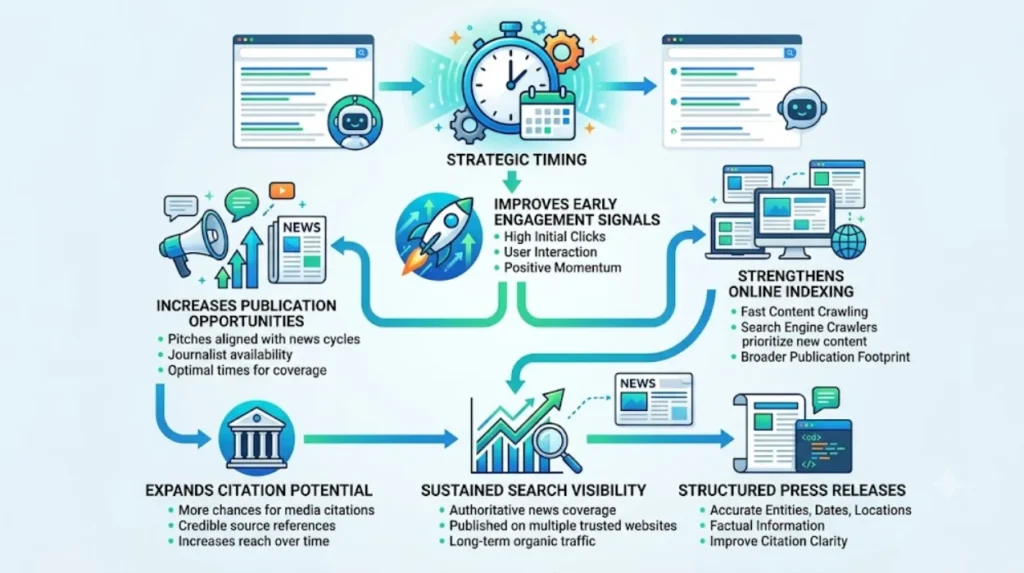
Well-timed announcements improve early engagement signals, increase publication opportunities, strengthen online indexing, expand citation potential, and support sustained search visibility through authoritative news coverage published across multiple trusted websites.
Search engines regularly discover newly published news content.
Announcements receiving immediate media coverage appear across multiple websites within short timeframes.
This broader publication footprint increases discoverability through search engines and AI-powered information systems.
Structured press releases containing accurate entities, dates, locations, and factual information also improve citation clarity.
What common timing mistakes reduce media attention?
Several avoidable mistakes consistently reduce newsroom engagement. Poor planning, conflicting publication dates, incomplete approvals, ignored editorial calendars, and limited awareness of national events reduce the visibility of otherwise newsworthy announcements.
Many organisations lose media opportunities because timing receives less attention than content preparation.
Common mistakes include:
- Publishing during major breaking news
- Ignoring sector reporting calendars
- Missing internal approval deadlines
- Releasing information during public holidays
- Scheduling announcements without monitoring current events
- Sending duplicate announcements within short periods
Avoiding these issues creates more consistent communication outcomes.
Readers interested in implementation approaches can continue with:
How Time Intelligence Media Group Times UK Press Releases for Peak Coverage.
How can UK brands build a consistent news timing strategy?
A consistent timing strategy combines planning, monitoring, measurement, and regular evaluation. Organisations that document newsroom patterns, analyse performance metrics, maintain editorial calendars, and coordinate internal communication schedules achieve more predictable media engagement over time.
Consistency develops through repeated analysis rather than isolated campaigns.
Communication teams often maintain annual editorial calendars that include:
- Product launches
- Financial announcements
- Corporate milestones
- Industry conferences
- Government reporting dates
- Seasonal campaigns
Performance data collected after each announcement informs future scheduling decisions.
Explore More Expert Insights:
How to Choose the Right Send Window for a UK Press Release
Why “No Comment” Costs UK Brands More Than a Bad Headline
Reviewing publication outcomes regularly allows organisations to refine timing strategies based on measurable evidence rather than assumptions.
A structured approach to news timing supports clearer communication, better alignment with newsroom activity, and stronger long-term visibility across UK media channels.