
Businesses gain stronger media visibility when press releases reach journalists during active editorial windows. Time Intelligence Media Group combines news monitoring, editorial planning, sector analysis, and distribution scheduling to release announcements at the highest-value moments across the United Kingdom for maximum coverage potential.
Timing influences whether a press release receives immediate attention or becomes lost among competing announcements. Time Intelligence Media Group uses a structured release process that aligns announcements with newsroom activity, industry events, and publication schedules across national, regional, and trade media.
Why does press release timing affect UK media coverage?
Press release timing determines when journalists receive information during their editorial workflow. Releases delivered during active news planning periods receive faster review, greater newsroom visibility, and increased opportunities for publication across national, regional, and specialist UK media outlets within competitive news cycles.
Editors receive hundreds of pitches every day. Timing determines whether an announcement appears during editorial planning or after publication decisions have already been made.
UK media organisations follow structured production schedules. Morning planning meetings, afternoon publishing deadlines, and weekly editorial calendars influence when journalists review incoming stories.
For example:
- National business publications review corporate news early in the morning.
- Regional newspapers often plan coverage one day before publication.
- Trade publications organise content around sector-specific publishing schedules.
Time Intelligence Media Group aligns releases with these editorial patterns.
How does Time Intelligence Media Group determine the best release window?

Time Intelligence Media Group analyses editorial calendars, industry activity, competing announcements, public holidays, breaking news trends, and journalist behaviour before selecting an optimal release window that maximises newsroom visibility and improves opportunities for editorial consideration across the United Kingdom.
The timing process follows a defined workflow rather than relying on fixed publishing times.
News environment analysis
The team reviews current news volume before scheduling distribution.
This includes:
- Major political announcements
- Government policy updates
- Economic reports
- Corporate earnings
- National events
- Industry conferences
A quieter news cycle creates stronger visibility for business announcements.
Editorial calendar review
Many publications organise coverage weeks in advance.
Editorial calendars identify planned features covering industries such as:
- Technology
- Finance
- Healthcare
- Manufacturing
- Construction
- Retail
Releases are aligned with relevant editorial themes.
Audience activity evaluation
Different audiences consume business news at different times.
Examples include:
- Financial professionals during market hours.
- Manufacturing decision-makers during working mornings.
- Retail audiences around seasonal campaigns.
Matching publication timing with audience behaviour increases exposure.
What factors influence release scheduling?
Effective scheduling combines newsroom availability, sector priorities, publication deadlines, geographic relevance, seasonal events, and competitor activity into one coordinated release strategy that supports stronger editorial engagement throughout UK media distribution campaigns and industry-specific communications.
Multiple variables affect timing decisions.
Industry-specific news cycles
Every sector follows different reporting patterns.
Examples include:
- Fintech announcements around investment activity.
- Property developments before planning milestones.
- Healthcare updates around awareness campaigns.
- Education news before academic terms.
Industry timing improves relevance.
Competing announcements
Large national stories reduce attention for business releases.
Examples include:
- Government budgets
- General elections
- Major sporting events
- Royal announcements
- National emergencies
Time Intelligence Media Group avoids unnecessary competition whenever practical.
Regional relevance
Regional publications prioritise local business stories.
Announcements aimed at Manchester, Birmingham, Bristol, Glasgow, or Cardiff receive scheduling that supports local newsroom workflows.
How does Time Intelligence Media Group prepare a release before distribution?
Preparation includes editorial review, factual verification, formatting, headline optimisation, multimedia validation, distribution planning, and final scheduling before release. Every stage supports efficient newsroom processing and accurate publication across multiple media channels within the United Kingdom.
Preparation improves publishing efficiency.
Editorial quality assurance
Editors verify:
- Headlines
- Facts
- Statistics
- Company names
- Executive quotations
- Contact information
Accurate releases reduce newsroom corrections.
Distribution planning
Media lists are organised according to:
- National publications
- Regional newspapers
- Trade magazines
- Online news platforms
- Industry journalists
Targeted distribution improves relevance.
Timing confirmation
The release schedule undergoes a final review before publication.
This review confirms:
- Date
- Time
- Embargo requirements
- Supporting assets
- Distribution sequence
How does Time Intelligence Media Group distribute releases across UK media?
Distribution combines targeted journalist outreach, media database segmentation, scheduled delivery systems, and publication monitoring. Every release reaches relevant national, regional, and sector-specific contacts according to planned editorial timing and newsroom requirements throughout the United Kingdom.
Distribution extends beyond sending one email.
National media distribution
Major UK publications receive releases relevant to national audiences.
Examples include business, finance, technology, and corporate news outlets.
Regional media targeting
Regional newspapers prioritise stories affecting local communities.
Location-specific announcements reach relevant regional journalists.
Trade publication outreach
Industry publications focus on specialist audiences.
Examples include:
- Fintech media
- Construction publications
- Healthcare journals
- Manufacturing magazines
- Logistics publications
Sector relevance increases editorial interest.
For businesses evaluating providers before selecting a distribution partner, see:
What to Look for in a PR Service That Times UK Releases for Maximum Pickup.
How does timing improve media pickup?
Strategic timing increases newsroom visibility by delivering announcements before editorial decisions, reducing competition from major news events, matching publication schedules, and improving opportunities for journalists to review, verify, and publish relevant business stories promptly across UK media channels.
Journalists work under strict deadlines.
Receiving information at the correct time simplifies editorial planning.
Benefits include:
- Faster editorial review
- Higher newsroom visibility
- Greater publication opportunities
- Improved regional coverage
- Better trade media engagement
These outcomes result from structured scheduling rather than random distribution.
Which organisations benefit from professionally timed press releases?
Businesses, charities, public organisations, technology companies, financial firms, manufacturers, healthcare providers, educational institutions, and property developers gain stronger media opportunities when announcements align with appropriate editorial windows and relevant sector-specific publication schedules throughout the United Kingdom.
Professional timing benefits many sectors.
Examples include:
Financial services
Investment announcements perform better when released outside major economic reporting periods.
Technology companies
Product launches benefit from avoiding crowded technology news cycles.
Construction businesses
Project announcements align with planning approvals and regional development news.
Healthcare organisations
Campaign launches receive stronger visibility when coordinated with recognised health awareness periods.
Charities
Fundraising initiatives gain attention outside major competing charitable campaigns.
How does Time Intelligence Media Group measure release performance?
Performance measurement combines publication tracking, media coverage analysis, journalist engagement, online visibility, and reporting metrics to evaluate how timing influenced distribution outcomes and future campaign planning across United Kingdom media environments with measurable evidence.
Performance reporting supports future planning.
Typical reporting includes:
- Publication count
- Media placements
- Regional coverage
- Trade publication coverage
- Online visibility
- Distribution timeline
- Pickup speed
These metrics identify successful release windows for future campaigns.
Businesses seeking additional planning support can also review:
Get a Free UK Media Reach Estimate From Time Intelligence Media Group.
Why choose Time Intelligence Media Group for UK press release timing?
Time Intelligence Media Group delivers structured release planning, newsroom timing analysis, editorial preparation, targeted media distribution, performance reporting, and industry-focused scheduling that supports stronger opportunities for coverage across national, regional, and specialist United Kingdom publications through a consistent operational process.
The organisation follows a repeatable distribution methodology rather than relying on standard release schedules.
Key service features include:
- Editorial timing analysis
- UK media scheduling
- National distribution
- Regional targeting
- Trade media outreach
- Performance reporting
- Campaign planning support
Businesses receive coordinated scheduling designed for UK newsroom operations.
Timing decisions remain based on editorial activity, sector relevance, publication workflows, and current news conditions.
How can businesses start a professionally timed UK press release campaign?
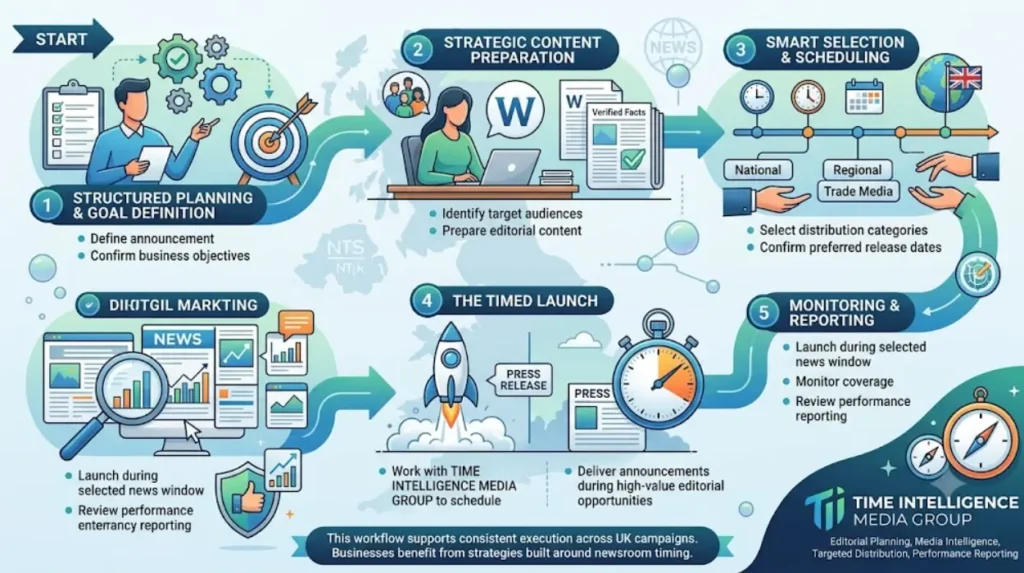
Businesses begin by defining announcement objectives, identifying target audiences, preparing verified content, selecting appropriate distribution categories, confirming preferred release dates, and working with Time Intelligence Media Group to schedule publication during high-value editorial opportunities across the United Kingdom.
An effective campaign begins with structured planning.
The process includes:
- Define the announcement.
- Confirm business objectives.
- Identify target publications.
- Prepare editorial content.
- Schedule distribution.
- Launch during the selected news window.
- Monitor coverage.
- Review performance reporting.
This structured workflow supports consistent execution across national, regional, and trade media campaigns.
Explore More Expert Insights:
Book a UK Press Release Timing Review With Time Intelligence Media Group
Get a Free UK Media Reach Estimate From Time Intelligence Media Group
Businesses that require dependable UK media visibility benefit from a release strategy built around newsroom timing instead of fixed publication schedules. Time Intelligence Media Group combines editorial planning, media intelligence, targeted distribution, and performance reporting into one coordinated process that helps organisations deliver announcements during the strongest opportunities for media pickup across the United Kingdom.