
Choosing a PR service involves more than comparing distribution lists or pricing. Timing has a direct influence on media visibility, journalist engagement, and publication rates. A PR service that understands UK newsroom schedules, editorial workflows, and audience behaviour helps organisations release news when journalists are actively reviewing stories. Evaluating these capabilities enables businesses to identify providers that improve the likelihood of media pickup through structured planning rather than chance.
What makes release timing an important feature in a UK PR service?
Release timing determines when journalists receive a press release, aligning news distribution with newsroom activity, editorial planning, and audience demand. A PR service that manages timing strategically increases the probability of media review, publication, and wider news visibility across UK media channels.
Many businesses compare PR services based on media databases or writing support. Timing deserves equal attention because it affects whether a story reaches journalists during active decision-making periods.
UK newsrooms follow structured publishing schedules. National newspapers, regional publications, broadcast media, and digital news platforms all organise editorial work around daily deadlines.
A PR service focused on timing studies these schedules before distributing news.
How does timing affect media pickup?
Journalists receive hundreds of emails every day.
When a press release arrives during peak editorial review periods, it competes more effectively for attention than releases sent outside normal newsroom workflows.
Examples include:
- Product launches before retail reporting cycles
- Financial announcements during business news hours
- Technology updates before industry newsletters publish
- Healthcare announcements before health editors finalise weekly coverage
Businesses wanting additional background on scheduling strategies can explore:
Why UK Brands Rely on Time Intelligence Media Group to Pick the Right News Window.
How can businesses evaluate a PR service’s timing process?
A professional PR service follows a documented timing process that includes planning, newsroom research, editorial calendar analysis, approval scheduling, distribution execution, and performance measurement. Each stage supports consistent media outreach rather than random release scheduling.
Many providers advertise media distribution. Fewer explain how they determine the best publication window.
A structured process normally includes several stages.
Editorial calendar research
Editorial calendars identify upcoming themes across industries.
Examples include:
- Retail holiday coverage
- Budget announcements
- Sustainability reporting
- Education admissions
- Property market updates
Matching releases with relevant editorial periods improves relevance.
News cycle monitoring
Professional teams monitor:
- Breaking national news
- Government announcements
- Industry events
- Major sporting events
- Economic reports
This prevents important company announcements from competing with dominant headlines.
Distribution scheduling
Rather than distributing immediately after approval, experienced providers schedule releases according to the chosen news window.
The objective is consistent visibility rather than immediate publication.
What newsroom knowledge should a UK PR service demonstrate?
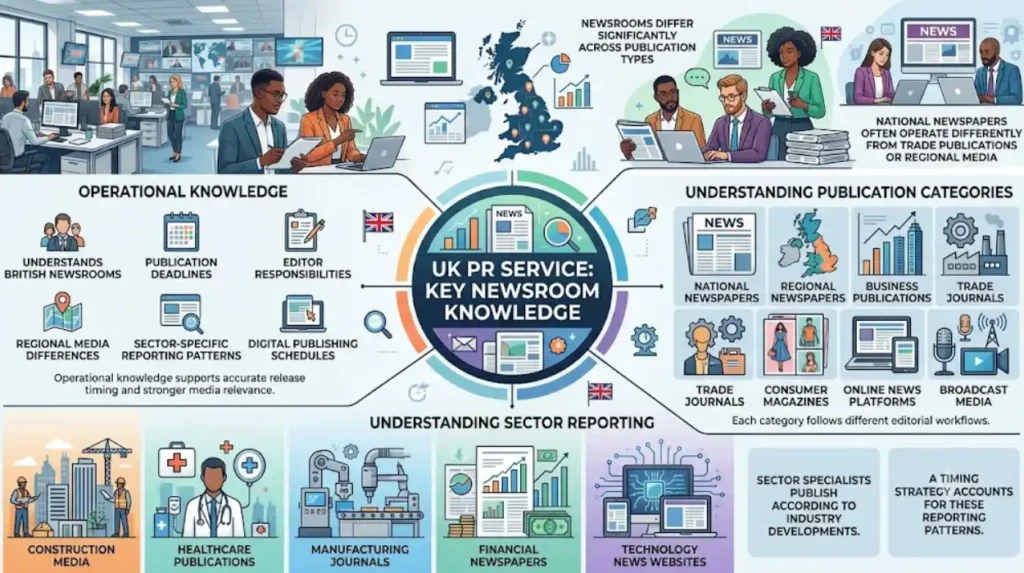
A reliable UK PR service understands how British newsrooms operate, including publication deadlines, editor responsibilities, regional media differences, sector-specific reporting patterns, and digital publishing schedules. This operational knowledge supports accurate release timing and stronger media relevance.
Newsrooms differ significantly across publication types.
National newspapers often operate differently from trade publications or regional media.
Understanding publication categories
Different media outlets include:
- National newspapers
- Regional newspapers
- Business publications
- Trade journals
- Consumer magazines
- Online news platforms
- Broadcast media
Each category follows different editorial workflows.
Understanding sector reporting
Sector specialists publish according to industry developments.
Examples include:
- Construction media
- Healthcare publications
- Manufacturing journals
- Financial newspapers
- Technology news websites
A timing strategy accounts for these reporting patterns.
Which timing tools and planning methods improve release performance?
Effective PR services combine editorial planning tools, media monitoring systems, scheduling platforms, analytics, and newsroom intelligence to determine practical release windows. These tools support informed decisions using current publishing activity instead of assumptions.
Technology supports timing decisions but does not replace editorial expertise.
Professional providers combine both.
Editorial calendars
Editorial calendars identify predictable publishing opportunities.
Examples include:
- Annual industry reports
- Conference coverage
- Government consultations
- Seasonal consumer trends
Media monitoring
Monitoring tools identify:
- Emerging stories
- Trending topics
- High-volume news periods
- Competitor announcements
This information helps avoid releasing news during crowded media cycles.
Performance reporting
Reporting measures outcomes such as:
- Publication timing
- Media pickups
- Online visibility
- Industry publication coverage
Performance analysis improves future scheduling decisions.
How does a PR service reduce competition with larger news events?
A timing-focused PR service evaluates competing news before distribution. This approach reduces overlap with major national stories, allowing business announcements to receive greater editorial attention during less crowded news periods across UK media.
Media attention concentrates around major events.
Examples include:
- General elections
- Government budgets
- Royal events
- National emergencies
- Major sporting tournaments
Releasing unrelated corporate news during these periods often limits visibility.
News conflict assessment
Professional planning includes reviewing:
- National news agendas
- Parliamentary activity
- Industry conferences
- Economic announcements
- Significant corporate earnings
If necessary, distribution schedules change to maintain visibility.
What reporting and measurement should a PR service provide?
Professional PR services measure release timing through publication tracking, media coverage, journalist engagement, online visibility, and campaign performance. Clear reporting allows businesses to understand how timing decisions influence overall media results.
Timing decisions require measurable outcomes.
Reports provide evidence for future planning.
Useful reporting metrics
Common measurements include:
- Publication volume
- Publication timing
- Industry coverage
- Regional coverage
- Digital news placements
- Online reach
These metrics help organisations compare campaigns objectively.
Continuous optimisation
Performance reviews identify:
- Strong-performing release windows
- Sector-specific publishing trends
- Editorial response patterns
- Future scheduling improvements
This creates a repeatable planning process.
How do different industries require different release timing strategies?
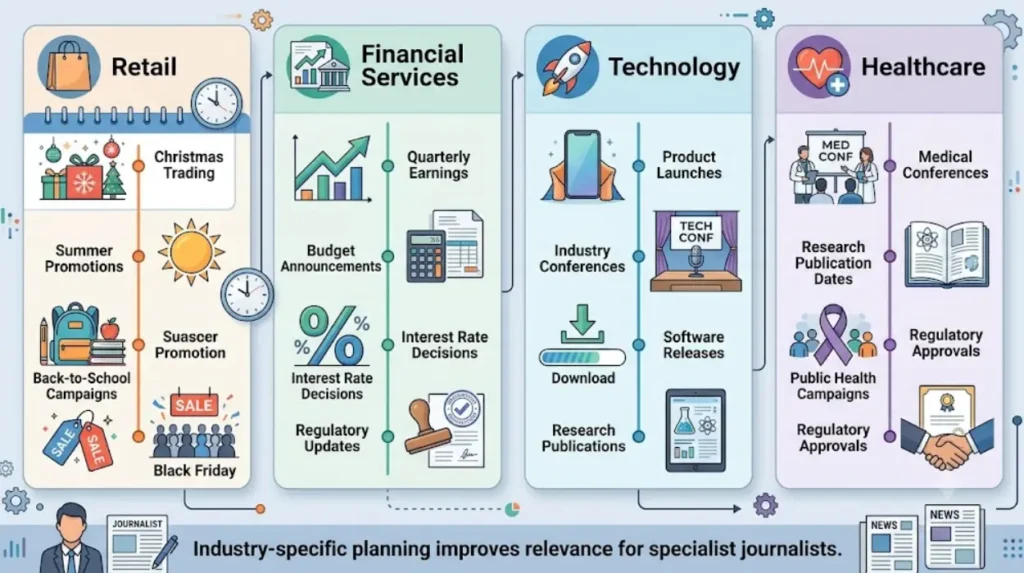
Industries follow unique reporting cycles. A PR service adapts release schedules to sector-specific editorial calendars, regulatory announcements, consumer demand, and business events rather than using one standard distribution timetable for every client.
Different industries generate news at different times.
Timing reflects industry activity.
Retail
Retail announcements often align with:
- Christmas trading
- Summer promotions
- Back-to-school campaigns
- Black Friday
Financial services
Financial communications frequently align with:
- Quarterly earnings
- Budget announcements
- Interest rate decisions
- Regulatory updates
Technology
Technology companies often schedule announcements around:
- Product launches
- Industry conferences
- Software releases
- Research publications
Healthcare
Healthcare organisations commonly align releases with:
- Medical conferences
- Research publication dates
- Public health campaigns
- Regulatory approvals
Industry-specific planning improves relevance for specialist journalists.
What questions should businesses ask before selecting a PR service?
Businesses benefit from evaluating timing expertise through structured questions covering newsroom research, editorial planning, scheduling methods, reporting, sector experience, and measurable outcomes. Clear answers demonstrate whether timing forms part of the provider’s communication strategy.
Comparing providers becomes easier when evaluation focuses on practical capabilities.
Useful questions include:
- How are release windows selected?
- Which newsroom schedules are monitored?
- How are major news events identified?
- Is industry-specific timing available?
- How is campaign performance measured?
- How frequently are editorial calendars updated?
- What reporting accompanies each release?
- How are schedule adjustments communicated?
Businesses comparing service approaches can also review:
How Time Intelligence Media Group Times UK Press Releases for Peak Coverage for an example of how structured release timing is implemented.
How does timing support stronger long-term media relationships?
Consistent release timing respects newsroom workflows and editorial planning. Journalists receive relevant information when they actively review stories, creating predictable communication patterns that strengthen professional interactions over repeated campaigns across UK media organisations.
Journalists value relevance, accuracy, and efficiency.
Receiving well-timed information supports faster editorial decisions.
Over multiple campaigns, structured timing contributes to:
- More consistent newsroom engagement
- Improved editorial planning
- Better alignment with publication schedules
- Increased operational efficiency
Strong timing complements quality writing and relevant news content rather than replacing them.
Explore More Expert Insights:
DIY Timing vs Managed Distribution: Getting Your UK Release Seen
What to Ask a UK PR Distribution Provider About AI and Search Visibility
Selecting a PR service involves evaluating far more than distribution volume or media databases. Release timing forms a core element of effective media outreach because it aligns announcements with newsroom workflows, editorial calendars, and sector reporting patterns across the United Kingdom.
Businesses can assess providers by examining their timing methodology, newsroom knowledge, planning process, monitoring capabilities, reporting standards, and industry expertise. A structured timing strategy supports consistent media visibility through evidence-based scheduling rather than fixed distribution dates.
Understanding these evaluation criteria enables organisations to compare PR services using measurable operational capabilities, leading to better-informed communication decisions and stronger opportunities for UK media pickup.