
A public statement shapes how journalists, customers, regulators, investors, and employees understand an issue. In the United Kingdom, refusing to comment during a developing story often creates an information gap. That gap is frequently filled with speculation, third-party opinions, archived information, and social media discussion instead of verified facts.
Why does saying “no comment” damage a UK brand?
A “no comment” response removes the organisation’s perspective from public reporting. Journalists continue publishing stories using available evidence, external sources, official records, and eyewitness accounts. The absence of verified information weakens public trust, increases uncertainty, and extends negative media attention across multiple communication channels.
A “no comment” statement is a refusal to provide information during media engagement. Journalists generally continue reporting because publication deadlines remain unchanged. News stories rarely stop because an organisation declines to participate.
Without an official explanation, reporters rely on alternative sources such as:
- Court documents
- Government records
- Industry experts
- Customers
- Former employees
- Competitors
- Public social media posts
Each source contributes information from a different perspective. The organisation loses the opportunity to explain context or correct inaccuracies before publication.
Why do journalists publish stories without an official response?
Journalists publish verified news regardless of whether an organisation participates. Editorial deadlines, public interest, and available evidence determine publication decisions. An official response improves balance, accuracy, and context but does not determine whether reporting proceeds or stops altogether.
News organisations follow editorial schedules. Delaying publication until a company comments is uncommon when sufficient evidence already exists.
What information replaces an official statement?
If no spokesperson responds, reporters frequently use:
- Previous company announcements
- Financial reports
- Regulatory findings
- Police statements
- Court filings
- Industry analysts
- Public records
These sources remain publicly accessible and often become the primary narrative.
Why do balanced comments matter?
A factual statement demonstrates that an organisation acknowledged the issue. Even a short response helps explain known facts, ongoing investigations, or operational changes without speculating.
How does “no comment” affect public trust?
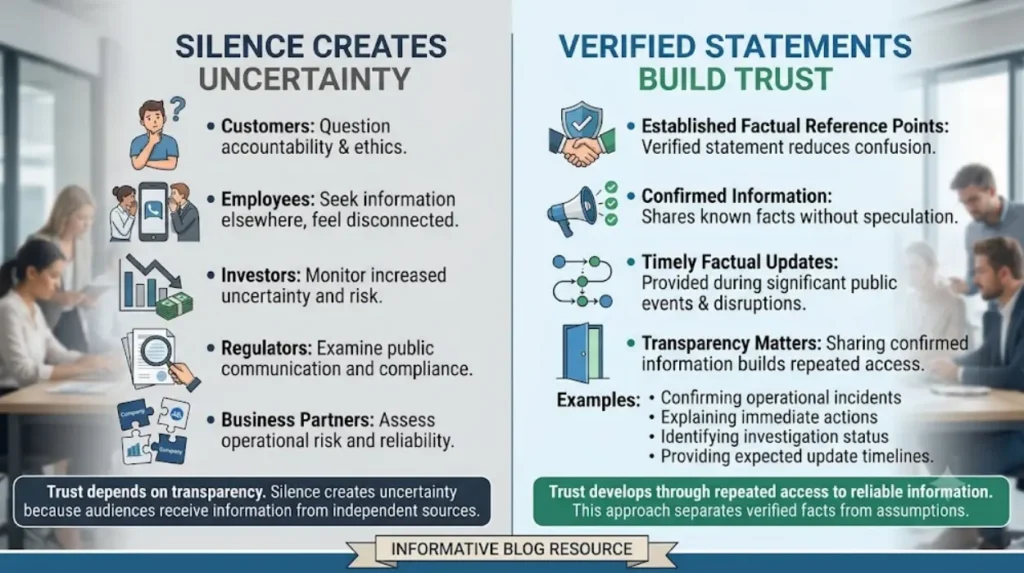
Trust depends on transparency and consistent communication. Silence creates uncertainty because audiences receive information from independent sources instead of the organisation. Customers, employees, investors, suppliers, and regulators expect timely factual updates during significant public events and business disruptions.
Trust develops through repeated access to reliable information.
When organisations remain silent:
- Customers question accountability.
- Employees seek information elsewhere.
- Investors monitor increased uncertainty.
- Regulators examine public communication.
- Business partners assess operational risk.
A verified statement reduces confusion by establishing factual reference points.
Why does transparency matter during a crisis?
Transparency means sharing confirmed information without speculation.
Examples include:
- Confirming an operational incident.
- Explaining immediate actions.
- Identifying investigation status.
- Providing expected update timelines.
This approach separates verified facts from assumptions.
How does silence influence media coverage?
Media coverage expands through repeated reporting across newspapers, television, radio, websites, and social platforms. Without official facts, later articles frequently reference earlier reports, increasing the visibility of incomplete or outdated information throughout the reporting cycle.
Modern news reporting develops continuously.
An initial article often generates:
- Follow-up investigations
- Television discussion
- Industry analysis
- Social media sharing
- Search engine visibility
Without updated company statements, earlier reports remain the primary reference for future coverage.
Why do early reports remain influential?
Search engines index published articles quickly.
Later journalists often review previous reporting before writing new stories. Early information therefore becomes part of the continuing public record.
What happens when search engines index incomplete information?
Search engines organise publicly available information based on relevance, authority, freshness, and user intent. If accurate organisational statements are unavailable, indexed articles, public documents, and third-party commentary become dominant search results for branded searches and related topics.
Search visibility influences long-term reputation.
Users searching for a company’s name often encounter:
- News reports
- Government announcements
- Court records
- Review websites
- Industry commentary
Without official published information, alternative sources receive greater visibility.
Search engines display information rather than verify organisational intent. They prioritise content that exists.
Readers interested in search visibility can explore:
What to Ask a UK PR Distribution Provider About AI and Search Visibility.
What financial effects can result from refusing to comment?
Communication decisions influence commercial outcomes because reputation affects customer confidence, investment activity, recruitment, partnerships, and stakeholder relationships. Extended uncertainty increases operational costs through prolonged media attention, additional communications work, and reputational recovery efforts following negative publicity.
Financial consequences often develop indirectly rather than immediately.
Examples include:
- Lost customer enquiries
- Delayed commercial partnerships
- Recruitment challenges
- Reduced investor confidence
- Increased legal communication costs
Each outcome results from reduced certainty rather than the original headline alone.
How does reputation affect commercial activity?
Reputation influences purchasing and investment decisions.
When reliable information is unavailable, stakeholders often delay decisions until greater certainty exists.
What is a better alternative to saying “no comment”?
A factual holding statement acknowledges the issue, confirms verified information, and explains ongoing actions without discussing unverified details. This approach provides journalists with accurate context while protecting legal, regulatory, and investigative responsibilities throughout developing situations effectively.
A holding statement differs from a detailed interview.
Its purpose is to communicate confirmed facts.
A basic structure includes:
- Acknowledgement of the issue.
- Verified facts.
- Current actions.
- Commitment to further updates.
What information belongs in a holding statement?
Useful information includes:
- Date of the incident.
- Confirmed operational status.
- Agencies involved.
- Investigation progress.
- Next scheduled update.
Information that remains unverified is excluded.
When is limited information appropriate?
Certain legal proceedings, criminal investigations, regulatory reviews, and contractual obligations restrict public disclosure. Organisations still communicate confirmed facts, explain disclosure limitations, and identify future update opportunities instead of responding solely with the phrase “no comment” to stakeholders.
Some situations require confidentiality.
Examples include:
- Active criminal investigations.
- Court proceedings.
- Market-sensitive financial announcements.
- Personal data protection.
- National security matters.
Legal restrictions limit specific disclosures but do not eliminate factual communication.
How can organisations communicate legally?
Organisations often state:
- The investigation continues.
- Authorities are cooperating.
- Certain information remains legally restricted.
- Further updates follow when available.
These statements provide clarity without breaching legal obligations.
How do social media and online discussions increase the impact of silence?

Social media distributes news rapidly through reposts, commentary, screenshots, videos, and user discussions. Without official updates, public conversations rely on assumptions, archived content, and unofficial interpretations that spread faster than later factual corrections across digital platforms.
Information spreads immediately after publication.
Online discussion commonly includes:
- Customer reactions
- Industry commentary
- Influencer analysis
- Employee posts
- Local community discussions
These conversations remain searchable long after the original event.
Why are corrections less visible?
Initial information receives the greatest engagement.
Later corrections often reach fewer people because public attention has already shifted to newer stories.
How can organisations prepare before media enquiries occur?
Preparation establishes clear communication responsibilities before incidents develop. Written response procedures, trained spokespersons, verified approval processes, and accurate contact information improve response speed while reducing confusion during periods of increased public attention and media scrutiny.
Preparation forms part of organisational risk management.
Important elements include:
Develop approved response procedures
Create documented workflows for:
- Media enquiries
- Executive approvals
- Legal review
- Crisis escalation
Identify authorised spokespersons
Only trained representatives provide official statements.
This reduces inconsistent messaging across departments.
Maintain accurate information
Prepared factual resources include:
- Company background
- Executive biographies
- Operational statistics
- Contact details
- Previous announcements
Accurate records improve communication efficiency during fast-moving situations.
What are the main lessons about saying “no comment”?
Refusing to comment removes an organisation from its own public narrative. Journalists continue reporting, search engines continue indexing, and audiences continue forming opinions. Clear factual communication provides context, improves accuracy, and strengthens transparency throughout developing public situations and ongoing media coverage.
Explore More Expert Insights:
How UK Property and Construction Firms Earn Media Coverage
What a UK Media Blackout Is and How to Recover From One
A public response does not eliminate negative news. It establishes verified information that journalists, stakeholders, and search engines can reference alongside independent reporting.
Key points include:
- Journalists publish with available evidence.
- Silence creates information gaps.
- Third-party sources fill those gaps.
- Search engines preserve published information.
- Transparent factual statements improve public understanding.
- Legal restrictions still allow communication of confirmed facts.
Understanding these communication principles helps organisations recognise why factual engagement generally contributes more effectively to accurate public reporting than a simple “no comment” response.