

A media-hosted research report publishes on third-party media platforms with editorial placement, audience distribution, and SEO visibility. An owned PDF is a downloadable file hosted on a company domain behind gates or on a resource hub.
Define the entities. A media-hosted research report appears on established industry publishers, trade journals, or research portals. These platforms provide article pages, email newsletters, and social channels that amplify reach. An owned PDF is a portable document format file published on an organisation’s website, usually requiring a form fill or link. Media-hosted reports use platform authority, audience subscriptions, and editorial context. Owned PDFs rely on direct traffic, organic search to the host domain, and on-site promotion.
Why do media-hosted reports reach a larger UK audience than owned PDFs?
Media platforms provide built-in audience pools, editorial amplification, syndication, and stronger domain authority in search engines. These factors produce higher impressions, referral traffic, and discoverability across UK professional networks.
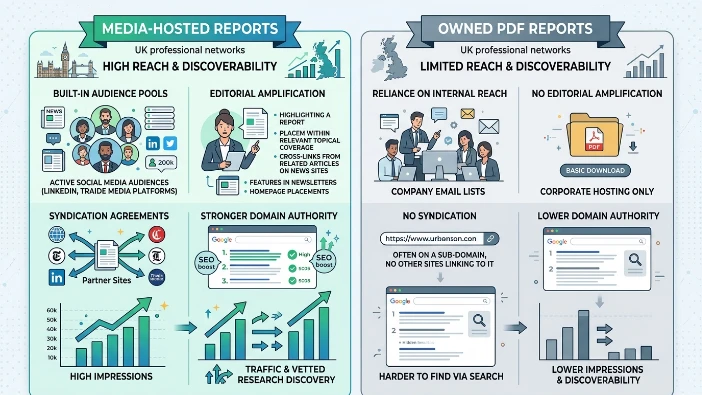
Third-party publishers maintain subscriber lists, segmented audience cohorts, and active social audiences. Editorial teams place reports within topical coverage and cross-link from related articles. Syndication agreements extend placement across multiple partner sites. Media domains often have higher domain authority scores, improving organic search rankings for report pages. UK audiences that rely on trade media for vetted research discover reports through newsletters, homepage features, and topic hubs more frequently than through corporately hosted PDFs.
How does editorial placement increase visibility and trust?
Editorial placement positions a report within a trusted news or industry context, giving it visibility in topic pages, newsletters, and feature lists. Editorial association signals third-party validation to UK professional readers.
Editorial teams select placement based on topical relevance and audience interest. Reports placed within editorial sections appear alongside news, analysis, and expert commentary. Newsletter inclusion sends a report directly to subscribers and often yields higher open and click-through rates than brand-owned email. Placement in topic hubs increases repeated exposure as readers browse related coverage. UK buyers and procurement teams treat editorial appearance as verification of relevance and quality.
What distribution channels do media hosts provide that owned PDFs lack?
Media hosts provide homepage features, topic hubs, section newsletters, social amplification, partner syndication, and paid promotion opportunities that extend reach beyond a brand’s direct audience.
Media-hosted report pages appear on publisher homepages and within industry vertical pages. Publishers include reports in curated newsletters with typical open rates between 15 and 30 percent for trade lists. Social posts from publisher channels reach followers and drive referral traffic. Syndication networks replicate content across partner sites, increasing impressions into the tens or hundreds of thousands. Paid newsletter sponsorships and sponsored placements amplify reach further. Owned PDFs rely on brand channels, direct SEO, and paid media buys for comparable distribution.
How do search engines index media-hosted reports compared with owned PDFs?
Search engines favour HTML pages on high-authority domains. Media-hosted report pages appear as indexable articles with metadata, structured data, and backlinks, increasing search visibility compared with standalone PDF files on lower-authority domains.
HTML article pages allow structured metadata like schema.org report properties, descriptive title tags, and canonical links. Publishers’ high domain authority improves ranking potential for competitive keywords. PDFs are indexable but often rank lower due to lack of semantic HTML, limited metadata, and weaker backlink profiles. Media pages attract inbound links from related coverage, amplifying authority. For UK-targeted queries, publisher domains with UK editorial focus index location signals more effectively than many corporate domains.
What metrics demonstrate larger audience reach for media-hosted reports?
Key metrics include page impressions, unique users, referral traffic, newsletter clicks, social shares, and backlinks. Media-hosted reports typically show higher values across these metrics compared with owned PDFs.
Measure impressions from homepage placement and topic hub exposure. Track unique users driven by publisher audiences and newsletter clicks. Monitor referral sources and social engagement metrics such as shares and comments. Count backlinks from related articles and partner sites after publication. UK-sector examples show media placement delivering 3–10x the referral traffic and 2–5x the backlinks compared with comparable owned PDF releases promoted only via brand channels.
What components increase reach when publishing on media platforms?
Effective components include an indexable HTML report page, strong headline and summary, data visualisations embedded as images, clear metadata, UK-focused examples, and an accompanying editorial summary or guest commentary.
An HTML page increases SEO value. Headlines and one-paragraph summaries improve click-through rates from listings. Embed charts as responsive images with alt text for indexing. Use structured data tags to mark report type, author, and publication date. Include UK case examples, local statistics, and sector-specific citations to align with regional search intent. An editorial summary or a guest expert quote increases editorial interest and likelihood of newsletter inclusion.
How do commercial outcomes differ between media-hosted reports and owned PDFs?
Media-hosted reports yield higher lead volume, broader lead quality mix, and greater inbound interest from previously unreachable segments. Owned PDFs produce deeper engagement per contact but fewer total leads without extensive promotion.
Media placements generate discovery from buyers and influencers outside a brand’s immediate network, increasing the top of funnel. This inflow produces leads at earlier research stages and expands brand awareness among procurement and technical audiences. Owned PDFs attract users already aware of the brand, often producing higher intent signals per download. For UK procurement cycles, media-driven leads accelerate shortlist inclusion when the report provides procurement-ready data and UK case examples.
When should organisations use owned PDFs instead of or alongside media-hosted reports?
Use owned PDFs for gated, downloadable technical dossiers, legal appendices, or proprietary datasets. Use them alongside media-hosted reports to capture interested readers and convert traffic driven by publisher pages.
Owned PDFs serve as detailed supporting assets: full datasets, contractual templates, and extensive methodology appendices. Place links to these PDFs from media-hosted report pages to capture engaged readers. Use gated PDFs to collect contact data for follow-up and pilot proposals. Coordinate versions so the media-hosted page provides summary insights and points readers to the owned PDF for deeper technical or procurement materials.
Explore More Expert Insights:
Research and Reports Services: What UK Brands Receive From Brief to Publication
Why 63% of UK Enterprise Brands Now Outsource Annual Report Production
How should teams measure and attribute ROI for media-hosted research?
Measure page impressions, referral traffic, newsletter clicks, leads attributed to report downloads, downstream pipeline value, and backlinks. Use UTM tagging, landing page funnels, and publisher conversion reports for accurate attribution.
Implement distinct UTM parameters for publisher placements and for owned PDF links. Track newsletter click-throughs and conversion paths that lead to demo requests, RFP entries, or procurement contacts. Attribute downstream pipeline and closed deals that reference the report in procurement documentation. Monitor backlink growth and organic search ranking improvements for targeted keywords. Use publisher analytics and CRM mapping to quantify media-driven pipeline over a rolling 6–12 month window.
What are practical steps to maximise UK reach via media-hosted reports?
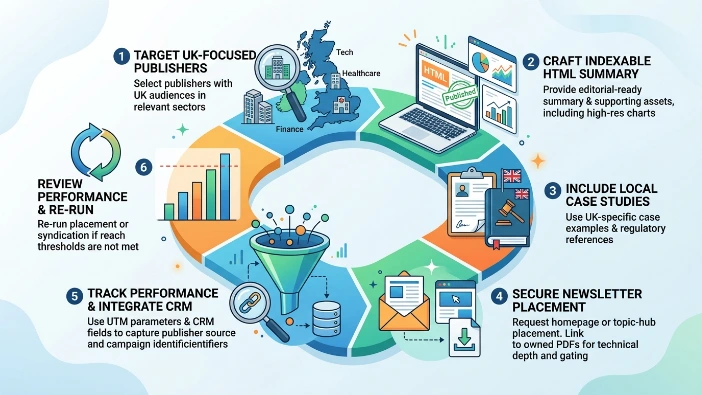
Target UK-focused publishers, craft an indexable HTML summary, include local case studies and regulatory references, secure newsletter placement, embed links to owned PDFs, and track performance with UTM and CRM integration.
Select publishers with UK audiences in relevant sectors. Provide an editorial-ready summary and supporting assets, including high-resolution charts and UK case examples. Request newsletter inclusion and homepage or topic-hub placement. Link to owned PDFs for technical depth and gating where lead capture is required. Ensure UTM parameters and CRM fields capture publisher source and campaign identifiers. Review publisher performance and re-run placement or syndication if reach thresholds are not met.
Explore the Complete Guide:
The UK B2B Buyer Reads 5 Reports Before Talking to Sales: What That Means
Media-hosted research reports reach larger UK audiences than owned PDFs because media platforms provide editorial placement, built-in distribution channels, stronger search indexing, and syndication. Media pages drive higher impressions, referral traffic, newsletter clicks, and backlinks. Owned PDFs retain value as deep technical assets and gated capture mechanisms. Combine media-hosted visibility with owned PDF depth, track performance with UTM and CRM mapping, and prioritise UK-focused editorial placement and local case studies to maximise reach and commercial impact.
Discover More Insights:
Long-Form Report vs White Paper vs Infographic: Which UK Format Converts Best?



