

UK B2B buyers typically read five independent information pieces: market overview reports, vendor comparisons, technical white papers, case-study reports, and buyer-guides. These pieces together provide market context, vendor differentiation, technical validation, demonstrated outcomes, and procurement guidance.
UK buyers use these five report types to build a complete decision picture before any sales contact. Market overview reports deliver sector size, growth rates, and trends. Vendor comparisons list feature differences, pricing models, and positioning. Technical white papers explain architectures, protocols, or integrations. Case-study reports show measurable outcomes in similar organisations. Buyer-guides translate options into procurement steps and checklists. Each report supplies a distinct evidentiary role in the buyer’s evaluation process.
Why do UK B2B buyers read five reports before contacting sales?
Buyers read five reports to verify vendor claims, reduce procurement risk, align solutions to technical requirements, quantify expected benefits, and prepare procurement questions. Multiple reports reduce unknowns and shorten later decision steps.
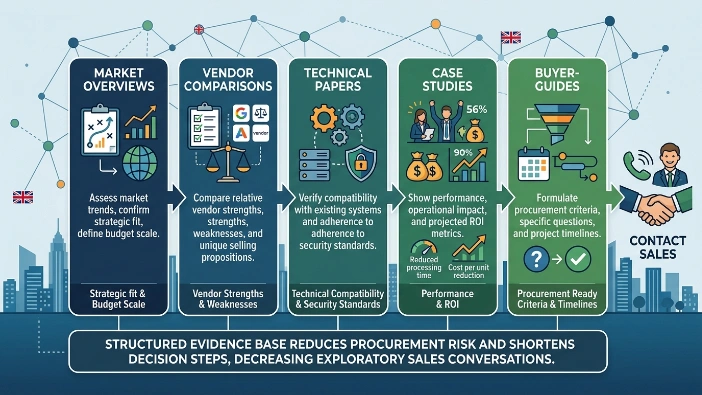
Decision-makers require independent evidence across commercial, technical, and operational dimensions. Market overviews confirm strategic fit and budget scale. Vendor comparisons reveal relative strengths and weaknesses. Technical papers validate compatibility with existing systems and security standards. Case studies show real-world performance and ROI metrics, for example reduction in processing time or cost per unit. Buyer-guides convert findings into procurement-ready criteria and timelines. This structured evidence base reduces the need for exploratory sales conversations.
Which types of reports provide strategic market context?
Market overview reports and industry forecasts provide strategic market context by detailing market size, segment growth rates, regulatory changes, and macro drivers such as automation, sustainability, or skills shortages.
Market overview reports include quantitative metrics: total addressable market in the UK, compound annual growth rates, and adoption rates across sectors. They list regulatory developments that affect procurement, for example new data-protection rules or sector-specific compliance requirements. Reports often include segmentation by organisation size or region within the UK, which helps buyers assess scale and priority. Strategic context frames whether a capability is core, optional, or experimental for a buyer’s organisation.
How do vendor comparisons help the UK buyer decision process?
Vendor comparison reports help buyers identify feature parity, pricing structures, support models, integration capabilities, and independent analyst ratings. They distil vendor differences into clear selection criteria aligned with buyer priorities.
Comparisons list features, minimum licensing terms, deployment models, and contract lengths. They document integration pathways with common enterprise systems and list third-party certifications. Comparison reports provide side-by-side metrics such as uptime guarantees, SLAs, and average implementation timelines. Buyers use these comparisons to eliminate vendors that fail key technical or contractual requirements. Where comparisons include quantifiable outcomes—like average time-to-value—they directly influence shortlisting decisions.
What technical evidence do UK buyers require before engaging sales?
Buyers require technical white papers and architecture documents that prove interoperability, security controls, deployment models, data flows, and compliance with UK regulations such as data residency and sector-specific rules.
Technical white papers describe system architecture, APIs, supported protocols, and integration steps with examples. They include security details: encryption standards, access controls, and audit logging. Herded evidence includes performance benchmarks and scalability testing data. Buyers match these technical specifications to existing IT stacks and risk frameworks. For public sector or regulated industries, papers must reference legal compliance and certification references relevant to the UK context.
How do case-study reports influence procurement choices?
Case-study reports influence procurement by showing measured outcomes, implementation timelines, costs, lessons learned, and client contexts that match the buyer’s industry, size, or use case.
Case studies provide concrete KPIs such as percentage cost reductions, throughput increases, or time saved. They outline project scope, stakeholder roles, and timelines, for example a six-month rollout across three UK sites. Inclusion of challenges and remediation steps gives buyers a realistic view of implementation risk. When case studies document third-party validation or audited results, buyers treat them as higher-trust evidence.
What role do buyer-guides play in converting research into procurement action?
Buyer-guides translate research into procurement steps by offering option matrices, checklist criteria, procurement timelines, stakeholder maps, and question sets for vendor evaluation.
Buyer-guides present procurement-ready materials such as requirement templates, scoring criteria, and budget modelling examples. They suggest stakeholder involvement, for example which departments to include in technical pilots and procurement evaluation. Guides provide example question sets for procurement and technical teams to use during vendor briefings. These guides reduce time-to-decision by converting research findings into executable evaluation plans.
How do buyers sequence these five report types during research?
Buyers start with market overviews, then use vendor comparisons, read technical white papers, review case studies, and finish with buyer-guides to prepare vendor questions and procurement timelines.
This sequence builds from strategic understanding to tactical readiness. Market overviews identify whether the category warrants investment. Comparisons narrow contenders. Technical papers confirm compatibility. Case studies validate outcomes in similar contexts. Buyer-guides convert accumulated evidence into procurement actions. This sequence explains why buyers contact sales only after consuming multiple report types: each step closes a distinct knowledge gap.
Which specific metrics in these reports matter most to UK B2B buyers?
Key metrics include ROI figures, time-to-value in months, total cost of ownership over three to five years, uptime percentage, implementation timelines in weeks, and compliance certifications relevant to UK regulations.
Buyers prioritise quantifiable data that map to procurement concerns. ROI figures quantify benefits. Time-to-value sets expectations for benefits realisation. Total cost of ownership captures licensing, implementation, and support costs. Uptime and performance metrics indicate reliability. Implementation timelines enable resource planning. Certifications and compliance references address legal and procurement risk for UK organisations.
What are the benefits of buyers reading five reports before sales contact?
Benefits include reduced procurement risk, faster evaluation cycles, fewer discovery meetings, clearer vendor shortlists, and higher-quality procurement RFPs and technical questions.
When buyers aggregate evidence across five report types, they eliminate vendors that fail key criteria early. Prepared procurement teams ask targeted questions and request focused demos. Vendors receive concise scopes, enabling faster quotes and pilot proposals. Organisations reduce internal debate by aligning stakeholders on documented facts. Overall procurement cost and calendar time decrease.
How should research teams structure reports for UK B2B buyers?
Report structure should include a clear summary, quantitative metrics, methodology, vendor or use-case specifics, technical appendices, and a procurement checklist tailored to UK regulatory and market contexts.
Summaries must include headline metrics and conclusions. Methodology sections list data sources and sample sizes. Technical appendices provide integration diagrams, API endpoints, and security controls. Use-case specifics show client contexts and measurable outcomes. Procurement checklists include contract clauses, compliance references, and example RFP questions. UK-focused details such as local case studies, region-specific pricing indications, and relevant statutory references increase report utility.
Explore More Expert Insights:
Why Fact-Dense Content Gets Cited in AI Overviews 5× More Often Than Opinion
The £20.4bn UK Digital Economy Needs Better Industry Research: Here’s Why
How does this five-report habit change seller interactions?
Sellers encounter more informed buyers who request targeted demos, advanced pricing scenarios, proof of compliance, and shorter pilot periods. Sales conversations focus on specific gaps identified in buyer research.
Buyers arrive with preset criteria and documented concerns. Sales teams must respond with precise evidence: implementation plans, SLA commitments, compliance proofs, and comparable client results. Early-stage discovery shifts from education to validation and negotiation. Sellers that anticipate common report questions shorten sales cycles by addressing evidence gaps proactively.
What does this pattern mean for procurement timelines in UK organisations?
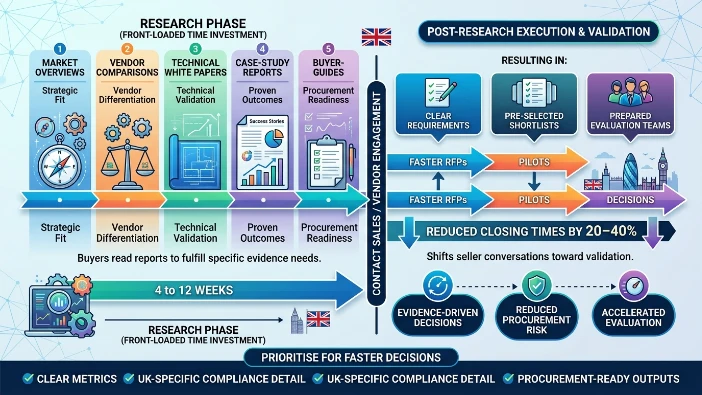
Procurement timelines shorten after the research phase because buyers enter vendor engagement with clear requirements, pre-selected shortlists, and prepared evaluation teams, resulting in faster RFPs, pilots, and decisions.
Front-loading research concentrates time investment before vendor contact. The research phase can take four to twelve weeks depending on project scope. After research, procurement, legal, and technical teams proceed through vendor evaluation in shorter cycles, often reducing closing times by 20–40 percent compared with exploratory engagements.
Read More to Understand Better:
Long-Form Report vs White Paper vs Infographic: Which UK Format Converts Best?
UK B2B buyers consistently read five distinct report types market overviews, vendor comparisons, technical white papers, case-study reports, and buyer-guides before contacting sales. Each report addresses a specific evidence need: strategic fit, vendor differentiation, technical validation, proven outcomes, and procurement readiness. This structured research process reduces procurement risk, accelerates evaluation, and shifts seller conversations toward validation. Buyers and report authors should prioritise clear metrics, UK-specific compliance detail, and procurement-ready outputs to support faster, evidence-driven decisions.
Get the Full Insights Here:
How Media-Hosted Research Reports Reach a Larger UK Audience Than Owned PDFs



