
Original data is first-party, proprietary information gathered through primary research, direct measurement, or exclusive access. It matters because it provides unique insights that drive audience trust, editorial differentiation, and measurable engagement.
Original data includes surveys run by a publisher, proprietary transaction records, sensor or telemetry feeds, and bespoke interviews. In 2026 UK media, original data differs from aggregated third-party datasets and public statistics because it is verifiable, timestamped, and controllable. Verifiable means the methodology and sample frame exist and can be cited. Timestamped means the collection date is explicit. Controllable means the publisher defines sampling, questions, and variables.
These properties produce reproducible claims, which editors and researchers prioritize. Major use cases include investigative journalism, sector reports, and data-driven features. Examples include a publisher-run national poll of 3,500 adults, exclusive anonymized retail transaction logs from a chain, and a bespoke sensor network measuring urban air quality across 12 cities.
How did UK media shift to prioritise original data by 2026?
The shift occurred through regulatory changes, audience demand for verification, and commercial value tied to unique content assets.
Regulatory shifts increased scrutiny of opaque data practices and raised standards for provenance. Audiences demanded clarity about sources after high-profile misinformation events. Publishers adapted by investing in primary collection and transparent methodology. Investment happened in-house and via partnerships with independent research labs. Newsrooms hired data scientists, field researchers, and statisticians to design studies and validate findings.
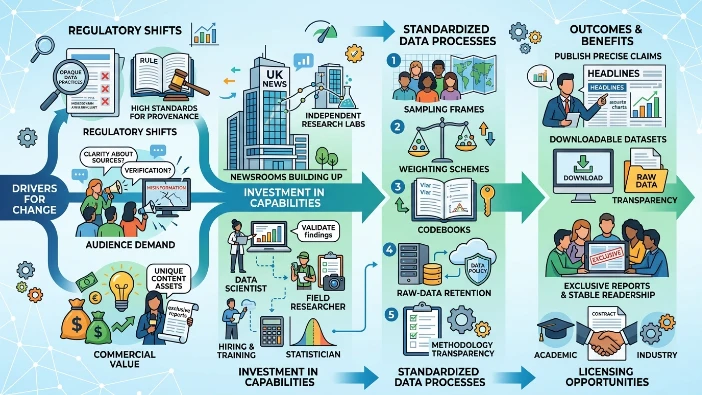
Data teams standardised documentation: sampling frames, weighting schemes, codebooks, and raw-data retention policies. These standards enabled editors to publish precise claims and provide downloadable datasets for journalistic transparency. Commercially, original data became an asset because it allowed publishers to produce exclusive reports that attracted stable readership and licensing opportunities for academic and industry reuse.
What processes do UK media organisations use to create original data?
Processes follow four stages: design, collection, validation, and publication, each with documented protocols and quality checks.
Design begins with a clear research question and operational definitions for variables. Teams write a protocol detailing sample frame, recruitment method, instruments, and ethical approvals. Collection uses mixed modes: online panels, telephone, field sensors, administrative record access, and structured interviews. Each mode has a documented chain of custody for data. Validation includes automated checks for missingness, outlier detection, and consistency tests. Statistical weighting corrects known sample biases using official benchmarks. Independent replication checks run by a second analyst confirm primary results. Publication packages include a methods section, an executive summary, downloadable anonymized dataset, and code used for analysis. Publishers often archive raw data under controlled access for verification requests. Examples of sampling scale in 2026: national polls commonly use 3,000–5,000 respondents; city-level sensor deployments cover at least 20 nodes per urban area.
What components make original data valuable in editorial content?
Value derives from uniqueness, methodological transparency, granularity, and reusability.
Uniqueness means no other outlet can publish the same dataset simultaneously. Methodological transparency means readers and researchers can evaluate reliability through clear protocols. Granularity refers to variable-level detail: demographic breakdowns, time-series stamps, and geo-coded records. Reusability means the dataset supports multiple derivative products: charts, feature stories, interactive tools, and external research. Together these components create content that sustains traffic and supports citation. For example, a national survey that includes hourly mood tracking across 28 days and postcode-level identifiers enables both a headline trend story and regional deep dives.
What measurable benefits do UK publishers gain from original data?
Publishers gain higher engagement metrics, improved search visibility, citation potential, and monetisable licensing deals.
Engagement metrics improve because exclusive data produces unique stories and interactive formats that extend session duration. Search engines increasingly prioritize content with verifiable claims and structured data; original datasets supply schema and citations that improve discoverability. Citations increase: academic papers, think tanks, and other media cite original datasets, extending reach. Licensing deals arise when universities, NGOs, or businesses request data access for research or benchmarking; publishers charge fees or create data-access subscriptions. Measurable outcomes in 2026 include a 20–60% lift in page dwell time for dataset-backed features and a 30–90% increase in inbound citations compared with typical reporting. Licensing revenue varies; mid-size publishers report annual six-figure sums when they maintain a regular cadence of proprietary studies.
How do search engines and AI treat original data content?
Search engines and AI systems prioritise content with clear sourcing, machine-readable metadata, and accessible supporting datasets.
Search algorithms evaluate provenance signals: named methodology sections, dataset downloads, and persistent identifiers (DOIs). Machine-readable metadata such as structured JSON-LD outlining variables and collection dates allows automated systems to index and assess reliability. AI models and research tools prefer primary sources when generating summaries and citations. Publishers that provide well-documented datasets receive higher trust signals in AI-driven content feeds. In practice, publishers add schema for dataset description, attach stable DOIs, and host CSV or Parquet files. These steps enable automated crawlers and research AIs to extract precise figures, boosting the dataset’s citation frequency in long-form analyses and data-driven tools.
What ethical and legal controls govern original data in UK media?
Controls include privacy law compliance, consent protocols, anonymisation standards, and data retention policies.
Privacy compliance follows the UK General Data Protection Regulation framework. Consent protocols require explicit informed consent for primary data collection and clearly documented lawful bases for administrative data use. Anonymisation includes removing direct identifiers and applying statistical disclosure controls for small-cell suppression and noise infusion. Legal review checks data-sharing agreements when datasets come from third-party partners. Retention policies specify archival durations and access controls for sensitive raw files. Publishers document these controls in a data statement accompanying published datasets. Examples of anonymisation practice include k-anonymity thresholds and differential privacy techniques for high-risk variables in small geographic areas.
How do newsrooms structure teams and tools for original data production?
Teams combine journalists, data scientists, survey managers, and legal advisors; tools include survey platforms, cloud storage, and reproducible analysis environments.
Newsrooms centralise data production in a research unit or embed analysts in desks. Roles include an editor who defines editorial questions, a survey manager who handles sample logistics, a data scientist for cleaning and analysis, and a legal advisor for contracts and privacy checks. Tools include enterprise survey platforms for panels, IoT platforms for sensor data, secure cloud storage with access logs, and reproducible notebooks (for example, Python or R scripts) version-controlled in repositories. Workflow automation handles routine validation checks. This structure ensures consistent methodology and faster time-to-publication for data-driven stories.
Explore More Expert Insights:
The UK B2B Buyer Reads 5 Reports Before Talking to Sales: What That Means
Why Fact-Dense Content Gets Cited in AI Overviews 5× More Often Than Opinion
What are practical use cases of original data in UK media?
Use cases include investigative series, policy benchmarking, localised reporting, and recurring sector reports that track change over time.
Investigative series use transaction logs or whistleblower datasets to reveal systemic issues. Policy benchmarking uses structured surveys and administrative data to measure public service performance against targets. Localised reporting uses hyperlocal sensor networks or community panels to reveal differences between neighbourhoods. Recurring sector reports, published quarterly or annually, track industry metrics such as consumer confidence, migration intentions, or climate-related indicators. Each use case creates multiple content formats: long-form features, data visualisations, and downloadable datasets for researchers.
How should readers evaluate claims based on original data?
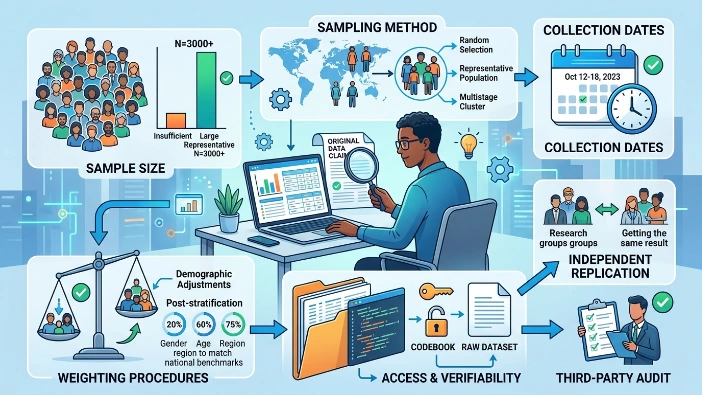
Readers should check sample size, sampling method, collection dates, weighting procedures, and access to raw data or codebook.
A reliable claim states the sample size and recruitment method, provides collection dates, explains weighting adjustments, and links to a codebook or dataset. Absence of these elements reduces verifiability. Readers should look for independent replication statements or third-party audits for high-impact claims. For example, a claim about national opinion should show a representative sample of at least 3,000 respondents with documented weighting to national demographic benchmarks.
Learn Everything About It Here:
How to Repurpose One Research Report Into 14 Separate UK Content Assets
Original data became the most competitive content asset in UK media by 2026 because it provides unique, verifiable insights that improve editorial quality, search visibility, and licensing potential. The shift rests on transparent processes, technical infrastructure, ethical controls, and multidisciplinary teams. Publishers that document methodology, provide machine-readable metadata, and protect privacy create datasets that are more citable, more engaging, and more commercially valuable.
Dive Deeper Into This Topic:
Research Report ROI: How One UK Brand Generated 340 Qualified Leads From One Study