

Brand safety is the set of policies, technologies, and workflows that prevent ads from appearing near content that harms a brand’s reputation; it covers content category exclusions, contextual alignment, and verified inventory sources.
Brand safety defines acceptable placement parameters for digital ads. It includes definitions of harmful content categories such as extremist material, illegal activity, explicit sexual content, violent content, hate speech, and misinformation. In the UK context, brand safety also addresses regulatory risks tied to Advertising Standards Authority (ASA) rulings and UK law, including content that could be judged misleading or harmful to minors. Key entities are publishers, ad exchanges, demand-side platforms (DSPs), supply-side platforms (SSPs), verification vendors, and advertisers’ legal/compliance teams.
Verification vendors provide measurement signals: viewability, domain-level checks, page-level contextual analysis, and third-party brand-safety scoring. Inventory sources fall into three classes: direct-sold publisher inventory, private marketplaces (PMPs) and open exchanges. Each source carries specific risks; direct-sold inventory and PMPs deliver higher transparency than open exchanges. In 2026, industry standards use content classifiers trained on UK English sources and regulatory taxonomies to label content at the page and article level.
Why do news environments score highest for brand safety in 2026?
News environments score highest because editorial controls, verified first-party data, publisher brand governance, and real-time fact-checking reduce risk exposure and increase context accuracy.
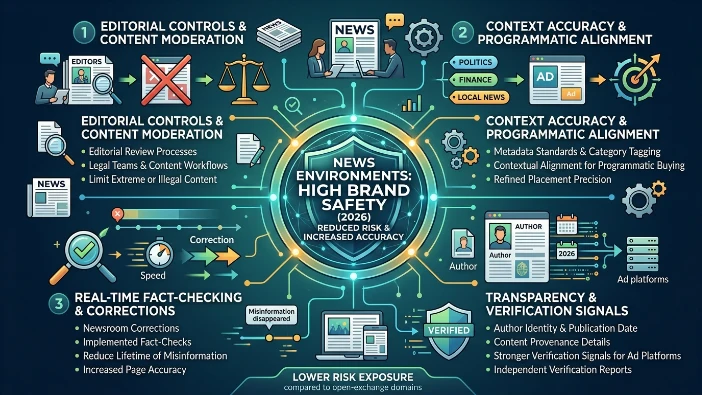
Major UK news publishers maintain editorial review processes, legal teams, and content moderation workflows that limit extreme or illegal content on their sites. Publishers apply metadata standards and category tagging to articles, which improves contextual alignment for programmatic buying. Newsrooms implement corrections and fact-checks that reduce the lifetime of misinformation on a page. News sites provide high levels of transparency about author identity, publication date, and content provenance, enabling stronger verification signals for ad platforms.
News inventory often originates in direct-sold or PMP channels with clearly defined domain lists. These channels allow advertisers to exclude entire domains or choose specific content verticals such as politics, finance, or local news. In 2026, contextual targeting systems integrate publisher taxonomy with page-level semantic analysis, increasing the precision of placement decisions. Independent verification reports show lower incidence of adjacency to banned content on verified national news domains compared with general-interest open-exchange domains.
How is brand safety measured in news environments?
Brand safety is measured through a combination of domain-level checks, page-level contextual classification, viewability metrics, and verification scores from independent vendors.
Measurement begins with inventory source validation. Buyers confirm domain lists and certificate provenance for supply. Domain-level checks identify publisher trust signals such as HTTPS, valid ads.txt/sellers.json entries, and publisher verification badges. Page-level classifiers analyse headlines, body text, images, and metadata. These classifiers apply taxonomies for harmful content and assign a risk score. Viewability metrics track whether an ad was in-view for a minimum threshold, commonly 50% of pixels for one continuous second for display or two seconds for video, as industry practice.
Independent verification vendors provide aggregated scores across domains and pages. These vendors report incidents of disallowed adjacency, content category distributions, and contextual matching accuracy. In news environments, verification shows higher contextual match rates and lower disallowed adjacency counts. Measurement also includes brand suitability overlays that apply advertiser-specific rules—for example, excluding politically sensitive content or crime coverage—creating a tailored brand safety profile.
What processes reduce brand risk when buying news inventory?
Processes that reduce risk include curated domain whitelists, publisher-level agreements, page-level contextual filters, and pre-bid verification checks.
Buyers establish curated domain whitelists that include only publishers meeting editorial and technical standards. Procurement of PMP or direct-sold inventory ensures contract-level controls, including indemnities and content remediation clauses. Pre-bid contextual filters evaluate page semantics and metadata before an ad is served; these filters use classifiers trained on UK news language. Pre-bid verification prevents bids on pages flagged for disallowed content categories.
Real-time monitoring follows placement, using continuous verification signals to detect anomalous content or sudden spikes in low-quality traffic. When a violation occurs, buyers execute remediation steps defined in publisher agreements, such as removing creative, pausing campaigns, or requesting retroactive credits. Compliance teams run periodic audits of inventory and verification logs to ensure processes function correctly. In 2026, automated workflows link verification alerts to campaign controls for immediate action.
What components define a safe news environment?
Components include editorial governance, metadata standards, verified inventory channels, robust ad tech integrations, and independent verification coverage.
Editorial governance consists of newsroom policies, content moderation teams, and legal review for sensitive material. Metadata standards ensure consistent tagging of article categories, authorship, and publication timestamps. Verified inventory channels are direct and PMP relationships that provide contractual transparency and control. Ad tech integrations connect publisher metadata, DSP targeting controls, and verification vendors to create real-time decisioning. Independent verification coverage provides external audits and public reporting on placement quality.
Additional components are reader comments moderation, image verification tools for user-generated content, and correction mechanisms for breaking news. These components produce lower incidence of adjacency issues and clearer provenance signals for programmatic systems. Together, they allow advertisers to implement precise brand-safety rules without overly broad exclusions that reduce reach.
What are the benefits of using news environments for UK brand safety?
Benefits include lower adjacency risk, higher contextual relevance, improved transparency, and better legal/regulatory alignment.
Lower adjacency risk reduces the chance of ads appearing next to extremist or illegal content. Higher contextual relevance increases ad effectiveness because news audiences often engage with topical material tied to current events. Improved transparency delivers clearer reporting and reconciliation of spend and impressions, reducing fraud exposure. Legal and regulatory alignment reduces the risk of ASA complaints and non-compliance with UK advertising standards.
Using news environments results in clearer performance attribution. Advertisers obtain page-level reporting with article identifiers, enabling accurate measurement of audience segments and topical engagement. News publishers supply first-party audience data that enriches targeting while preserving privacy compliance under UK data protection frameworks. This combination supports both brand safety and measurement integrity.
What use cases benefit most from news environments in 2026?
Use cases include brand awareness campaigns, public information drives, and sector-specific outreach for finance, health, and politics.
Brand awareness campaigns benefit from the high trust associated with established news brands. Public information drives—such as government or health communications—require placements in credible editorial contexts to ensure message acceptance. Sector-specific outreach for finance or health gains from topical alignment with relevant news coverage, increasing the likelihood of engagement. Political or issue-based advertising requires strict vetting; news environments facilitate compliance with transparency and provenance requirements.
News environments also support crisis communications where message accuracy and placement timing are critical. In these cases, verified publisher relationships and editorial calendars enable precise scheduling and contextual targeting that preserves message credibility.
How do advertisers maintain reach while ensuring safety across multiple news sites?
Advertisers maintain reach by combining curated whitelists, cross-publisher agreements, frequency management, and contextual breadth controls.
Curated whitelists include a broad set of verified UK news domains that meet editorial and technical standards. Cross-publisher agreements secured through PMPs or direct deals allow buyers to access multiple publisher inventories without relying on open exchanges. Frequency management prevents overexposure on a single site by setting caps across the curated set. Contextual breadth controls permit targeting across allowable verticals such as regional news, business, or lifestyle while excluding high-risk categories like graphic crime coverage.
Discover More Insights:
Brand Awareness vs Direct Response: Choosing the Right UK Banner Campaign Objective
Programmatic tools aggregate inventory across publishers and apply unified brand-safety and frequency rules. This unified approach prevents duplicative reach because it coordinates targeting rules and deduplication across domains. Buyers implement consistent creative rotations and campaign windows to sustain reach without compromising safety.
Explore More Expert Insights:
Why Premium News Site Banner Ads Have Lower Bounce Rates Than Social Display
UK Digital Ad Spend Hit £20.4bn in 2025: Where Banner Advertising Fits in the Mix
What reporting and audit practices confirm brand safety in news placements?
Page-level logs record article identifiers, timestamps, and contextual scores for each placement. Third-party verification reports provide independent counts of disallowed adjacency, viewability, and invalid traffic metrics. Contractual KPIs in publisher agreements define remediation timelines, acceptable thresholds for violations, and crediting mechanisms. Periodic inventory audits validate seller identities, ads.txt/sellers.json accuracy, and metadata consistency.
Audits include sampling of placements for manual review and automated checks against content taxonomies. Buyers maintain proof-of-compliance artifacts for regulatory review and internal governance. Consistent reporting enables trend analysis and continuous improvement of brand-safety rules.
How will brand safety in UK news environments evolve after 2026?
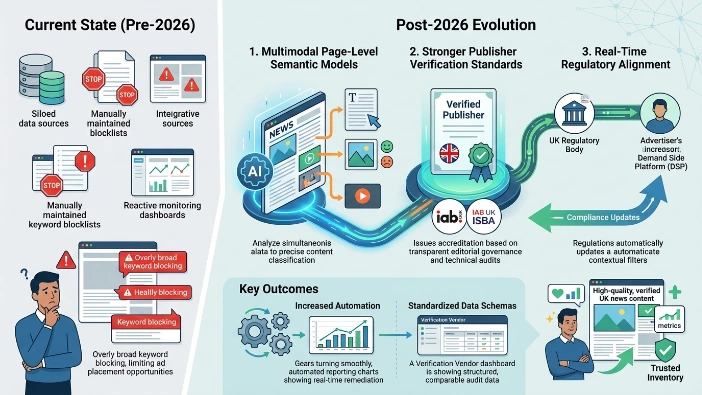
Brand safety will evolve through improved page-level semantic models, stronger publisher verification standards, and real-time regulatory alignment.
Page-level semantic models will incorporate multimodal signals text, images, and video to classify content with higher precision. Publisher verification standards will be formalised, with industry bodies issuing stronger accreditations for editorial governance and technical transparency. Real-time regulatory alignment will link regulatory taxonomies to contextual classifiers so advertisers can enforce compliance with updated rules quickly.
Automation will increase the speed of remediation and reporting. Verification vendors will provide standardised data schemas for easier auditability. These advances will further concentrate safe inventory liquidity in verified news environments while enabling precise targeting and measurement.
Explore the Complete Guide:
How to Plan a UK Banner Campaign Across Multiple News Sites Without Duplicating Reach
Brand safety in UK digital advertising consists of policies, processes, and technologies designed to prevent harmful ad adjacency. News environments score highest in 2026 because editorial governance, metadata standards, verified inventory channels, and independent verification produce clearer provenance, lower adjacency risk, and stronger regulatory alignment. Advertisers achieve safety and scale by using curated whitelists, PMPs or direct deals, page-level contextual filters, and standardised reporting and audit practices. These practices preserve brand integrity while enabling measurable reach and topical relevance in the UK market.



