

An agency partnership is an intermediary arrangement where a marketing or media agency negotiates, manages, and executes campaigns on behalf of the brand; a direct publisher partnership is a direct contractual relationship between the brand and a content publisher for placement and promotion.
An agency acts as a central coordinator. Agencies handle strategy, planning, creative production, buying media, and performance reporting for brands. Agencies maintain relationships with multiple publishers and use those relationships to aggregate inventory, negotiate rates, and bundle services. A direct publisher relationship removes the intermediary. Brands contract the publisher to produce or place content, to run ads, or to host campaigns on the publisher’s owned channels. Agencies usually charge management fees, media markups, or retainers. Direct publisher deals typically use placement fees, content production fees, revenue-share models, or flat sponsorship rates. Agencies provide campaign orchestration across publishers and channels. Publishers provide control over content context, first-party data access, and site-level audience signals.
How do costs compare between agency and direct publisher partnerships?
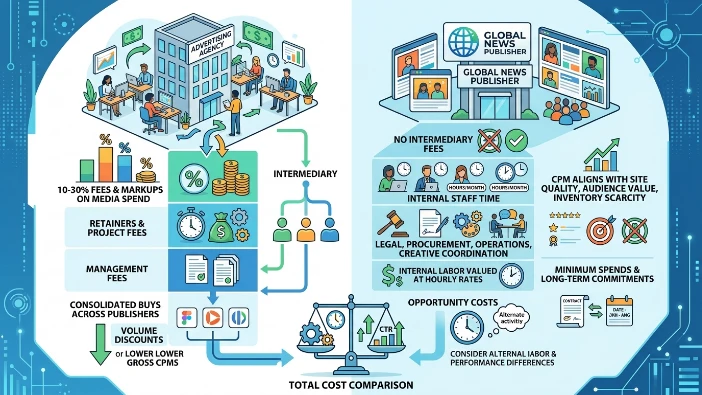
Agency partnerships typically add 10–30% in fees and markups on top of media spend; direct publisher deals remove intermediary fees but require resources for negotiation and campaign management.
Agencies bill through retainers, project fees, or percentage markups on media buys. Typical agency markups in UK digital media vary by service and scale; a conservative range is 10–30% of media spend plus fixed management fees. Agencies consolidate buys to secure volume discounts across publishers, which can lower gross CPMs. Direct deals remove the intermediary markup.
Direct publisher CPMs often align with site quality, audience value, and inventory scarcity. Brands save on agency fees but allocate internal staff time for legal, procurement, operations, and creative coordination. Direct deals can require minimum spends or long-term commitments that change effective cost-per-thousand impressions. Total cost comparison requires accounting for internal labour valued at hourly rates, opportunity costs, and media performance differences.
What operational processes change when switching from an agency to a direct publisher model?
Switching to direct publisher partnerships shifts responsibility for negotiation, contracting, tracking, creative delivery, and measurement from the agency to in-house teams.
An agency manages media planning, publisher sourcing, negotiation, invoicing, trafficking, and consolidated reporting. When a brand moves to direct partnerships, internal teams must adopt those functions or hire specialists. Contracting with publishers requires legal review of terms on exclusivity, usage rights, data sharing, and cancellations. Technical implementation includes ad trafficking, tag management, and verification setup. Measurement requires connecting publisher reporting to the brand’s analytics stack and reconciling first-party data. Creative workflows change because publishers often require specific asset formats and editorial guidance. Procurement and finance must handle multiple invoices and payment terms. Data governance responsibilities increase: direct deals often grant access to publisher first-party data that brands must integrate and protect under UK data protection rules.
What components should brands evaluate in a cost-benefit analysis?
Brands should evaluate fees, media CPMs, performance metrics, time-to-launch, legal risk, data access, and long-term strategic control.
Start by listing direct costs: agency retainer, agency markups, publisher rates, content production costs, and measurement tools. Add indirect costs: internal labour for contract management, ad ops, analytics, and creative handoffs. Compare expected performance: click-through rates, viewability, engagement, and conversion rates per channel or publisher. Assess time-to-launch differences: agencies often accelerate setup; direct deals can require longer negotiation. Evaluate legal and brand safety risk: publisher controls editorial context; agencies often include brand-safety tech and processes. Data access matters: direct publisher relationships usually provide richer first-party signals and audience segments. Strategic control affects the ability to customize creative, test formats, and keep ownership of produced content. Assign monetary values or weighted scores to each component to produce a comparable net benefit figure.
How does measurement and attribution differ between agency and direct publisher models?
Agency partnerships centralise reporting and cross-publisher attribution; direct publisher partnerships require fragmented reporting integration and stronger first-party measurement.
Agencies supply consolidated dashboards that combine publisher metrics, ad server logs, and conversion tracking. Agencies often manage tag implementation, pixel governance, and multi-touch attribution models. In direct partnerships, each publisher supplies its own reports. Brands must reconcile discrepancies in impressions, clicks, viewability, and conversions. Direct publisher deals enable access to first-party audience segments and on-site behavioural data that agencies cannot fully replicate. Effective direct measurement requires a robust analytics stack, server-to-server reporting, and agreed common definitions for metrics. Brands must ensure consistent event mappings and time windows for attribution. Where possible, implement server-side tracking or privacy-first measurement solutions to maintain consistency across direct publishers and owned channels.
What are the benefits of working with agencies for UK brands?
Agencies deliver aggregated buying power, centralised campaign management, creative strategy, and specialist expertise that shortens time-to-launch.
Agencies bring relationships across multiple publishers, which allows volume negotiation and bundled pricing. Agencies provide consolidated planning, single-point reporting, and a single contractual relationship for many publishers. Agencies maintain specialist teams for creative, programmatic trading, analytics, and campaign optimisation. Agencies expedite procurement and technical setup due to established workflows. For brands requiring rapid multichannel rollout, agencies reduce internal hiring needs. Agencies also provide strategic oversight across channels, enabling consistent messaging and cross-publisher testing strategies.
What are the benefits of working directly with publishers for UK brands?
Direct publisher partnerships give brands higher content control, better contextual relevance, access to publisher first-party data, and potential cost savings on fees.
Direct deals allow brands to define editorial context, place custom content, and control creative formats. Publishers offer access to premium inventory, audience segments derived from first-party data, and onsite placements that drive engaged attention. Removing an intermediary reduces markups and increases transparency over media pricing. Direct partnerships also support bespoke commercial models such as revenue share, sponsored content series, or integrated content programmes. These models produce richer performance signals for long-term audience development. Direct arrangements facilitate stronger ownership of produced content and clearer rights for reuse across channels.
What risks and limitations should brands consider for each model?
Agency risks include higher fees, potential dilution of publisher relationships, and less direct control; direct publisher risks include operational overheads, slower scaling, and legal complexity.
An agency can add cost through fees and markups, and may prioritise relationships that serve their broader client roster. Agencies also introduce an extra layer between brand and audience insights. Direct publisher deals shift resource burden to the brand. Negotiation complexity increases, and establishing consistent measurement across multiple publishers takes time. Direct agreements can lock brands into minimum commitments or restricted placements. Both models require strong brand-safety and data-protection protocols. Brands must verify compliance with UK regulations on advertising, consumer protection, and data privacy for both agency-led and direct publisher campaigns.
Explore More Expert Insights:
How 10-Property Media Networks Deliver What Single Publishers Cannot for Brands
Media Partnership Solutions for UK Brands: Scope, Timeline and Investment Guide
When does a direct publisher model deliver the greatest ROI for UK brands?
Direct publisher partnerships deliver highest ROI when brands pursue long-term content programmes, need first-party audience building, or require premium contextual placements.
Direct deals work best for sustained campaigns with repeated placements, sponsored content series, or audience-development objectives. Brands that prioritise content quality and editorial alignment gain from direct control over placements and creative. When first-party data integration is essential for personalisation or measurement, direct access to publisher segments improves targeting and attribution. High average order value campaigns or niche B2B audiences benefit from publisher alignment and bespoke formats. Evaluate the expected campaign duration and frequency: direct partnerships show positive ROI when campaigns run multiple activations over 6–18 months.
How should UK brands decide between agency and direct publisher partnerships?
Decide by quantifying costs, mapping internal capabilities, assessing campaign duration, and matching objectives to the strengths of each model.
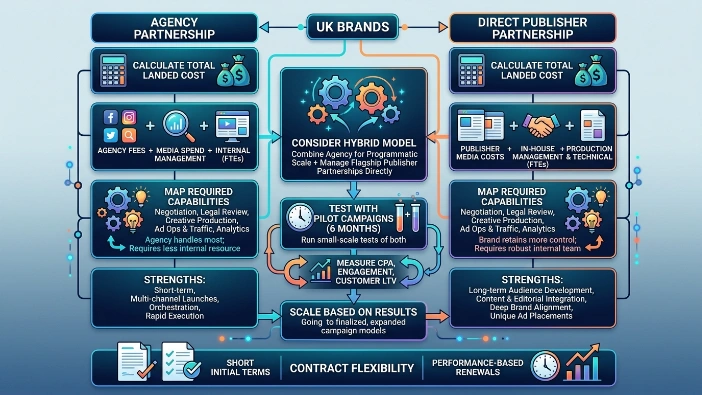
Calculate total landed cost for both models including internal labour. Map required capabilities: negotiation, legal review, creative production, ad ops, and analytics. Match campaign objectives to model strengths: short-term, multi-channel launches prefer agency orchestration; long-term audience development and editorial integration favour direct publisher deals. Consider hybrid models: use an agency for programmatic scale and manage flagship publisher partnerships directly.
Explore the Complete Guide:
What B2B Creator Partnerships Look Like in 2026 Versus 2023 in the UK
Test with pilot campaigns and measure CPA, engagement, and customer LTV over six months to inform a scaled decision. Use contract clauses to preserve flexibility, such as short initial terms or performance-based renewals.
Learn More Here:
How to Negotiate a UK Publisher Partnership That Protects Your Brand and Budget



