

A media partnership solution is a structured agreement between a brand and a media owner or network that defines scope, deliverables, measurement, and commercial terms to achieve specific business outcomes within the UK regulatory environment.
Define media partnership solution as a contracted collaboration where a media partner provides audience access, content placement, creative support, and measurement capabilities. Define brand as a commercial entity seeking audience reach, lead generation, sales, or awareness. In the UK, partnerships operate under Advertising Standards Authority rules and data protection regulation enforced by the Information Commissioner’s Office. A solution bundles services: audience targeting, creative production, media buying, measurement reporting, and optimisation. The solution replaces ad-hoc buys with accountable outcomes tied to KPIs and contractual remedies.
What scope elements must a media partnership include?
Scope elements include objectives and KPIs, target audience definitions, channel formats and placements, creative responsibilities, measurement framework, and compliance obligations.
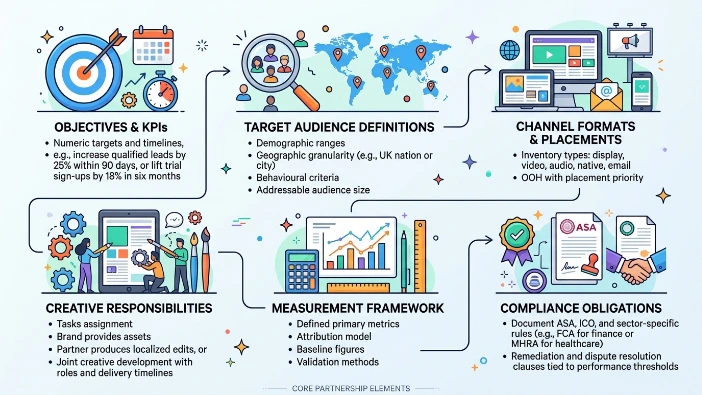
Objectives list explicit numeric targets and timelines, for example increase qualified leads by 25% within 90 days or lift trial sign-ups by 18% in six months. Target audience definitions require demographic ranges, geographic granularity (for example UK nation or city), behavioural criteria, and addressable audience size. Channel formats specify inventory types such as display, video, audio, native, email, and OOH with placement priority.
Creative responsibilities assign tasks: brand provides assets, partner produces localized edits, or joint creative development with roles and delivery timelines. A measurement framework defines primary metrics, attribution model, baseline figures, and validation methods. Compliance obligations document ASA, ICO, and sector-specific rules such as FCA for finance or MHRA for healthcare. Include remediation and dispute resolution clauses tied to performance thresholds.
How long does a typical media partnership take from scoping to launch?
The typical timeline runs 8–14 weeks from initial scoping to live campaign, with steps for discovery, contracting, creative production, technical setup, pilot testing, and launch.
Week 1–2 covers discovery: objectives, audience definition, and initial partner shortlist. Week 3–5 covers contracting: scope finalisation, data-sharing agreements, and SLAs. Week 4–8 overlaps creative production with approval cycles and asset delivery. Week 6–9 covers technical setup: tag deployment, API integration, consent configuration, and QA. Week 8–12 includes pilot execution with holdout controls and initial measurement. Week 10–14 holds launch and scaling phases contingent on pilot success gates. Timelines compress for simple campaigns and extend for cross-platform or regulated campaigns requiring legal sign-off. Build contingency time for third-party verification and data access provisioning.
How should brands budget for media partnership investments?
Budget components include media spend, production costs, partner fees, measurement and verification fees, and contingency; allocate percentages based on campaign complexity and objectives.
Set media spend as the largest line, typically 60–80% of total investment for awareness and direct response campaigns. Production costs for creative and localization represent 8–15% of total. Partner fees for audience access, campaign management, and creative services represent 10–20% depending on bundled services and performance risk. Measurement and verification fees for third-party providers represent 2–5%. Contingency of 5–10% covers unforeseen technical or compliance costs. For example, a £500,000 total campaign might allocate £350,000–£400,000 to media, £40,000–£75,000 to partner fees, £40,000–£75,000 to production, £10,000–£25,000 to verification, and £25,000 for contingency. Adjust allocations for pilots by reducing media spend and increasing measurement proportionally.
What commercial models exist and how do they affect risk and outcomes?
Commercial models include CPM/CPC buys, fixed-fee retainers, revenue-share or performance-based models, and hybrid contracts that blend fixed and variable elements to balance risk and incentives.
CPM and CPC models assign direct cost per thousand impressions or per click and suit campaigns prioritising scale. Fixed-fee retainers pay for scope and operational management and suit long-term content partnerships. Performance-based models tie fees to outcomes such as leads or sales and shift risk to the partner, with agreed verification methods. Hybrid contracts combine base retainers with performance bonuses or penalties tied to numerical KPIs. Model selection affects agency alignment: performance models incentivise outcome delivery but require robust attribution and verification. Ensure contracts detail measurement methods and dispute resolution for performance claims.
What measurement practices ensure contractual accountability?
Ensure contractual accountability with baseline measurement, agreed attribution model, independent verification, regular reporting cadence, and remediation clauses tied to numeric thresholds.
Baseline measurement records pre-campaign metrics such as conversion rate, average order value, or awareness levels. Agree an attribution model: last-click, multi-touch, or incrementality testing using holdout groups. Include provisions for third-party verification of viewability, invalid traffic, and conversions. Define reporting cadence: weekly operational dashboards and monthly strategic reviews with raw data access. Remediation clauses specify make-goods, payments withheld, or termination triggers when performance falls short by defined percentages. Require access to server-to-server logs or hashed identifiers for traceability while complying with UK data protection law.
What technical integrations and data agreements are required?
Required integrations include tag deployment, audience sync APIs, consent management integration, CRM data feeds, and data-processing agreements that define access and retention.
Tag deployment enables measurement and conversion tracking. Audience sync APIs allow matched targeting and frequency management across platforms. Consent management must integrate with the partner’s systems to ensure lawful processing under UK data protection rules and define lawful bases. CRM data feeds provide offline conversion matching and LTV analysis. Data-processing agreements define roles, subprocessors, retention periods, and security standards. Ensure encryption, access controls, and data minimisation in contracts. Include technical acceptance criteria and timelines to avoid launch delays.
What outcomes and ROI can brands expect from well-executed partnerships?
Expected outcomes include measurable lift in targeted KPIs, reduced acquisition costs, faster time-to-insight, and demonstrable ROI calculated from lift versus baseline and total investment over defined periods.
Outcomes depend on objectives and baseline. For acquisition campaigns, expect 10–40% improvement in conversion rates during optimised phases and a 15–30% reduction in cost per acquisition relative to untargeted buys. For awareness and consideration campaigns, expect measurable lift in brand metrics such as ad recall and purchase intent within 4–12 weeks. Time-to-insight shortens when reporting is automated, reducing analysis cycles by 50% in some cases. Calculate ROI by comparing incremental revenue or lifetime value attributable to the partnership against total campaign costs, using holdout groups or incrementality tests for causal attribution.
Explore More Expert Insights:
What a Fully Managed UK Media Partnership Delivers in 90 Days: Real Numbers
Scaling Into UK Media: Partnership Timelines, Costs and Results
What use cases demonstrate successful media partnership structures in the UK?
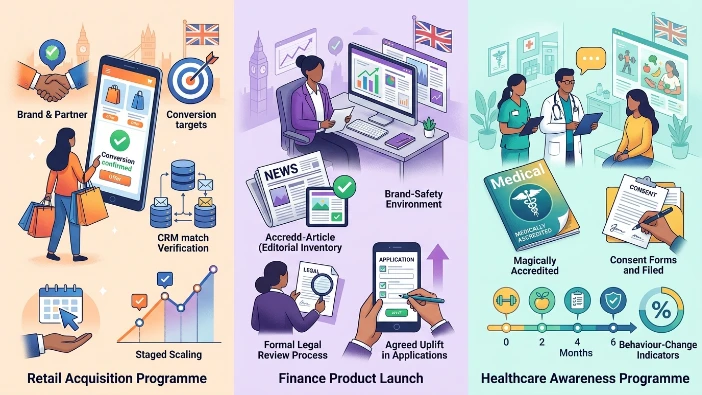
Use cases include a retail acquisition programme using performance-based contracts, a finance product launch requiring regulatory review and brand-safety environments, and a healthcare awareness programme demanding editorial expertise and strict compliance.
In retail acquisition, partnerships used performance-based models with CRM match for conversion verification. Contracts specified conversion targets and staged scaling. In finance product launches, partners provided editorial inventory within regulated-safe contexts and formal legal review processes for creative, with measurement via agreed uplift in applications. In healthcare awareness programmes, partners supplied editorial partnerships with medically accredited content, strict consent workflows, and measurement via behaviour-change indicators tracked over six months. Each use case required tailored commercial terms and measurement protocols.
What practical steps finalise a media partnership contract?
Final steps include confirming KPI baselines, embedding measurement clauses, signing data-processing agreements, scheduling pilot phases with success gates, and formalising payment and remediation terms.
Confirm baseline metrics and lock in the attribution method in contract appendices. Embed measurement clauses specifying third-party verification and access to logs. Sign data-processing agreements that meet UK data-protection standards. Schedule a pilot phase of defined duration and budget with numeric success gates. Finalise payment terms that include holdbacks or performance tranches linked to milestones. Ensure contract includes termination and remediation language tied to objective thresholds and a governance schedule for regular reviews.
For More Details, Explore:
How to Identify the Right UK Media Partner for Your Industry in 4 Steps
Media partnership solutions for UK brands require precise scope definitions, realistic timelines, structured budgets, and contract models that align incentives. Include rigorous measurement, independent verification, technical integrations, and compliance documentation. Use pilots with defined success gates and staged scaling to manage risk. For more detailed implementation templates, measurement frameworks, and sector-specific guides, consult industry resources and legal counsel specialised in media contracts.
Learn More Here:
69% of UK Marketers Think Their Strategy Works — Their Audiences Disagree



