
A 10-property media network is an organised group of ten distinct publisher titles or channels that share audience, commercial, and measurement infrastructure under a single negotiated deal. It combines ten editorial ecosystems to offer brands scale, diverse audiences, and centralised campaign management.
A 10-property network defines each property by vertical (news, finance, and lifestyle), audience profile, and content format. The network centralises commercial terms, inventory allocation, campaign trafficking, and reporting. Contracts cover aggregated inventory guarantees, cross-title exclusivity rules, unified pricing, and attribution frameworks. Commercial teams map brand objectives to specific properties and audience segments across the ten titles. Operationally, the network reduces negotiation time by replacing ten separate media buys with a single agreement and a single point of contact.
What components enable better targeting at scale?
Components include a shared first-party data pool, cross-title audience segments, unified identity resolution, and central activation tools. These elements enable brands to target defined cohorts with scale across ten properties.
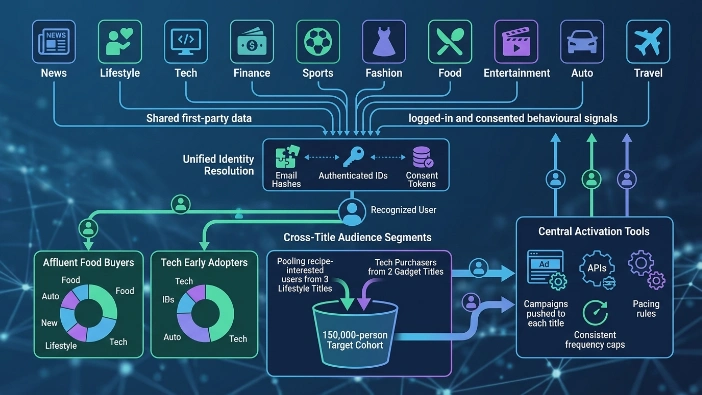
Shared first-party data aggregates logged-in and consented behavioural signals from all ten properties. Cross-title audience segments classify users into cohorts such as “affluent food buyers” or “tech early adopters” with population sizes broken down by title and combined totals. Unified identity resolution links identifiers—email hashes, authenticated IDs, and consent tokens—so the same user is recognised across properties. Central activation tools push campaigns to each title through a single ad server or API, using consistent frequency caps and pacing rules. Real examples include pooling recipe-interested users from three lifestyle titles and tech purchasers from two gadget titles to create a 150,000-person target cohort.
What measurement and attribution advantages exist?
A 10-property network provides unified reporting, consistent attribution windows, cohort-level attribution, and cross-title lift testing to show aggregated and per-property outcomes. This creates clearer links between spend and outcomes.
Unified reporting standardises metrics such as viewable impressions, engaged minutes, completion rates, and conversions per 1,000 users. Attribution uses a common last-touch or multi-touch model agreed upfront and applies the same time window across titles to avoid inconsistent crediting. Cohort-level attribution tracks conversions for users exposed on multiple properties versus those exposed on a single property. Cross-title lift testing runs controlled experiments where one set of regions or user cohorts receives network exposure and a matched control receives none, enabling statistically valid uplift measurement. The network aggregates results and shows per-property contribution so brands see which titles deliver the best cost-per-conversion.
What commercial models do networks offer that single publishers rarely provide?
Networks offer guaranteed cross-title impressions, audience-based CPM tiers, blended inventory packages, performance-based revenue share, and audience licensing deals. These models provide predictable scale and direct alignment with business outcomes.
Guaranteed cross-title impressions commit a fixed number of viewable impressions across the ten properties with penalties for under-delivery. Audience-based CPM tiers price inventory by segment value, for example £15 CPM for high-intent commerce cohorts and £5 CPM for mid-funnel awareness. Blended inventory packages mix premium editorial placements and high-frequency social formats under one fee. Performance-based revenue share ties part of the network fee to agreed KPIs such as cost-per-lead or cost-per-sale. Audience licensing allows brands to access anonymised, consented segments for their own activation. Single publishers struggle to match this because they lack the breadth of inventory and cross-title governance for guaranteed, blended, or licensed group-wide offers.
What creative and format benefits do networks provide?
Networks enable multi-format storytelling across ten editorial environments, integrated content series, and repurposing of creative assets at scale. Brands use a consistent narrative across display, native, video, audio, and newsletters to increase impact.
Creative teams coordinate editorial calendars across properties to run a central content series adapted per title. For example, a five-episode video series runs on the network’s main site, promoted via native articles on three lifestyle titles, short social clips on two social-first titles, and audio summaries in two podcast channels. Centralised creative specifications reduce asset variations to manageable templates while allowing editorial adaptations. The network ensures consistent message timing, frequency capping, and cross-promotion to avoid audience fatigue. This multi-format orchestration produces higher aggregate completion rates and deeper engagement than single-title campaigns.
What operational efficiencies reduce campaign friction?
Operational efficiencies include single contracting, consolidated trafficking, unified QA, and one invoice for all properties. These efficiencies shorten launch time and lower administrative costs.
Single contracting eliminates repetitive legal negotiation with ten publishers. Consolidated trafficking uses one ad server configuration and a unified creative library to distribute assets across properties. Unified quality assurance applies the same technical checks—tag validation, viewability verification, and creative rendering—in one pass. Consolidated invoicing issues one monthly statement with property-level line items. Brands save internal procurement time and reduce time-to-live by 20 to 60 percent versus coordinating with ten independent publishers.
What risks and governance challenges require attention?
Risks include audience overlap, double-counting, inconsistent disclosure standards, and data-sharing compliance; governance must set deduplication, unified disclosure, and privacy controls. Addressing these risks preserves measurement integrity and legal compliance.
Audience overlap occurs when the same users appear on multiple properties, inflating reach metrics unless deduplication is applied. Double-counting affects frequency capping and unique reach calculations. The network must implement identity resolution and dedupe logic with transparent methodologies. Disclosure standards require consistent labelling for sponsored or branded content across titles to meet advertising rules. Data-sharing compliance demands documented lawful bases, consent preservation, and secure data transfer mechanisms across properties. Governance documents include audit rights, data-retention policies, and a single escalation path for disputes.
What outcomes do brands achieve when using a 10-property network?
Brands achieve larger unique reach, improved cost-efficiency per conversion, richer audience insights, and simplified campaign management. These outcomes produce measurable uplifts in scale and efficiency.
Unique reach increases because combined audiences across ten properties deliver larger and more varied cohorts. Cost-efficiency improves when network negotiation secures volume discounts and optimises audience allocation to lower cost-per-conversion. Richer audience insights arise from pooled engagement data and cross-title behavioural profiles that reveal content paths and affinity clusters. Simplified campaign management reduces time spent on procurement, trafficking, and reporting. Reported outcomes include reach increases of 2x to 5x compared to a single top-tier title and conversion cost reductions of 15 to 35 percent in performance-linked campaigns.
Explore More Expert Insights:
Media Partnership Solutions for UK Brands: Scope, Timeline and Investment Guide
What a Fully Managed UK Media Partnership Delivers in 90 Days: Real Numbers
Which use cases suit 10-property networks best?
Use cases include national brand launches, product rollouts across segments, multi-format content campaigns, and measurement-driven performance programmes. Networks scale campaigns that need broad reach or diverse audience coverage.
National brand launches require rapid, large-scale awareness across regions and demographics; networks supply coordinated reach across titles. Product rollouts that target discrete segments—commuters, parents, professionals—use property selection within the network. Multi-format content campaigns that require video, native, and audio benefit from property specialisms. Measurement-driven performance programmes use the network’s unified attribution and cohort testing to optimise for conversions. Each use case leverages the network’s combined inventory, centralised execution, and consolidated measurement.
How should brands evaluate a 10-property network?
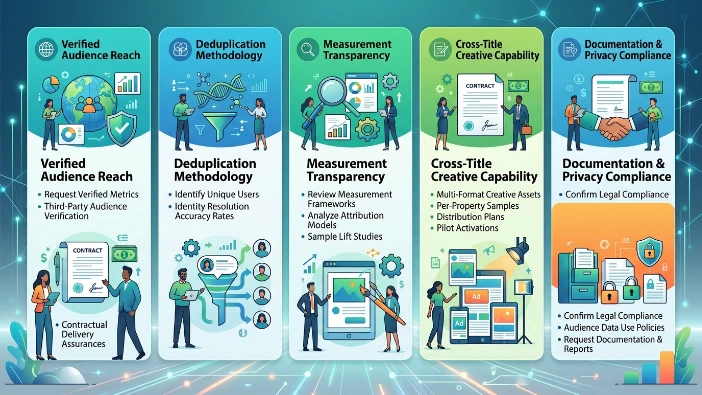
Evaluate networks by verified audience reach, deduplication methodology, measurement transparency, contractual guarantees, and cross-title creative capability. Use documented evidence and sample reports when assessing suitability.
Request verified audience metrics with third-party audience verification where available. Ask for deduplication methods and identity resolution accuracy rates. Review measurement frameworks, attribution models, and sample lift studies. Examine contractual guarantees for delivery, pricing floors, and remediation clauses. Test creative capability with pilot activations and request per-property creative samples and distribution plans. Confirm legal and privacy compliance documentation for audience data use.
Read the Full Blog Here:
The Rise of Publisher-Brand Alliances: How UK Media Is Monetising Differently
Ten-property media networks combine scale, diverse audiences, centralised operations, and consistent measurement to deliver outcomes that single publishers cannot match. They reduce procurement friction, enable multi-format storytelling, and provide unified attribution that links spend to business outcomes. Brands pursuing national reach, segmented rollouts, or performance-linked campaigns benefit from the network model when evaluation focuses on verified reach, deduplication, measurement transparency, and contractual guarantees.
Get Detailed Information Here:
Content Licensing vs Co-Creation: Which Media Partnership Model Suits Your Brand?