

A publisher-brand alliance is a formal collaboration where a media owner and a commercial brand share content creation, audience access, and revenue opportunities. These alliances combine publisher editorial reach with brand marketing budgets to deliver jointly produced content and monetisation models.
A publisher-brand alliance defines partners, objectives, content rights, distribution windows, and revenue splits. Publishers provide audience data, editorial platforms, production capabilities, and distribution channels. Brands provide creative briefs, product information, marketing budgets, and campaign measurement needs. Contracts specify licensing terms, usage rights, exclusivity periods, and performance metrics. Legal elements include intellectual property assignment, moral rights waivers for commissioned contributors, and data-processing agreements when audience data is shared.
How do publisher-brand alliances function in practice?
Alliances operate through agreed workflows: planning, content production, distribution, audience measurement, and revenue reconciliation. Collaborative governance ensures editorial integrity, legal compliance, and campaign performance tracking.
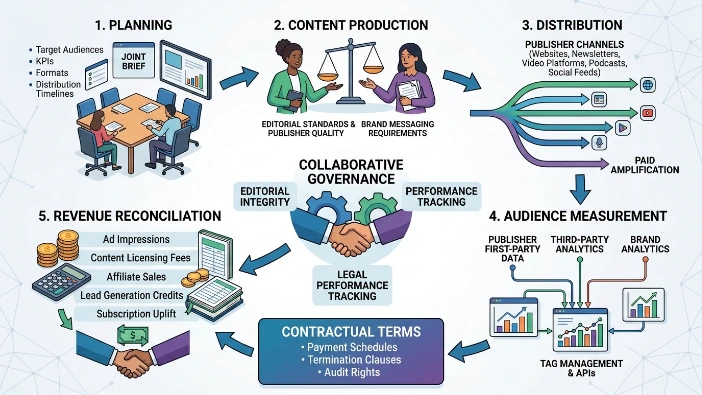
Planning begins with a joint brief that sets target audiences, KPIs, formats, and distribution timelines. Content production follows editorial standards that align with publisher quality while meeting brand messaging requirements. Distribution exploits publisher channels—websites, newsletters, video platforms, podcasts, and social feeds plus paid amplification when required. Audience measurement uses publisher first-party data, third-party analytics, or brand analytics linked through tag management and APIs. Revenue reconciliation tallies ad impressions, content licensing fees, affiliate sales, lead generation credits, or subscription uplift. Contractual terms outline payment schedules, termination clauses, and audit rights.
What revenue models do publishers and brands use together?
Revenue models include content licensing fees, sponsored content, revenue share on commerce, lead-generation payments, subscription bundling, and programmatic inventory allocation. Each model allocates value differently between publisher and brand.
Content licensing fees involve fixed payments from brands to publishers for reuse rights across brand channels or for syndication. Sponsored content pays publishers for producing branded articles, videos, or native placements. Commerce-linked revenue shares allocate a percentage of sales generated through publisher-created commerce pages or affiliate links. Lead-generation models pay per qualified lead delivered to the brand. Subscription bundling involves including branded content or offers inside paid newsletter or subscriber products, with the brand compensating for inclusion. Programmatic allocation assigns a share of premium inventory or guaranteed impressions to brand partners in exchange for fixed revenue or CPM floors.
What are the core components of successful alliances?
Core components are clearly defined objectives, aligned editorial guidelines, shared audience data, robust measurement frameworks, legal clarity, and defined revenue mechanics. These elements ensure operational efficiency and measurable outcomes.
Objectives must be quantifiable: brand awareness lift, sales conversion rates, lead volume, or subscription growth. Editorial guidelines list tone, fact-checking protocols, disclosure requirements, and placement rules to maintain reader trust. Shared audience data includes segments, engagement metrics, and content performance benchmarks that inform targeting and creative choices. Measurement frameworks specify attribution models, reporting cadence, and success thresholds. Legal clarity covers licensing terms, content ownership, indemnities, and data protection obligations. Revenue mechanics document pricing, invoicing, payment milestones, and what constitutes billable deliverables.
What benefits do publisher-brand alliances deliver for publishers?
Publishers gain diversified revenue, strengthened audience monetisation, reduced reliance on programmatic ads, and enhanced content production budgets. These benefits improve financial stability and content quality.
Diversified revenue arises from fixed licensing and sponsorship payments that reduce cyclical ad income volatility. Audience monetisation improves when publishers package premium, contextual inventory for brand partnerships, converting high-intent readers into long-term subscribers or commerce customers. Reduced reliance on programmatic ads lowers exposure to ad-fraud and header-bidding complexities. Enhanced production budgets enable higher-quality journalism, video series, and podcast production that attract engaged audiences and justify premium pricing.
What benefits do brands obtain from these alliances?
Brands acquire contextual credibility, publisher audience access, improved content quality, and measurable engagement tied to editorial environments. These outcomes increase message relevance and campaign efficiency.
Contextual credibility arises from association with trusted editorial environments and third-party fact-checking. Brands access defined audience cohorts with known behaviours, rather than buying anonymous programmatic impressions. Higher content quality results from publisher production capabilities—investigative features, studio-quality video, and professional editorial oversight—that increase dwell time and persuasion. Measured engagement comes from publisher analytics on session duration, scroll depth, and subscription uplift, enabling brands to connect spend to meaningful outcomes.
What use cases show how alliances monetise differently?
Use cases include long-form branded series, licensed editorial formats, commerce integrations, co-produced events, and subscriber-funded sponsored hubs. Each use case maps specific monetisation mechanics to audience behaviour.
Long-form branded series involve episodic video or written features funded by brand fees and distributed across publisher platforms, with measurement tied to view completion and social engagement. Licensed editorial formats allow brands to republish publisher-created explainers under licence on brand properties, paying fixed fees for distribution rights. Commerce integrations transform editorial into shopping channels where publishers run product pages and share revenue on transactions. Co-produced events translate content themes into physical or virtual events with ticket sales, brand sponsorship, and premium access tiers. Subscriber-funded sponsored hubs place brand-funded content behind subscriber walls where the publisher retains subscription revenue and charges the brand for preferential placement.
What governance and compliance issues require attention?
Governance demands editorial independence clauses, transparent disclosure, data privacy compliance, and audit rights. Addressing these issues preserves trust and legal compliance.
Editorial independence clauses protect newsroom decisions and specify where brand input is limited to factual corrections or compliance checks. Transparent disclosure mandates clear labelling of sponsored content and native advertising to meet regulatory guidance and consumer expectations. Data privacy compliance requires lawful bases for processing, data minimisation, and secure transfer mechanisms when sharing audience segments. Audit rights allow brands to verify performance metrics while publishers retain protections over proprietary analytics methodologies. Contractual safeguards cover liability, indemnity, and dispute-resolution pathways.
Explore More Expert Insights:
69% of UK Marketers Think Their Strategy Works — Their Audiences Disagree
Why Human-Generated Media Partnerships Beat AI Content for UK Audience Trust
How do publishers measure the success of alliances?
Success measurement uses defined KPIs such as engaged views, session duration, conversion rate, subscription uplift, and ROI metrics. These KPIs connect editorial activity to business outcomes.
Engaged views quantify video completion rates or article read-through rates. Session duration and scroll depth indicate content relevance and retention. Conversion rate tracks actions like newsletter sign-ups, product purchases, or trial activations attributable to the alliance. Subscription uplift measures net new paid subscribers attributable to a partnership campaign. ROI metrics compare total campaign cost against incremental revenue from direct sales, lifetime value of converted subscribers, or long-term brand lift studies.
What future trends will shape publisher-brand alliances in the UK?
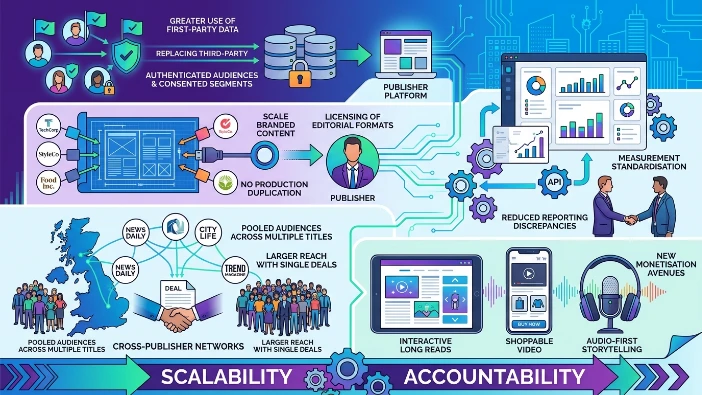
Future trends include greater use of first-party data, more licensing of editorial formats, cross-publisher networks, and measurement standardisation. These trends increase scalability and accountability.
First-party data replaces third-party cookies; publishers rely on authenticated audiences and consented segments for targeting. Licensing of editorial formats allows publishers to scale branded content without duplicating production resources. Cross-publisher networks create pooled audiences across multiple titles to offer brands larger reach with single deals. Measurement standardisation emerges through industry bodies and common APIs to reduce discrepancies across reporting systems. Advances in content formats—interactive long reads, shoppable video, and audio-first storytelling—create new monetisation avenues.
Discover More Insights:
Content Licensing vs Co-Creation: Which Media Partnership Model Suits Your Brand?
Publisher-brand alliances reconfigure monetisation away from purely programmatic ads toward mixed models that combine licensing, sponsorship, commerce, subscriptions, and event revenue. Clear contracts, shared data, rigorous measurement, and editorial safeguards enable alliances to deliver distinct commercial outcomes for both publishers and brands. The UK market’s shift to first-party data, format licensing, and cross-publisher cooperation will accelerate these models and create scalable, accountable revenue streams.
Learn More Here:
How 10-Property Media Networks Deliver What Single Publishers Cannot for Brands



