
The headline reports a measurable gap: 69% of surveyed UK marketers report confidence in their marketing strategies, while independent audience feedback and engagement data indicate lower alignment and effectiveness. This describes a perception–reality discrepancy between marketers and audiences.
The figure signals a divergence between marketer self-assessment and observable audience behavior. Marketers evaluate strategy through internal metrics, campaign plans, and channel choices. Audiences express their views through engagement rates, survey responses, conversion actions, and retention metrics. When internal confidence reaches 69% but audience indicators do not corroborate that confidence, the result is a credibility and performance gap. Researchers and analysts use cross-sectional surveys, controlled experiments, and longitudinal analytics to quantify this gap. The phrase “audiences disagree” refers to measurable signals such as falling engagement, low trust scores, negative sentiment in feedback, or low conversion relative to benchmarks.
Why does this perception gap occur?
The gap arises from differing measurement perspectives: marketers rely on input and reach metrics while audiences respond through behavioural metrics and sentiment, producing inconsistent assessments of effectiveness.
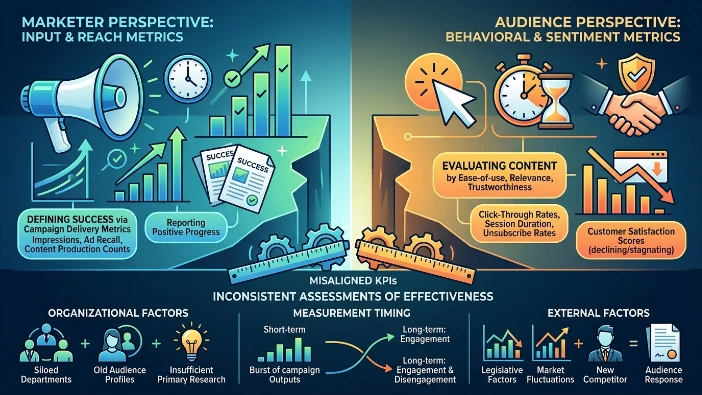
Marketers often define success using campaign delivery metrics, such as impressions, ad recall, or content production counts. Audiences evaluate content by ease-of-use, relevance, and trustworthiness, which generate measurable behavioral outcomes: click-through rates, session duration, unsubscribe rates, and customer satisfaction scores. Misaligned Key Performance Indicators (KPIs) create a situation where marketing teams report positive progress while audience-derived metrics decline or stagnate. Organisational factors also affect the gap siloed teams, outdated audience personas, and insufficient primary research. Measurement timing matters: marketers may report short-term campaign outputs while audiences reveal long-term disengagement. External factors such as market shifts, regulatory changes, and competitor moves influence audience response independently from marketer assessments.
How can marketers measure audience agreement accurately?
Marketers must measure audience agreement with direct behavioral metrics, structured feedback mechanisms, and longitudinal cohorts to validate claimed strategy effectiveness.
Accurate measurement requires three categories of data. First, quantitative behavioral metrics include conversion rates, time-on-site, repeat purchase rates, and churn rates. Second, qualitative feedback captures sentiment through structured surveys, focus groups, and open-text analysis. Third, comparative benchmarking uses industry-standard metrics and independent third-party studies. Combine these sources in time-series analysis to detect trends. Use representative sampling across demographics and channels to avoid bias. Calibration of internal KPIs against audience-centered metrics prevents inflated self-assessment. For example, if a campaign reports high reach but zero lift in conversion and negative survey sentiment, audience disagreement is validated. Implementing continuous tracking of Net Promoter Score (NPS) or Customer Effort Score (CES) alongside engagement metrics provides ongoing validation.
What components of a marketing strategy cause audience disagreement?
Components that produce audience disagreement include inaccurate audience segmentation, irrelevant messaging, poor channel fit, and inconsistent experience across touchpoints.
First, audience segmentation errors occur when personas are outdated or based solely on demographic assumptions rather than behavioral data. Second, messaging issues arise when content lacks clarity, utility, or credibility for the target audience. Third, channel mismatch happens when the chosen channels are not where priority audience segments consume information. Fourth, inconsistent customer experience appears when brand voice, value proposition, or service levels vary across channels. Each component produces distinct observable signs: high bounce rates signal poor content relevance, low repeat engagement signals weak value delivery, and negative sentiment in social channels signals credibility problems. Correcting these components requires direct audience research, iterative testing, and alignment of channel strategy with observable consumption patterns.
How does measurement bias contribute to inaccurate marketer confidence?
Measurement bias appears when internal metrics over-represent favourable signals, sampling is non-representative, or attribution models inflate perceived campaign impact.
Measurement bias takes several forms. Self-selection bias occurs when feedback comes from highly engaged or extreme opinion groups rather than a representative sample. Attribution bias emerges when last-click models or simplistic attribution frameworks assign outsized credit to marketing touchpoints. Survivorship bias exists when only successful campaigns are analysed, ignoring failures. Confirmation bias happens when teams prioritise metrics that support existing beliefs. These biases create a false-positive signal that strategies work. Removing bias requires randomised controlled trials, holdout groups, and attribution models that account for multi-touch journeys. External audits and independent benchmarking reduce internal echo chambers and reveal true audience response.
What process should organisations follow to close the perception–reality gap?
Organisations should adopt a four-step process: align KPIs to audience outcomes, perform representative audience research, run controlled experiments, and integrate findings into iterative strategy updates.
Step one: redefine success metrics to prioritise audience outcomes such as retention, satisfaction, and lifetime value. Step two: conduct representative research using stratified sampling and mixed methods, combining surveys, interviews, and behavioral logs. Step three: run experiments such as A/B tests, geo-based rollouts, and holdout groups to isolate causal effects. Step four: implement a feedback loop where experimental results update personas, creative direction, and channel mix on a regular cadence. Governance requires clear ownership for audience metrics and regular reporting to leadership. Document hypotheses, test results, and decision rules to maintain transparency and reproducibility.
What are the benefits of aligning marketer perception with audience data?
Alignment improves resource allocation, increases return on investment, raises audience retention by measurable percentages, and strengthens long-term brand equity.
When perception aligns with audience data, organisations allocate budgets to channels and messages that produce measurable outcomes. Improved targeting reduces cost per acquisition by quantifiable amounts and increases conversion efficiency. Audience-centered strategies increase retention and repeat purchase rates, raising lifetime value. Transparent, evidence-based decision-making increases stakeholder trust and reduces wasted activity. Public-facing benefits include higher credibility scores and improved word-of-mouth metrics. Internally, teams gain clarity on prioritisation and reduce redundant campaigns. Measured improvements appear in campaign lift studies, benchmark comparisons, and operational KPIs.
What use cases show this discrepancy clearly in the UK market?
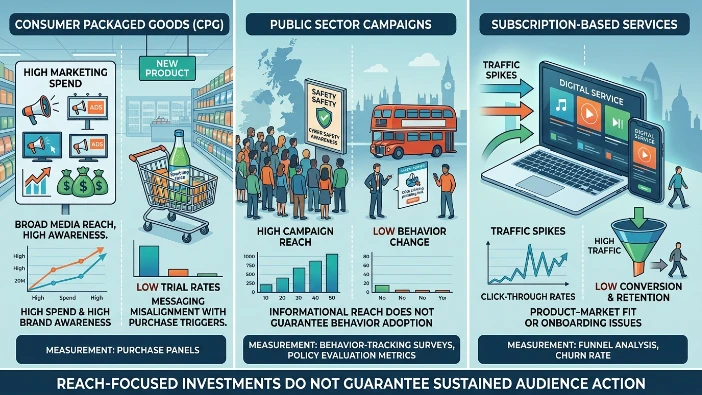
Use cases include consumer packaged goods launches with low trial despite heavy spend, public sector awareness campaigns with high reach but low behavior change, and subscription services with high traffic but low conversion.
In consumer packaged goods, campaigns with broad media reach often fail to convert when messaging misaligns with purchase triggers; trial rates remain below expectations despite high awareness. In public health or safety campaigns, informational reach does not guarantee behavior change; surveys frequently show awareness without adoption of recommended actions. For subscription-based digital services, marketing may drive traffic spikes while conversion and retention lag, indicating product–market fit or onboarding issues. Each use case requires targeted measurement approaches: purchase panels for CPG, behavior-tracking and policy evaluation metrics for public sector, and funnel analysis for subscription services. Case data from independent studies demonstrate consistent patterns: reach-focused investments do not guarantee sustained audience action.
Explore More Expert Insights:
Why Human-Generated Media Partnerships Beat AI Content for UK Audience Trust
Third-Party Validation Now Drives More Pipeline Than Owned Content
How should researchers and analysts cite and validate the “69%” claim?
Analysts should source the claim to the original survey or report, verify sampling methodology, check question wording, and cross-reference independent audience metrics.
Validation steps include locating the primary source of the 69% figure and confirming sample size, sampling method, and survey timing. Examine whether the survey sampled marketers across industry sectors and company sizes. Confirm question wording to detect leading or ambiguous phrasing. Cross-reference the claim with independent audience data from analytics platforms, third-party market research, or academic studies. Document any discrepancies and present both the marketer-reported figure and audience-derived metrics side by side. When publishing, include citations to the primary data and methodological notes to ensure transparency and reproducibility.
How should readers continue learning about media partnership selection and solution planning?
Readers should study process-orientated content that moves from identification, evaluation, and contracting to measurement and optimisation to gain practical skills for media partnership selection and planning.
Start with frameworks that define partner criteria, such as audience overlap, editorial fit, measurement capabilities, and compliance standards. Learn evaluation techniques including pilot campaigns, performance-based contracts, and third-party verification. Study contract terms that specify metrics, reporting frequency, and remediation clauses. Build measurement plans that include baseline data, control groups, and continuous optimisation protocols. For further reading on intermediate and advanced stages of partnership selection and solution planning, consult resources that focus on evaluation frameworks and investment guidance.
Get the Full Insights Here:
How to Identify the Right UK Media Partner for Your Industry in 4 Steps
Concluding factual summary: The reported 69% figure highlights a measurable mismatch between marketer confidence and audience response. Closing that gap requires audience-centred KPIs, representative measurement, controlled testing, and iterative governance. Implementing these practices produces verifiable improvements in engagement, conversion, and retention metrics.
Read More to Understand Better:
Media Partnership Solutions for UK Brands: Scope, Timeline and Investment Guide