

Content licensing is a contractual transfer of rights that allows a brand to republish or reuse publisher-owned content under specified terms. Licensing assigns usage windows, territories, formats, and payment terms while the publisher retains core editorial ownership or grants limited rights.
Content licensing defines the licensed asset, permitted channels, and duration. Licences specify exclusivity or non-exclusivity, language rights, and derivative-work allowances. Typical licences cover articles, video episodes, podcasts, images, and data sets. Payments take the form of fixed fees, tiered fees by territory, or recurring licence payments. Legal clauses address attribution, moral rights, indemnity, and termination. Licensing supports scale when brands need ready-made editorial or data without running full production workflows.
Co-creation is a collaborative production process where a brand and publisher jointly develop content from concept through distribution and measurement. Co-creation shares creative control, production resources, and often revenue or cost responsibilities.
Co-creation establishes joint governance: a steering group, a creative director from the publisher, and brand content lead. The partnership defines deliverables, editorial standards, production timelines, and distribution plans. Co-creation typically uses publisher studios, editorial teams, and brand marketing teams working on scripts, shoots, and editorial drafts together. Financial arrangements include shared production budgets, profit-share on commerce outcomes, or fixed contributions by each party. Co-creation results in bespoke formats tuned to specific audiences and objectives.
How do licensing and co-creation compare in process?
Licensing follows a rights-transfer process with short timelines and fewer stakeholders; co-creation follows a collaborative production process with longer timelines and multiple governance stages. The processes differ in input, approval cycles, and resource allocation.
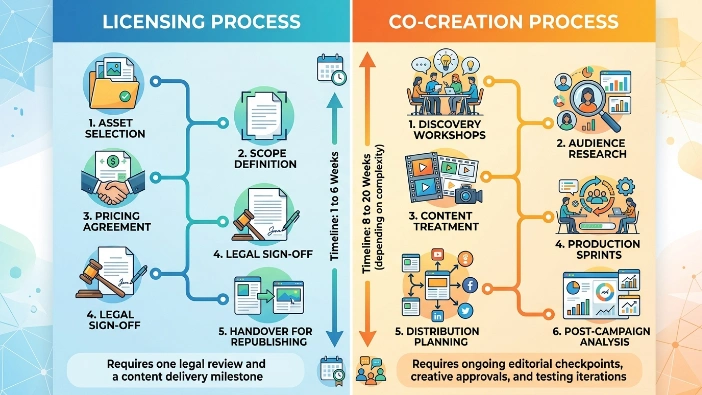
Licensing process steps include asset selection, scope definition, pricing agreement, legal sign-off, and handover for republishing. The typical timeline ranges from 1 to 6 weeks for standard licences. Co-creation steps include discovery workshops, audience research, content treatment, production sprints, distribution planning, and post-campaign analysis. Co-creation timelines range from 8 to 20 weeks depending on format complexity. Licensing requires one legal review and a content delivery milestone. Co-creation requires ongoing editorial checkpoints, creative approvals, and testing iterations.
What components determine cost and value?
Cost and value depend on rights scope, production effort, audience reach, measurement depth, and exclusivity. Pricing models reflect these components with clear cost drivers and measurable outputs.
For licensing, cost drivers include asset type (text, video, audio), territory count, duration, and exclusivity. Value metrics include estimated audience reach, historical engagement rates, and topical relevance. For co-creation, cost drivers include pre-production research, production days, editorial hours, distribution spend, and measurement complexity. Value metrics include bespoke audience targeting, engagement depth (session length, completion rates), and conversion pathways. Contracts often include performance bonuses tied to pre-agreed KPIs such as leads, sales, or subscription uplift.
What editorial and legal safeguards apply to each model?
Both models require disclosure rules, editorial guidelines, IP clauses, and data-protection measures; co-creation needs additional governance for brand influence and editorial independence. Safeguards protect reputation and regulatory compliance.
Disclosure rules mandate clear labelling of sponsored or co-produced content to align with advertising regulations. Editorial guidelines define factual standards, allowed claims, and review processes. IP clauses clarify whether copyrights transfer fully, whether sublicensing is permitted, and how derivative works are treated. Data-protection measures involve lawful bases, consent records, and secure data transfers when audience segments are shared. Co-creation contracts add governance for approval workflows, a veto framework for editorial independence, and audit rights for measurement claims.
What measurement frameworks suit licensing and co-creation?
Licensing uses distribution and engagement metrics; co-creation uses engagement, conversion, and long-term attribution metrics tied to joint KPIs. Measurement complexity increases with deeper collaboration.
Licensing measurement tracks impressions, unique views, time-on-page, and referral traffic to brand channels after republishing. Brands compare baseline traffic to post-licence performance and apply simple attribution windows. Co-creation measurement tracks engaged views, conversion rate, lead quality, subscription uplift, and lifetime value of acquired customers. Co-creation uses multi-touch attribution, cohort analysis, and controlled experiments when feasible. Both models require shared reporting cadence and agreed definitions of metrics to avoid disputes.
What benefits does licensing deliver for brands?
Licensing delivers speed to market, lower production cost, predictable pricing, and access to trusted editorial assets. It suits campaigns that prioritise reach and efficiency.
Licensing allows brands to republish high-quality content without commissioning full production. Costs remain predictable through fixed fees or tiered licences. Timelines compress because the publisher provides finished assets. Brands gain association with third-party editorial credibility through attribution and publisher bylines. Licensing supports multi-territory rollouts with straightforward rights management. Licensing fits product launches requiring quick content availability and consistent messaging across channels.
What benefits does co-creation deliver for brands?
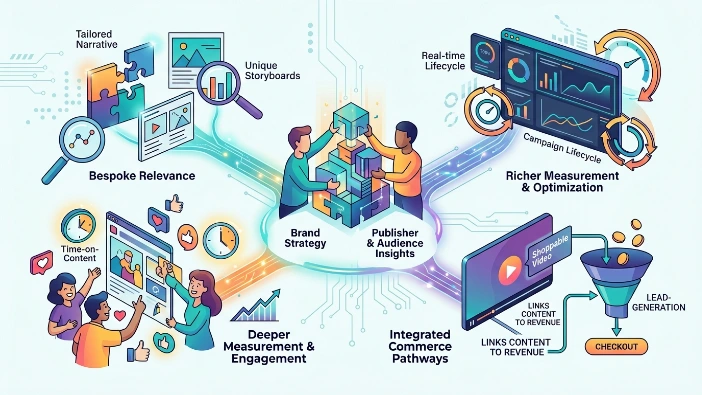
Co-creation delivers bespoke relevance, deeper audience engagement, richer measurement, and integrated commerce pathways. It suits strategic campaigns that prioritise differentiation and measurable outcomes.
Co-creation produces tailored narratives aligned with brand strategy and publisher audience insights. Custom formats yield higher engagement metrics such as completion rates and time-on-content. Co-creation allows integrated conversion mechanisms such as shoppable video and lead-generation funnels embedded in content. The partnership enables iterative optimisation during the campaign lifecycle. Co-creation supports long-term brand building and direct-response outcomes that link content to revenue.
When should a brand choose licensing over co-creation?
Choose licensing when time constraints, fixed budgets, or scale requirements dominate and when the priority is rapid distribution of credible content. Licensing minimises production overhead and shortens campaign timelines.
If the campaign requires launch within 2 to 6 weeks, licensing suits the schedule. If budgets limit production days and ongoing editorial involvement, licensing reduces cost. If the objective focuses on broad reach, topical authority, or republishing existing explainers, licensing provides efficient access to publisher credibility. Brands that need standardised global rollouts often prefer licensing for clear rights management.
When should a brand choose co-creation over licensing?
Choose co-creation when the goal is deep engagement, custom formats, integrated commerce, or long-term audience development that justifies higher investment and longer timelines. Co-creation delivers bespoke experiences and measurable business outcomes.
If the campaign targets a specific audience segment with personalised storytelling, co-creation enables tailored creativity. If the objective ties to direct conversions—sales, trials, subscriptions—co-creation integrates conversion paths inside the content. If the brand plans a sustained content programme over 6 to 18 months, co-creation builds audience loyalty and cumulative impact. Co-creation fits initiatives requiring A/B testing, data-driven optimisation, and multi-format distribution.
Explore More Expert Insights:
How to Identify the Right UK Media Partner for Your Industry in 4 Steps
5 Media Partnership Models That Generate Leads Without a Single Paid Ad
What operational capabilities do brands need for each model?
Licensing requires contract management, republishing workflows, and basic analytics; co-creation requires cross-functional teams, project management, and shared analytics infrastructure. Capability gaps determine feasibility and success.
For licensing, brands need legal review capacity for rights, a content operations team to integrate assets, and analytics to measure republished performance. For co-creation, brands need a content lead, performance marketing, CRM integration, creative production capability, and access to shared measurement tools. Co-creation requires weekly governance meetings, approval workflows, and a single source of truth for campaign metrics.
What hybrid approaches combine licensing and co-creation?
Hybrid approaches use licensed assets as starter content, followed by co-created sequels or amplified activations; they balance speed and customisation. Hybrids allow phased investment and iterative scaling.
A hybrid path licenses a core explainer or data report for immediate distribution. The brand then commissions a bespoke video series or interactive experience building on licensed content. Measurement from the licensed phase informs the creative brief for co-creation. Financially, hybrids use an initial licence fee plus staged production budgets tied to performance milestones.
Check Out the Full Article:
The Rise of Publisher-Brand Alliances: How UK Media Is Monetising Differently
Content licensing and co-creation offer distinct trade-offs. Licensing delivers speed, lower production cost, and predictable rights for scale. Co-creation delivers bespoke formats, deeper engagement, and integrated conversion mechanics for measurable outcomes. Brands choose licensing when timelines and budgets prioritise efficiency. Brands choose co-creation when objectives prioritise differentiation, measurable ROI, and long-term audience development.
Explore the Complete Guide:
How 10-Property Media Networks Deliver What Single Publishers Cannot for Brands



