

Human-generated media partnerships are collaborations between content creators and media outlets where humans plan, produce, edit, and verify all content to ensure accuracy, context, and editorial integrity.
A human-generated media partnership defines roles, workflows, and editorial standards shared between two or more organisations. Partners agree on audience targets, content formats, publication schedules, and verification processes. Human editors assign tasks to journalists, subject-matter experts, researchers, and fact-checkers. Each piece passes through human review stages: briefing, reporting, editing, legal checks, and publishing.
Entities include national newspapers, regional broadcasters, trade publications, independent journalists, academic institutions, and non-profit press teams. For example, a regional charity, a local BBC bureau, and a university research team can form a partnership to produce a verified investigative series.
Why does human-generated content increase trust among UK audiences?
UK audiences place higher trust in content produced and verified by named human experts, journalists, and established editorial teams than in content generated solely by AI systems.
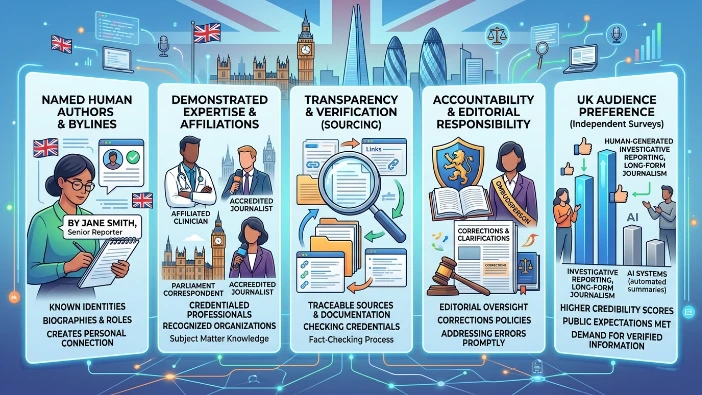
Trust correlates with transparency, accountability, and demonstrated expertise. Human-generated content attaches author names, bylines, and expert affiliations. Readers can verify credentials, contact authors, and trace source documents. UK regulatory frameworks and public expectations emphasise editorial responsibility.
Newspapers and broadcasters maintain corrections policies and ombudsperson functions; these mechanisms increase perceived reliability. Independent surveys in the UK consistently show higher credibility scores for human-produced investigative reporting and long-form journalism than for automated summaries or AI-written articles. Human-produced content provides sourced quotes, interview transcripts, and named attributions. Examples include parliamentary reporting by accredited journalists and health features authored by clinicians with disclosed affiliations.
How do human workflows prevent factual errors and misinformation?
Human workflows combine source verification, contextual judgment, and editorial oversight to reduce factual errors and identify misinformation vectors.
Reporters conduct primary interviews, obtain original documents, and corroborate claims with multiple independent sources. Editors check context, chronology, and consistency across statements. Legal teams assess libel risk and accuracy. Fact-checkers cross-reference claims against public records, datasets, and expert commentary. Humans interpret nuance in testimony, cultural references, and legal language that automated systems often misread. Error correction follows established protocols: publish corrections, update digital copies, and notify distribution partners. For example, a health investigation references peer-reviewed studies, interviews with named clinicians, and regulatory filings to confirm a claim before publication.
What processes do human-generated partnerships use for quality control?
Partnerships implement defined editorial stages: commissioning, reporting, editing, fact-checking, legal review, and final sign-off by senior editors.
The commissioning stage sets scope, angle, and sourcing requirements. Reporters develop interview plans and evidence checklists. Editors enforce word limits, tone, and evidence presentation. Independent fact-checkers verify numerical claims, dates, and direct quotations against primary records. Legal review ensures compliance with UK defamation and privacy law. Senior editors grant final sign-off and require a documented audit trail for each story. Cross-partner audits occur when multiple organisations publish the same investigation; partners exchange source lists and redaction decisions. These processes establish accountability and enable retrospective review for transparency requests.
Which components make human-generated partnerships more credible than AI content?
Credibility arises from named authors, transparent sourcing, independent verification, editorial oversight, and legal accountability.
Named authors and affiliations allow readers to evaluate expertise. Transparent sourcing lists documents, datasets, and interview subjects. Independent verification includes at least two corroborating sources for factual claims that affect public decision-making. Editorial oversight enforces ethical standards and corrections policies. Legal accountability exposes publications to libel and regulatory enforcement, incentivising accuracy. AI-generated content lacks consistent bylines, rarely provides verifiable primary-source links, and cannot accept legal responsibility in the same way. Human partnerships maintain records of consent and anonymisation decisions for sensitive reporting, which supports ethical standards and public trust.
Where does human context add value that AI cannot replicate?
Human context interprets cultural nuance, regulatory frameworks, ethical trade-offs, and lived experience in ways that automated systems cannot reliably replicate.
Context requires judgement about relevance, harm, and reader needs. Reporters assess the societal impact of a story, weigh competing rights, and choose which expert voices to prioritise. Cultural nuance affects phrasing and emphasis that determine how audiences perceive intent. Regulatory interpretation requires human legal reasoning tied to UK statutes and case law. Lived experience and community insight surface through interviews and participant observation. For example, reporting on regional public health outcomes integrates local service structures, patient testimonies, and clinician perspectives that an AI trained on broad datasets cannot localise precisely.
How does human-generated content handle ethical and sensitive subjects?
Human teams apply established ethical guidelines, consent procedures, anonymisation protocols, and editorial review to protect sources and readers.
Journalistic codes require informed consent for interviews, careful anonymisation for vulnerable sources, and sensitivity in language for trauma or health issues. Editors balance public interest against potential harm, documenting decisions for internal review. Ethical oversight bodies and press regulators provide external accountability and dispute resolution. AI systems produce outputs based on training data patterns and lack the capacity to obtain consent or apply ethical judgement consistently. Human partnerships retain correspondence, consent forms, and recording logs to substantiate ethical compliance when challenged.
When do human-generated partnerships outperform AI in audience engagement?
Human-generated partnerships produce higher sustained engagement for investigative, local, health, and policy reporting that requires authority, depth, and accountability.
Long-form investigations and local journalism rely on trust built over time. Human authorship creates relationships between communities and outlets through named reporters and follow-up reporting. Health and policy reporting require precise interpretation of evidence and regulatory context.
Readers return to sources they perceive as reliable for consequential topics like healthcare, local government decisions, and major public-interest investigations. AI summarisation supports surface-level discovery but fails to retain readership when the subject demands traceable evidence and robust analysis. Examples include regional investigations that lead to policy reviews and national inquiries initiated after credible human-led reporting.
Explore More Expert Insights:
Third-Party Validation Now Drives More Pipeline Than Owned Content
UK Publishers Forming 2× More Brand Partnerships Since 2023: Why?
What are the limitations of AI-only content for UK audiences?
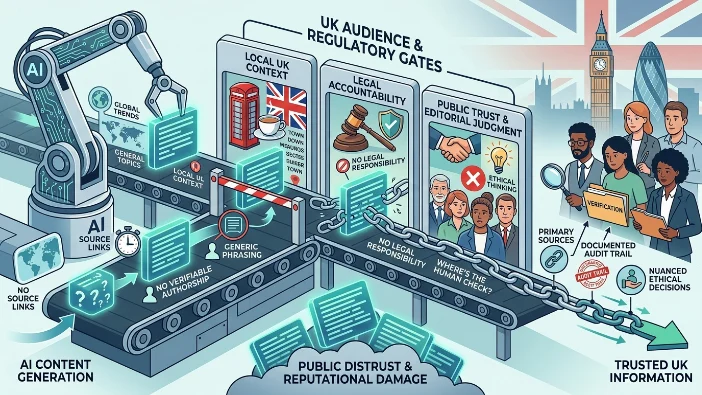
AI-only content lacks verifiable authorship, consistent source transparency, legal accountability, and nuanced editorial judgment required for public trust.
AI outputs often omit primary-source links and produce plausible but incorrect assertions without a verifiable audit trail. They generate generic phrasing with limited relevance to local legal and cultural contexts. Automated content lacks a human chain of custody for source materials and cannot accept legal responsibility under UK law. For topics requiring ethical decisions or exclusive sourcing, AI content increases the risk of harm, misrepresentation, and reputational damage for publishers. Human oversight mitigates those risks through documented verification and accountability.
How should media outlets structure partnerships to maximise trust?
Outlets formalise agreements that specify bylines, source disclosure standards, verification steps, correction policies, and legal responsibilities.
Agreements list partner roles, editorial approval authorities, and timelines. They require named authorship and public disclosure of key sources when safe. They define fact-checking protocols, minimum corroboration standards for serious claims, and legal review for sensitive topics. They include post-publication monitoring for errors and audience feedback channels. Partners retain shared audit trails and commit to correction procedures. These structures create reproducible processes that stakeholders and regulators can evaluate objectively.
Discover More Insights:
5 Media Partnership Models That Generate Leads Without a Single Paid Ad
Human-generated media partnerships increase trust among UK audiences through named authorship, transparent sourcing, rigorous verification, editorial oversight, and legal accountability. These partnerships apply human judgement to contextualise complex topics, manage ethical risks, and sustain engagement for consequential reporting. For readers, policymakers, and regulators, the presence of human processes and clear documentation provides a verifiable basis for trust that AI-only content cannot match.
Learn More Here:
What a Fully Managed UK Media Partnership Delivers in 90 Days: Real Numbers



