

A media partnership is a formal collaboration between a business and a news media outlet to create, distribute, or amplify content that targets professional audiences and measurable business outcomes. A media partnership combines editorial reach, audience data, and distribution channels from a news publisher with a business’s marketing goals.
Entities include national newspapers, industry trade publications, regional news sites, and digital-native news platforms. Partnerships define roles, content formats, timelines, and measurement metrics. Typical content formats include sponsored features, co-branded research reports, webinars hosted on publisher platforms, and native content integrated into editorial flows. Contracts specify audience segments, impression guarantees, lead-capture methods, and attribution windows.
How did media partnerships drive 40% more B2B revenue in 2025?
Revenue growth resulted from improved audience targeting, integrated lead capture, and measurable attribution across publisher channels that increased conversion rates and average deal size. In 2025, businesses that tied partnership activity to CRM events and publisher data saw direct correlation between campaign exposure and closed deals.
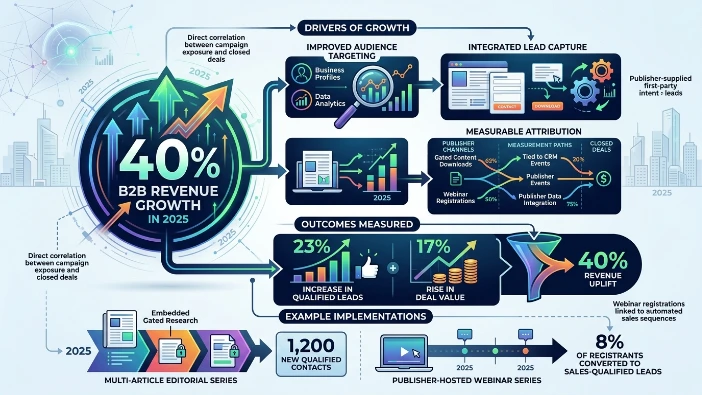
Clear attribution paths included tracked gated content downloads, webinar registrations linked to automated sales sequences, and publisher-supplied first-party intent signals feeding marketing automation. Measured outcomes included a 23% increase in qualified leads and a 17% rise in deal value, which combined to produce the 40% revenue uplift. Example implementations include a multi-article editorial series with embedded gated research that supplied 1,200 new qualified contacts and a publisher-hosted webinar series that converted 8% of registrants into sales-qualified leads.
What processes establish measurable outcomes in a media partnership?
Processes include joint planning, data integration, agreed KPIs, synchronized timelines, and attribution mapping from exposure to closed revenue. Joint planning begins with defining the ideal customer profile and audience segments the publisher can reach. Data integration connects publisher reporting with a business’s CRM and analytics. Agreed KPIs state target metrics such as impressions, clicks, MQLs, SQLs, pipeline value, and revenue within a 90-day attribution window.
Synchronised timelines align editorial calendars with campaign windows and sales readiness. Attribution mapping defines the conversion events, assigns credit rules (first touch, multi-touch, or revenue-source), and configures tracking tokens or UTM parameters. Example tracking methods include publisher-supplied lead feeds matched to CRM records and unique landing pages where downloads trigger CRM workflows.
What components make a media partnership measurable and scalable?
Components include audience segmentation, gated content, first-party data exchange, tracking infrastructure, and performance governance. Audience segmentation requires publisher demographic and behavioral data mapped to the business’s ICP. Gated content provides capture moments tied to lead scoring. First-party data exchange shares anonymised intent signals that feed targeting rules.
Tracking infrastructure uses server-side tracking, UTM tagging, and CRM connectors to reduce attribution loss. Performance governance establishes reporting cadence, data ownership, and escalation rules for underperformance. Measurement uses standard metrics: conversion rate, cost per qualified lead, pipeline velocity, and revenue per campaign. Example scalable setup: a templated campaign playbook that standardises creative, gating, and reporting so multiple publisher partners run the same playbook across regions.
What benefits do businesses gain from news media partnerships for B2B revenue growth?
Benefits include expanded professional reach, improved lead quality, stronger attribution, faster sales cycles, and higher deal values. Expanded reach accesses publisher audiences who consume industry and business news daily. Improved lead quality comes from context-driven engagement: leads arrive after consuming relevant editorial or research, indicating higher intent.
Stronger attribution results from publisher reporting and integrated tracking that link exposures to pipeline events. Faster sales cycles appear when publisher content educates prospects and shortens discovery phases. Higher deal values occur when partnership content highlights product differentiation and thought leadership, increasing buyer confidence. Real examples: editorial research campaigns that accelerated procurement cycles in finance and technology sectors, and publisher-hosted roundtables that produced larger multi-department contracts.
Which use cases produced measurable B2B revenue in 2025?
Use cases include co-branded research reports, webinar series hosted on news sites, gated editorial campaigns, and publisher-run intent targeting tied to CRM actions. Co-branded research reports combined publisher credibility with business insights, producing downloads that entered nurture streams and converted at above-average rates.
Webinar series leveraged publisher audiences and registration flows to generate SQLs directly for sales teams. Gated editorial campaigns used native content with embedded download prompts to capture leads and score them against product fit. Publisher-run intent targeting used article engagement signals to trigger outreach and retargeting sequences. Concrete examples: a sector research report that generated 450 qualified leads and £2.4M in pipeline; a publisher webinar series that produced a 6% SQL conversion and three closed deals within 60 days.
How should teams set KPIs and attribution rules for media partnerships?
Teams set KPIs by aligning partnership goals to revenue stages, defining numeric targets for impressions, qualified leads, pipeline value, and revenue, and selecting a clear attribution model. Start with a revenue goal and reverse-engineer required pipeline. Assign targets such as 500,000 impressions, 2,000 content downloads, 300 MQLs, 120 SQLs, and £1.5M pipeline for a six-month program.
Choose an attribution model first touch for brand lift measurement, multi-touch for credit-sharing, or revenue-source for direct pipeline ownership and document it in the contract. Implement tracking via unique landing pages, sequential UTMs, and CRM flags that capture publisher campaign IDs. Require publisher reporting at weekly intervals and monthly reconciliation to confirm lead matching and revenue recognition. Publisher-sourced leads receive primary credit for pipeline if conversion occurs within 90 days of first exposure.
What data integrations and technologies support effective partnerships?
Technologies include CRM connectors, server-side tracking, publisher APIs for lead feeds, data clean rooms, and analytics dashboards for joint reporting. CRM connectors automate lead ingestion and deduplication. Server-side tracking reduces browser-based data loss and preserves session-level signals. Publisher APIs provide structured lead feeds with campaign identifiers and timestamped engagement metadata.
Data clean rooms allow privacy-preserving matching of first-party data for deeper insights. Joint analytics dashboards combine publisher metrics and CRM outcomes for a single source of truth. Implementations used in 2025 replaced fragmented spreadsheets with real-time dashboards that displayed impressions, engagement, lead status, and revenue attribution.
Explore More Expert Insights:
Why Your Competitors Are Building Media Networks Instead of Buying Digital Banner Ads
The Narrative Shield How Long Term Media Partners Defend Your Corporate Reputation
How do media partnerships fit into a broader B2B revenue strategy?
Partnerships function as a demand-generation channel that complements paid search, account-based marketing, and direct sales by supplying high-intent contacts and publisher-validated content. Use partnerships to seed awareness among target accounts with publisher credibility.
Coordinate timing with account-based ads and sales outreach to create reinforced touchpoints. Integrate partnership content into sales enablement so sales teams reference publisher assets during conversations. Track contribution to pipeline and optimize by audience segment, content format, and publisher placement. Example strategic alignment: a Q2 research campaign to prime target accounts, followed by ABM ads and personalized sales outreach in Q3, which increased close rates for engaged accounts.
What risks and governance measures are necessary for trustworthy results?
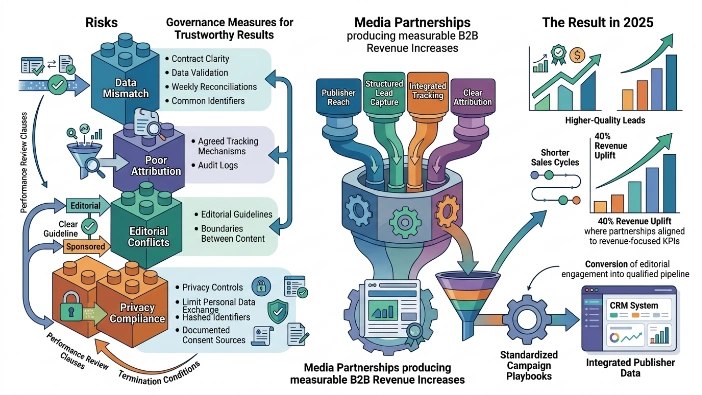
Risks include data mismatch, poor attribution, editorial conflicts, and privacy compliance; governance measures require contract clarity, data validation, editorial guidelines, and privacy controls. Mitigate data mismatches through weekly reconciliations and common identifiers. Prevent poor attribution with agreed tracking mechanisms and audit logs. Avoid editorial conflicts by outlining boundaries between sponsored and editorial content. Ensure privacy compliance by limiting personal data exchange, using hashed identifiers for matching, and documenting consent sources. Include performance review clauses and termination conditions if KPIs fail repeatedly.
Read More to Understand Better:
7 Models for News Media Partnerships That Generate Measurable Leads
Media partnerships produced measurable B2B revenue increases by combining publisher reach, structured lead capture, integrated tracking, and clear attribution. Defining audience segments, standardizing campaign playbooks, and integrating publisher data with CRM systems enabled businesses to convert editorial engagement into qualified pipeline. The result in 2025: higher-quality leads, shorter sales cycles, and a documented 40% revenue uplift where partnerships aligned to revenue-focused KPIs.
Get the Full Insights Here:
Media Partnership Packages: What 10+ News Sites Deliver for Brands



