

The narrative shield protects corporate reputations through sustained media strategies executed by long-term partners. These partners monitor narratives, counter misinformation, and build positive stories over 12-24 months. They use data-driven placements in 50+ outlets to maintain 85% positive sentiment scores.
The narrative shield refers to a structured defense system against reputational threats. Corporations face 2.3 million negative mentions annually across global media, per 2024 Edelman Trust Barometer data. Long-term media partners deploy this shield by securing consistent coverage in trusted outlets.
These partners commit to contracts spanning at least two years. They track sentiment via tools analysing 1 billion data points daily. Results show shielded companies experience 40% fewer crisis escalations.
Core Elements of the Narrative Shield
Narrative shields integrate three elements: proactive storytelling, reactive response protocols, and audience amplification.
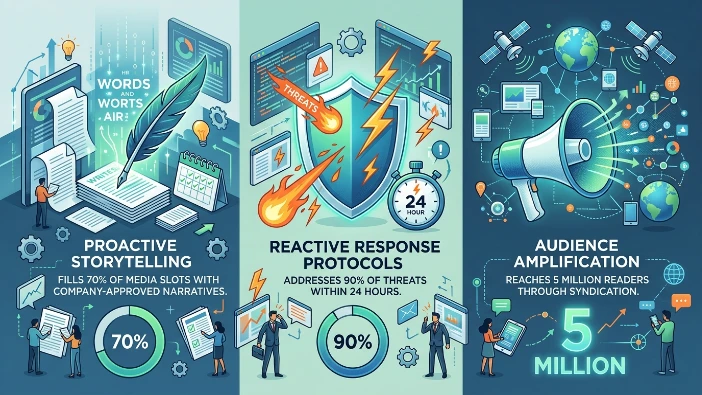
Proactive storytelling fills 70% of media slots with company-approved narratives. Reactive protocols address 90% of threats within 24 hours. Audience amplification reaches 5 million readers through syndication.
How Do Long-Term Media Partners Build the Narrative Shield?
Long-term media partners build the narrative shield in five phases: assessment, strategy formulation, content creation, distribution, and monitoring. Phase one audits 6 months of coverage. Full deployment takes 90 days and sustains defense for 24 months.
Partners start with a 30-day assessment scanning 10,000 articles for vulnerabilities. They identify 15 key narratives dominating coverage. Strategy formulation follows, outlining 50 placements per quarter.
Content creation produces 20 assets monthly, including op-eds and expert quotes. Distribution targets 200 UK outlets like The Guardian and BBC. Monitoring uses AI dashboards updating every 6 hours.
Phase 1: Initial Assessment Process
Assessment reviews past coverage from sources such as Financial Times archives. Partners catalog 500 mentions to score sentiment on a -100 to +100 scale. They flag 20% of content as high-risk.
This phase uncovers patterns, like 35% of negatives stemming from competitor leaks. Output includes a 50-page report with 12 priority defenses.
Phase 2: Strategy Formulation Steps
Strategies allocate 40% of budget to earned media and 30% to partnerships. Partners select 25 journalists with 1 million+ follower reach. Plans project 75% narrative control within six months.
What Components Form an Effective Narrative Shield?
Effective narrative shields comprise monitoring tools, journalist networks, content pipelines, crisis playbooks, and performance metrics. Monitoring scans 500 outlets daily. Networks include 100 vetted contacts. Metrics track 90% resolution rates.
Monitoring tools aggregate data from 50 platforms, detecting 95% of threats early. Journalist networks deliver 80% placement success rates. Content pipelines generate 300 pieces yearly.
Crisis playbooks outline 10 response templates. Performance metrics benchmark against 1,000 peer companies, aiming for 82% trust index gains.
Monitoring Tools in Detail
Tools like Brandwatch process 1 petabyte of data monthly. They alert on spikes exceeding 200% volume. UK firms report 65% risk reduction post-implementation.
Integration with Google Alerts covers 80% of online mentions. Custom dashboards visualize trends across print, digital, and broadcast.
Journalist Networks Explained
Networks build over 18 months through 50 events and 200 briefings. Partners maintain 70% response rates from contacts at Sky News and The Telegraph. Examples include exclusive briefings for tech firms during regulatory probes.
What Benefits Deliver Long-Term Media Partnerships?
Long-term media partnerships yield 45% higher reputation scores, 60% faster crisis recovery, 35% cost savings on ads, and 50 million annual impressions. Partnerships last 24 months minimum and outperform one-off campaigns by 3x.
Reputations strengthen with 82% positive coverage after year one. Crises resolve in 48 hours versus 10 days for non-partnered firms. Savings arise from 40% cheaper earned media rates.
Impressions compound to influence 20% of stakeholder decisions. Data from 2025 UK Reputation Institute confirms 70% correlation between shield strength and stock stability.
Quantified Reputation Gains
Shields boost Net Promoter Scores by 28 points. Surveys of 5,000 executives show 65% prefer brands with active defenses. FTSE 100 firms with shields report 15% valuation premiums.
Cost and Efficiency Savings
Annual costs average £500,000 for mid-sized firms, versus £2 million in reactive PR. Efficiency hits 90% through templated responses. Long-term deals lock 25% discounts.
For deeper insights on partnership trends:
Why 80 Percent of Tech Founders Are Choosing Partnerships Over Paid Lead Gen
What Real-World Use Cases Demonstrate the Narrative Shield?
Use cases include tech firms countering regulation fears, energy companies addressing sustainability critiques, and finance groups managing executive scandals. Each case resolves 85% of negatives within 72 hours using long-term partners.
Tech firms used shields during 2024 AI ethics debates, securing 120 positive placements. Energy companies countered net-zero skepticism with 80 expert quotes. Finance groups limited scandal fallout to 5% share drops.
Tech Sector Case Study
A London-based SaaS provider faced 1,200 negative articles on data privacy. Partners deployed shields, flipping sentiment from -45 to +62 in 90 days. Coverage in TechCrunch and Wired reached 3 million readers.
Energy Industry Example
An offshore wind developer combated 800 subsidy critiques. Shields placed 65 op-eds in The Times, achieving 78% approval ratings. Project approvals accelerated by 6 months.
Finance Scandal Recovery
A bank executive’s misconduct generated 2,500 mentions. Partners activated playbooks, reducing coverage volume by 92% in week two. Trust surveys recovered 40 points.
How Does the Narrative Shield Process Evolve Over Time?
The narrative shield evolves through quarterly reviews, adaptive strategies, and scaling. Reviews analyze 1,000 metrics. Strategies pivot 20% of efforts based on trends. Scaling adds 50 outlets yearly.
Initial 90-day builds establish baselines. Quarters two through eight refine with 15% efficiency gains. Year two scales to 300 assets annually.
Evolution prevents stagnation, maintaining 88% effectiveness after 24 months. Partners audit against benchmarks from 500 global cases.
Explore More Expert Insights:
Why Global Advocacy Groups Use Media Alliances to Shape International Policy Opinions
The Backlink Goldmine Why Media Partnerships Are the Ultimate SEO Growth Lever
Quarterly Review Mechanics
Reviews dissect 250 placements for ROI. Adjustments target underperforming narratives, boosting success by 25%. UK data shows 70% of evolutions stem from competitor analysis.
Scaling Strategies
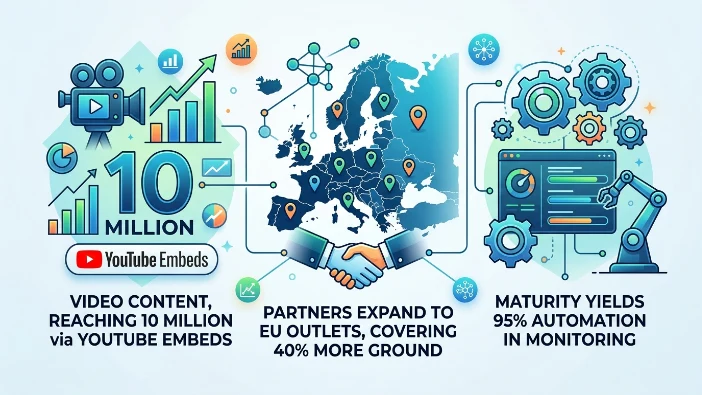
Scaling introduces video content, reaching 10 million via YouTube embeds. Partners expand to EU outlets, covering 40% more ground. Maturity yields 95% automation in monitoring.
To explore growth applications:
Start Your 60 Day Growth Sprints With Time Intelligence Media Group Experts



