
A news media partnership model defines the structure, roles, and exchange of value between a business and a news publisher to generate identifiable leads and measurable pipeline. A model specifies content type, audience access, data exchange, and attribution. Entities include national newspapers, regional papers, trade journals, and digital-native news platforms.
Contracts define deliverables such as sponsored research, native articles, webinars, and newsletter placements. Measurement elements include lead capture methods, tracking tokens, and reporting cadence. Clear definitions reduce confusion during execution and create repeatable playbooks for marketing and sales teams.
How do different partnership models capture and qualify leads?
Each model captures leads through gated assets, registration flows, or publisher lead feeds and qualifies them with scoring rules, intent signals, and CRM matching. Gated assets require an email or business details to download research or view premium content.
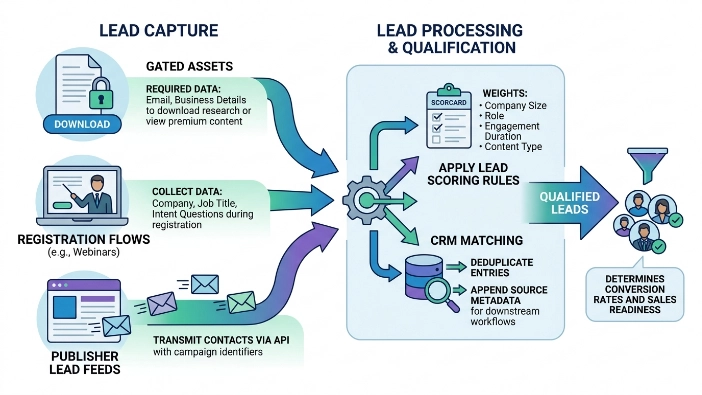
Registration flows for webinars collect company, job title, and intent questions. Publisher lead feeds transmit captured contacts via API with campaign identifiers. Qualification applies lead scoring that weights company size, role, engagement duration, and content type. CRM matching deduplicates entries and appends source metadata for downstream workflows. The combination of capture and qualification determines conversion rates and sales readiness.
Which seven models produce measurable leads?
Seven models include sponsored research reports, native editorial with gated sections, publisher-hosted webinars, newsletter sponsorship with gated follow-ups, intent-based article targeting, co-branded tools or calculators, and subscription trial promotions. Sponsored research reports combine publisher distribution with co-created data, producing downloads that feed nurture paths. Native editorial with gated sections places a brief free article followed by a gated deep-dive that requires registration.
Publisher-hosted webinars use the publisher’s registration system and audience to generate live leads. Newsletter sponsorship with gated follow-ups places a gated asset linked from a high-open newsletter. Intent-based article targeting uses engagement signals to trigger lead lists for outreach. Co-branded tools or calculators require inputs and collect leads for benchmarking reports. Subscription trial promotions offer time-limited access to a business tool in exchange for sign-up details. Each model provides discrete capture points and feeds measurable metrics into CRM.
What are the typical components of each model?
Components include content format, audience segment, lead capture mechanism, scoring rules, tracking identifiers, and reporting schedule. Content format defines length, assets, and creative. Audience segment specifies industry, role, and geography. Lead capture mechanism is a landing page, form, or API feed. Scoring rules assign numeric weights to firmographics and engagement events. Tracking identifiers include UTM parameters, campaign IDs, and publisher-assigned tokens. Reporting schedule sets daily lead feeds and weekly reconciliations. Standardising these components enables consistent measurement across multiple publishers and campaign iterations.
How do publishers and brands agree on attribution and reporting?
Attribution and reporting are documented in the partnership agreement with defined attribution windows, credit rules, data fields, and reconciliation processes. Agreements set the attribution window, commonly 30, 60, or 90 days from first exposure. Credit rules adopt first touch for awareness metrics, multi-touch for shared campaigns, or revenue-source for direct pipeline claims. Data fields include timestamp, campaign ID, content URL, and captured form fields. Reconciliation occurs weekly with a monthly audit to match publisher leads to CRM records and revenue outcomes. Legal sections address data ownership, consent provenance, and compliance with data protection laws.
How do teams integrate publisher data into existing marketing stacks?
Teams integrate publisher data through CRM connectors, APIs, server-side events, and tagging standards to reduce data loss and automate workflows. CRM connectors ingest lead feeds and apply deduplication rules. APIs transmit structured lead records with campaign metadata. Server-side event pipelines capture conversions when client-side tracking fails. Tagging standards enforce consistent UTM and campaign ID usage across publisher placements. Automation rules assign lead owners, apply nurture sequences, and update lead scores based on engagement depth. Integration delivers near-real-time visibility into lead flow and enables faster sales follow-up.
What measurement metrics show model effectiveness?
Key metrics include number of leads, qualified lead rate, cost per qualified lead, SQL conversion rate, pipeline value, and revenue attributed within the defined window. The number of leads tracks volume. Qualified lead rate measures quality relative to total leads.
Cost per qualified lead divides investment by qualified lead count. SQL conversion rate shows movement from marketing qualification to sales qualification. Pipeline value aggregates potential deal sizes associated with partnership leads. Revenue attributed counts closed deals that entered through the partnership within the attribution window. These metrics allow side-by-side comparison of models to prioritise channels with the best ROI.
How do content types affect lead quality and volume?
Long-form research, webinars, and interactive tools generate fewer but higher-quality leads; short-form native articles and newsletter links generate higher volume with lower initial qualification. Research downloads commonly require detailed contact fields and attract senior roles, producing leads with higher conversion potential. Webinars attract decision-makers when topics align with procurement cycles and yield higher engagement metrics.
Interactive tools require user inputs that reveal fit and priorities. Native articles and newsletter links produce broader reach and higher volume but need subsequent scoring to identify sales-ready contacts. Choosing the content type aligns with campaign goals for either volume-driven awareness or high-intent pipeline creation.
What operational practices improve lead conversion from media partnerships?
Operational practices include rapid lead handoff, standardised sales playbooks using publisher content, and scheduled data reconciliations for quality control. Rapid handoff assigns leads to sales within 24 hours with context about content consumed. Sales playbooks reference exact publisher assets and recommended messaging for each content type. Scheduled reconciliations verify lead integrity and close gaps in tracking. Training sales teams on publisher credibility and content angle increases conversion efficiency. Documented escalation paths address lead anomalies and ensure accountability across marketing and sales teams.
Explore More Expert Insights:
How to Map Your Content to 3 Specific Media Partner Audience Segments
Why 80 Percent of Tech Founders Are Choosing Partnerships Over Paid Lead Gen
Which use cases in the UK show clear ROI from these models?
Use cases include technology procurement campaigns, financial services benchmarking, and healthcare procurement education where publisher audiences align with procurement teams and C-level readers. Technology procurement campaigns used co-branded research to target IT directors and produced measurable pipeline within 60 days.
Financial services benchmarking reports generated qualified leads from treasury and finance roles that converted at above-average deal values. Healthcare procurement education webinars targeted NHS procurement leads and produced clear attendance-to-SQL conversion. Each use case pairs a publisher with a matching audience segment to ensure relevance and measurable outcomes.
How should teams choose which model to test first?
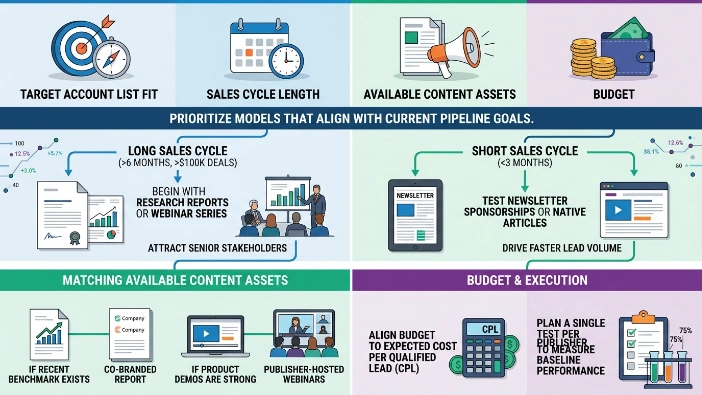
Select a model based on target account list fit, sales cycle length, available content assets, and budget; prioritise models that align with current pipeline goals. If the sales cycle is long and deals exceed six figures, begin with research reports or webinar series that attract senior stakeholders. For shorter sales cycles under three months, test newsletter sponsorships or native articles that drive faster lead volume. Match available content—if a recent benchmark exists, use a co-branded report; if product demos are strong, choose publisher-hosted webinars. Align budget to the expected cost per qualified lead and plan a single test per publisher to measure baseline performance.
Check the Complete Explanation:
How Media Partnerships Drove 40% More B2B Revenue in 2025
These seven models provide structured ways to generate measurable leads through news media partnerships by defining content, capture mechanics, integration points, and measurement rules. Teams in the United Kingdom achieve better outcomes when they select models that match sales cycle length, align content to target accounts, and implement clear attribution and data integrations. Testing one model at a time and enforcing consistent tracking yields comparable metrics and faster optimisation.
Explore More Useful Information:
Media Partnership Packages: What 10+ News Sites Deliver for Brands