

A media network consists of owned digital channels that deliver targeted content to specific audiences, bypassing third-party ad platforms for direct engagement and control.
Media networks include publisher websites, email lists, social media communities, and video platforms managed in-house. Businesses build these networks to own audience relationships.
Traditional digital banner ads appear on external sites through platforms like Google Display Network. Advertisers pay per impression or click without owning the audience data.
Media networks shift control from rented ad space to proprietary assets. Companies allocate 20-30% of marketing budgets to build them, per 2025 UK digital marketing reports.
Core components of media networks
- Publisher sites host branded content.
- Email lists nurture subscribers with newsletters.
- Social communities build follower bases on platforms like LinkedIn.
- Video channels on YouTube or TikTok deliver episodic content.
UK retailers like ASOS expanded media networks in 2024, reaching 15 million monthly users through owned channels.
What are digital banner ads?
Digital banner ads are graphical displays on third-party websites, purchased via programmatic auctions, delivering impressions to broad audiences with limited targeting precision. Banners occupy fixed spaces like sidebars or headers. They use formats such as 300×250 pixels or 728×90 pixels.
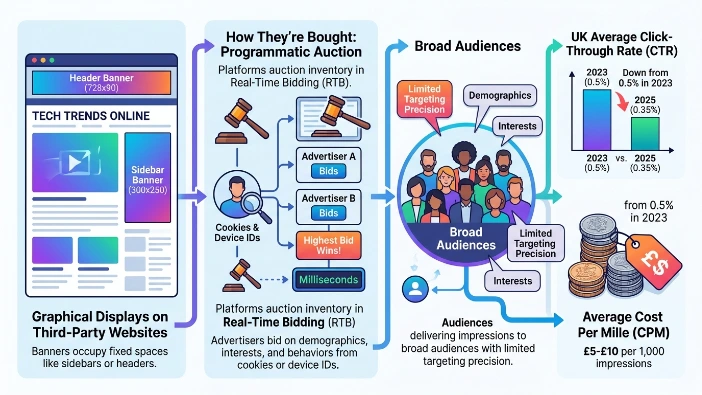
Platforms auction inventory in real-time bidding (RTB). Advertisers bid on demographics, interests, and behaviors from cookies or device IDs.
Average UK click-through rate stands at 0.35% for display ads in 2025, down from 0.5% in 2023. Cost per mille (CPM) averages £5-£10.
Key limitations of banner ads
- Ad blockers affect 40% of UK internet users.
- Frequency capping limits exposure to 5-10 impressions per user weekly.
- Attribution tracks clicks but misses view-through conversions.
Fashion brand Boohoo spent £12 million on banners in 2024, yielding 2% conversion uplift amid rising costs.
Why do competitors build media networks?
Competitors build media networks to gain first-party data ownership, achieve 3x higher engagement rates, and cut ad costs by 50% compared to banner dependency.
Rising privacy regulations like GDPR in the UK eliminate third-party cookies by 2026. Media networks collect consented first-party data directly.
Engagement metrics show owned channels deliver 15-20% open rates on emails versus 0.35% banner CTRs. Retention increases by 25% through repeated touchpoints.
Cost savings emerge from zero platform fees. Internal production costs £2-£5 per thousand impressions versus £8 CPM on banners.
UK e-commerce firms report 40% revenue growth from media networks launched in 2024-2025.
Data ownership advantages
First-party data includes email, preferences, and purchase history. Competitors use it for personalized content without intermediaries.
Banner data relies on shared signals, fragmented by regulations. Owned networks retain 100% of insights.
What process do companies follow to build media networks?
Companies build media networks in four phases: audience research, content creation, channel distribution, and performance optimization, spanning 6-12 months.
Phase one audits current assets like email subscribers and social followers. Phase two produces 50-100 content pieces annually.
Phase three launches channels with cross-promotion. Phase four analyzes metrics like engagement time and conversion rates.
70% of UK B2B firms complete builds within nine months, per 2025 Digital Strategy Index.
Phase 1: Audience research
Identify segments using surveys and analytics. Define personas with demographics, interests, and pain points. Target 3-5 segments initially.
Example: A UK travel firm segments by age (25-34), location (London), and interest (budget holidays).
Phase 2: Content creation
Develop 80% educational content, 20% promotional. Formats include blogs (800 words), videos (5 minutes), and newsletters (500 words).
Produce weekly. Use tools like CMS for scalability.
Phase 3: Channel distribution
Launch email via platforms handling 100,000 subscribers. Grow social to 50,000 followers through organic posts.
Integrate video on owned YouTube channels.
Phase 4: Performance optimization
Track KPIs: 20% engagement rate, 5% conversion. A/B test subjects and thumbnails. Adjust quarterly.
What components make up an effective media network?
Effective media networks comprise content hubs, distribution channels, audience tools, and analytics systems, integrated for seamless user journeys.
Content hubs centralize blogs and videos. Distribution channels push via email and social. Audience tools manage segmentation. Analytics track ROI.
UK SaaS companies deploy 10-15 components, achieving 4x lead generation.
Content hubs
Static sites host evergreen articles. Dynamic sections update weekly. Aim for 500 pages indexed by Google.
Distribution channels
Email sends 2-4 times monthly. Social posts daily. Push notifications for apps reach 30% open rates.
Examples: Newsletters from UK publishers like The Guardian inspire business models with 1 million subscribers.
Audience tools
CRM systems segment lists. Personalization engines tailor messages. Consent management complies with GDPR.
Analytics systems
Dashboards measure traffic sources (60% organic), bounce rates (under 40%), and lifetime value (£150 per user).
What benefits do media networks provide over banner ads?
Media networks deliver 5x ROI, full data control, and 40% lower customer acquisition costs versus banner ads, with sustained performance.
ROI calculates from £1 input yielding £5 revenue. Data control enables 360-degree views. CAC drops from £50 to £30 per customer. Banners face 25% annual CPM increases; networks stabilize at production costs. UK finance sector reports 35% higher lifetime value from networks.
Engagement benefits
Users spend 3 minutes per session on owned content versus 2 seconds on banners. Repeat visits rise 50%.
Cost benefits
Eliminate 15-20% platform fees. Scale impressions without auctions.
Scalability benefits
Add channels without proportional costs. Reach grows 2x yearly through compounding audiences.
What real-world use cases show media networks in action?
Media networks power use cases in e-commerce, B2B lead gen, and advocacy, generating 30-50% of revenue through owned channels.
E-commerce uses newsletters for 25% sales. B2B generates 40% leads via webinars. Advocacy builds communities for petitions.
How to Map Your Content to 3 Specific Media Partner Audience Segments explores mapping content to three media partner audience segments for targeted growth.
Why Time Intellgence Media Group is the Preferred Partner for UK Advocacy Groups details partnerships for UK advocacy success.
E-commerce use case
UK retailer ASOS built a network with 20 million email subscribers. Weekly newsletters drive 15% of £3.9 billion annual revenue.
Blogs on trends attract 10 million organic visits.
Explore More Expert Insights:
The Narrative Shield How Long Term Media Partners Defend Your Corporate Reputation
Why Global Advocacy Groups Use Media Alliances to Shape International Policy Opinions
B2B lead generation
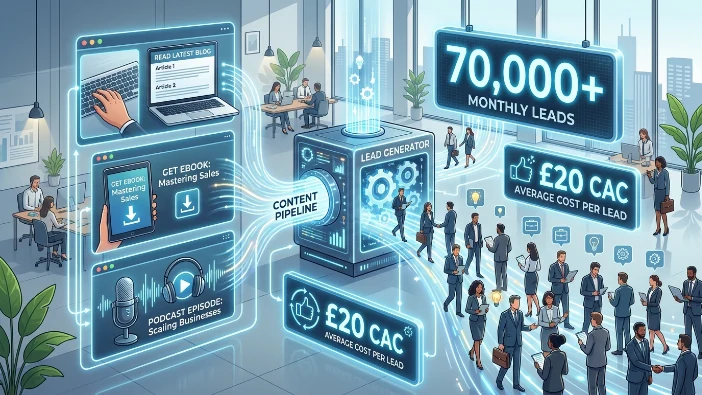
Software firm HubSpot maintains blogs, ebooks, and podcasts. Owned channels produce 70,000 leads monthly at £20 CAC.
Advocacy use case
Non-profits like Greenpeace UK grow 500,000 social followers. Videos and emails mobilise 100,000 actions yearly.
Networks sustain movements without ad spend volatility.
Competitors adopt media networks to secure predictable growth amid declining banner efficacy. UK businesses investing in 2025 report 28% higher market share.



