An event coverage proposal is a formal document from a media or production partner that lists specific deliverables, timelines, rights terms, and costs for reporting, recording, and distributing event content. It defines responsibilities, outputs, quality standards, and legal terms.
A clear proposal ensures both organiser and partner share the same expectations. The document identifies the event scope, dates, venue, and key sessions. It lists the types of coverage offered: live reporting, edited video, photography, audio recording, written summaries, and social media updates. The proposal states delivery timelines for each asset and specifies technical formats. It includes staffing details: number of cameras, reporters, editors, and on-site contact names. Rights and permissions appear as explicit clauses covering usage windows, territory, sublicensing, and attribution. Pricing appears as line items for each deliverable. A comprehensive proposal reduces disputes and speeds approval.
What core deliverables must organisers insist on?
Organisers must require an itemised list of 12 deliverables covering raw capture, edited assets, transcripts, metadata, rights, and performance reporting with clear delivery times and file specifications. Demand exact formats, file names, and quality thresholds.
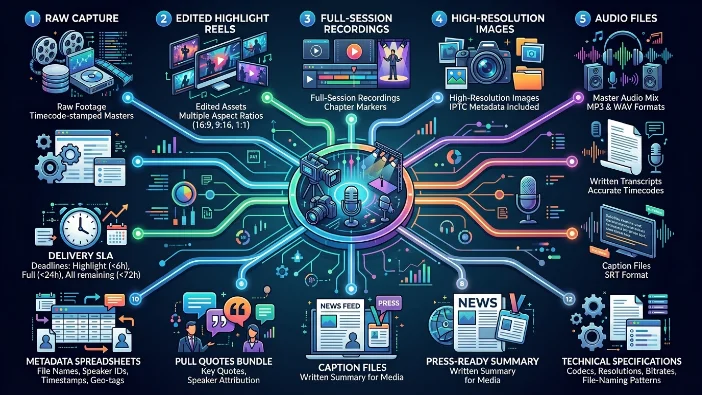
The 12 deliverables form a complete coverage package. Require raw footage with timecode-stamped masters, edited highlight reels in multiple aspect ratios, full-session recordings with chapter markers, high-resolution images with IPTC metadata, and audio files in MP3 and WAV. Include verbatim transcripts with timecodes and caption files in SRT format. Require a press-ready written summary and a bundle of pull quotes attributed to speakers. Request metadata spreadsheets listing file names, speaker IDs, timestamps, and geo-tags. Insist on delivery deadlines tied to measurable SLAs: first highlight reel within 6 hours, full session within 24 hours, and all remaining assets within 72 hours. Specify codecs, resolutions, bitrates, and file-naming patterns to avoid post-delivery rework.
How should rights and usage be specified?
Rights and usage must be explicit: list granted rights, exclusive or non-exclusive status, usage duration, permitted territories, sublicensing rules, and attribution requirements. Include license start and end dates, and processes for extended use.
Define whether rights are unlimited or limited to a set period such as 12 months. State territories: United Kingdom only, global, or specific markets. Specify media types covered: broadcast, online, social, internal use, and paid advertising. Declare whether the organiser retains archive rights and whether the partner can repurpose content for its own promotion. Require written waivers or release forms from speakers where necessary and attach exemplar release templates. Include a clause for additional fees if the organiser extends use beyond the contracted period. Require clear attribution format for published items and a published-byline policy for partner-generated editorial content.
What technical specifications must the proposal include?
Technical specifications must list formats, resolutions, audio levels, captioning standards, file-naming conventions, and delivery methods (FTP, DAM, or cloud links). Provide exact parameters for video, audio, and images.
For video, demand masters in MXF or MOV with ProRes 422 HQ or equivalent, and deliver compressed MP4 H.264 and H.265 variants tuned for platforms. Specify resolutions: 3840×2160 for 4K masters, 1920×1080 for HD masters, 1080×1920 and 1080×1080 for social cuts. Set audio standards: 48 kHz, 24-bit for masters, and normalized loudness at -23 LUFS for broadcast. For images, require TIFF or high-quality JPEG with minimum 300 dpi and IPTC/XMP metadata filled. Captioning must meet BBC accessibility guidelines and include SRT and VTT files. File-naming conventions must follow organiser schema: eventcode_session_speaker_assettype_timestamp.ext. State preferred delivery channels and confirm checksum or MD5 hashes for file integrity.
What operational timelines and SLAs must be enforced?
Set specific SLAs for capture, editing, first-publish assets, full delivery, and reporting; supply target times and remedies for missed SLAs. Use measurable hour-based targets and acceptance criteria.
Specify on-site capture readiness at least 60 minutes before the event. Require raw file ingest into the partner DAM within 3 hours of capture completion. Demand first highlight reel and social clips within 6 hours of session end for media pickup. Require full-session edited masters and transcript delivery within 24 hours. State final delivery of all assets, including high-res images, metadata sheets, and rights documentation, within 72 hours. Define acceptance criteria: technical pass, metadata completeness above 95%, and caption accuracy below a 5% word-error threshold. Include remedies such as partial refunds, rework obligations, or credits for missed SLAs.
How should quality assurance be defined?
Quality assurance requires pre-event technical tests, sample deliverables, and post-delivery validation checks for technical quality, metadata accuracy, and caption fidelity. Require documented test results and acceptance sign-off.
Require the partner to conduct a site technical test covering camera feeds, audio routing, and upload bandwidth. Request sample deliverables pre-event: a 30-second test clip, a sample image with metadata, and a demo transcript. Post-delivery validation must include waveform checks, visual inspection for dropped frames, and a metadata audit against the organiser’s schema. Caption and transcript accuracy must be checked against a sample transcript with errors flagged. Require an acceptance sign-off form to be signed within 48 hours of final delivery or the deliverable is deemed non-compliant and subject to remediation.
What reporting and measurement deliverables are necessary?
Demand a post-event report with coverage inventory, distribution timestamps, Quality-Adjusted Reach figures, Message Penetration summary, placement prominence notes, and a performance appendix with raw metrics and source links. Include a standardised spreadsheet and a brief executive summary.
The report must include a full inventory of published items with URLs and publication timestamps. Provide traffic or view metrics where available and note which outlets used supplied assets. Include calculated Quality-Adjusted Reach using the organiser’s outlet relevance scores. Summarise message penetration by listing items that contained predefined messages and quotes. Describe placement prominence for each high-priority outlet. Attach the raw dataset as a CSV with columns for asset name, outlet, audience estimate, prominence score, message presence, and sentiment label. Include recommendations only as opt-in appendices. Require delivery of the report within 10 business days and an initial data snapshot within 48 hours.
Explore More Expert Insights:
Why Annual Conferences That Use Managed Coverage See 52% More Delegate Returns
Post-Event Content Packages: How Media Coverage Extends Your UK Event ROI
What compliance and legal protections must be included?
Include data protection clauses, indemnities for copyright breaches, speaker release confirmations, insurance requirements, and confidentiality obligations. Require documentation and limits of liability.
Specify compliance with UK data protection law for any personal data captured and processed. Require the partner to supply copies of speaker release forms and model releases for photography. Include indemnity clauses for copyright infringement and a cap on liability consistent with the contract value. Require public liability insurance and professional indemnity coverage with minimum amounts specified. Include confidentiality terms for unreleased material and embargo management procedures. State dispute resolution steps and governing law as United Kingdom jurisdiction.
What pricing and payment terms give organisers clarity?

Demand a transparent pricing schedule that separates capture, editing, rights, rush fees, and optional add-ons, with payment milestones tied to deliverable acceptance. Require clear refund and rework terms.
List line-item pricing for staff days, equipment hire, travel, per-minute editing rates, per-image charges, transcription per minute, and rush fees for accelerated delivery. Specify whether EMV calculations or archive access incur extra charges. Require a payment schedule: deposit on contract signing, milestone payment on first delivery acceptance, and final payment upon complete delivery and acceptance. Define refund or credit terms for SLA failures and the process for disputed invoices. Require a change-order mechanism for additional requests beyond the agreed scope and clear hourly rates for after-hours work.
Learn Everything About It Here:
From Room to Feed: How UK Event Content Travels Across 10 Platforms in 24 Hours
A complete event coverage proposal must include 12 specific deliverables covering capture, edited assets, transcripts, metadata, rights, technical standards, SLAs, QA, reporting, legal protections, and clear pricing. Insist on concrete formats, hour-based delivery targets, and documented acceptance criteria. These elements reduce risk, protect rights, and enable fast publication and accurate measurement.
For guidance on measurement frameworks and metrics, see:
Measuring Event Media Coverage: 7 Metrics Beyond Impressions for UK Organisers