

Media coverage is the systematic reporting, distribution, and amplification of event information through news outlets, trade press, broadcast, and online platforms; it increases audience reach, builds public credibility, and generates measurable attendance and sponsorship uplift.
Media coverage functions as an external validation mechanism for events. It delivers event facts, speaker profiles, session highlights, and post-event outcomes to audiences beyond registered delegates. In the UK market, mainstream national outlets, regional press, specialist trade publications, and broadcast channels each serve distinct audience segments.
National outlets reach a general UK audience and influence corporate decision-makers. Regional press reaches local professionals and communities. Trade publications reach sector-specific buyers and influencers. Broadcast and podcast coverage reach time-constrained audiences who prefer audio-visual formats. Each channel converts awareness into different action types: ticket purchases, sponsor inquiries, speaker invitations, or future delegate interest. Media coverage also creates discoverable content that search engines index, improving organic visibility for event-related searches over time.
How does media coverage increase measurable attendance and revenue for events?
Media coverage increases measurable attendance and revenue by driving direct registrations, improving sponsor value perception, and creating searchable content that sustains long-term ticket sales and lead generation.
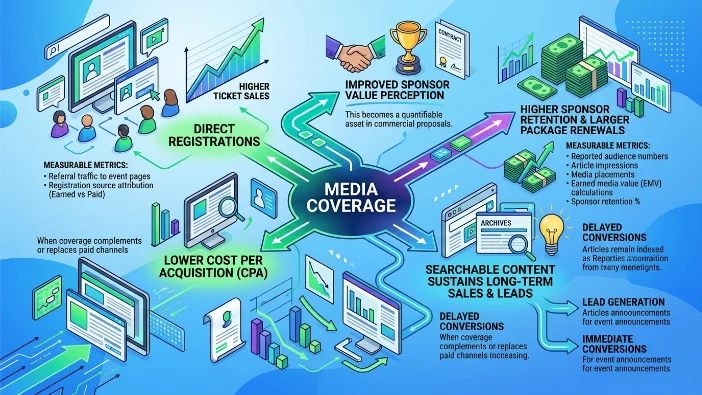
Coverage produces immediate and delayed conversion paths. Immediate conversions occur when event announcements or speaker stories reach audiences ready to purchase tickets. Delayed conversions occur as articles and reports remain in search indexes and social archives, attracting attendees for subsequent events. Sponsorship revenue rises because measurable media reach becomes a quantifiable asset in commercial proposals.
Reported audience numbers, article impressions, and media placements convert into higher sponsor retention rates and larger package renewals. Media coverage also reduces marketing cost per acquisition when coverage replaces or complements paid channels. Measurable metrics include referral traffic to event pages, registration source attribution, earned media value calculations, and sponsor retention percentages.
What components make an effective media coverage strategy for UK events?
An effective media coverage strategy includes clear messaging, target outlet mapping, press-ready materials, speaker media training, and a distribution timeline tied to commercial objectives.
Clear messaging defines the event’s primary news hook, angle, and the facts journalists need. Target outlet mapping identifies national, regional, trade, and broadcast targets with audience demographics and editorial calendars. Press-ready materials include concise press releases, high-resolution images, short speaker bios, session descriptions, and embargoed data or reports. Speaker media training prepares presenters to deliver quotable soundbites and handle interviews. Distribution timelines schedule pre-event announcements, on-the-day briefings, and post-event reports to sustain coverage momentum. Effective strategies integrate measurement plans that track placements, audience reach, referral traffic, and social engagement. Combining these components ensures consistent coverage across channels and aligns media activity with ticketing and sponsorship goals.
How is media coverage produced and distributed for a typical UK conference?
Production and distribution follow a defined process: identify news hooks, create assets, pitch outlets, schedule interviews, and publish reports before, during, and after the event.
First, organisers audit event elements to identify one or more news hooks: keynote announcements, research findings, policy panels, or high-profile attendees. Second, organisers assemble press packs containing a concise release, quotes, images, and fact sheets. Third, targeted pitching contacts journalists and editors with tailored angles aligned to each outlet’s audience. Fourth, interviews and briefing calls are scheduled for speakers and subject matter experts to provide exclusive insights. Fifth, live or same-day reporting is facilitated through embargoed releases and media accreditation to allow timely publication. Finally, post-event distribution provides summaries, recorded sessions, and outcome metrics to sustain earned coverage and enable follow-up stories. This process creates a cadence of narrative exposure that supports ticket sales and sponsor reporting.
What measurable benefits do events see from managed or planned media coverage?
Measured benefits include increased registrations, higher sponsor renewals, improved brand recognition, enhanced search visibility, and better post-event lead conversion rates.
Specific metrics include percentage increases in registration attributed to earned media channels, sponsor renewal rates compared before and after coverage implementation, search engine visibility improvements for event keywords, and the number of leads derived from media-driven traffic. Case-level examples show single events reporting double-digit registration lifts from coordinated media announcements, or sponsors agreeing to larger packages when coverage metrics were presented. Media coverage also generates archival content that continues to deliver organic search traffic and inbound enquiries months after an event. Measurement frameworks that link PR placements to registration systems and sponsor dashboards provide clear evidence of media value.
Who are the key stakeholders involved in securing media coverage for UK events?
Stakeholders include event organisers, communications leads, speakers, sponsors, media relations specialists, and venue communications teams.
Event organisers set objectives and allocate resources for media activity. Communications leads craft messaging and manage outreach. Speakers supply expertise, quotes, and interviews. Sponsors provide newsworthy announcements, funding for content production, and audience testimonials. Media relations specialists maintain journalist relationships, prepare press packs, and pitch stories. Venue communications teams coordinate access, logistics, and local promotion. Each stakeholder has a defined role and deliverable: organisers define the news hook, communications leads prepare assets, speakers supply content, sponsors provide credibility, media specialists execute outreach, and venues enable onsite access for reporting.
What types of UK media channels produce the strongest return for different event objectives?
National print and online outlets produce trust and executive reach; trade publications produce qualified leads; regional media produce local attendance; broadcast and podcasts produce high-engagement audiences.
National print and major online outlets deliver visibility to national decision-makers, useful for corporate conferences and large-scale industry summits. Trade publications generate sector-specific leads and buyer interest, important for B2B conferences and exhibitions. Regional media drive local professional attendance and community support, useful for city-based events and regional networks. Broadcast and podcast coverage create deep engagement with listeners and viewers who value long-form interviews and panel highlights. Selecting the right channel mix aligns coverage outputs with specific event outcomes, such as ticket sales, sponsor acquisition, or policy influence.
Explore More Expert Insights:
How Live Events Generate 4× More Earned Media When Coverage Is Pre-Planned
What Experiential Marketing Budgets Are Missing: The Media Coverage Multiplier
How should event metrics be tracked to show media coverage impact?
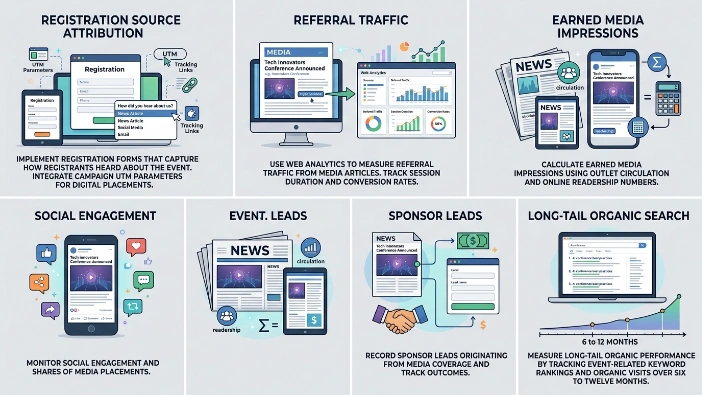
Track registration source attribution, referral traffic, earned media impressions, social engagement, sponsor leads, and long-tail organic search performance.
Implement registration forms that capture how registrants heard about the event and integrate campaign UTM parameters for digital placements. Use web analytics to measure referral traffic from media articles and track session duration and conversion rates. Calculate earned media impressions using outlet circulation and online readership numbers. Monitor social engagement and shares of media placements. Record sponsor leads originating from media coverage and track outcomes. Measure long-tail organic performance by tracking event-related keyword rankings and organic visits over six to twelve months. These combined metrics create a robust attribution model for media activity.
What use cases show media coverage as a decisive growth lever in the UK events market?
Media coverage increases conference attendance, secures higher-value sponsorships, supports regional event growth, and amplifies research dissemination to policymakers and practitioners.
In the corporate conference use case, targeted national and trade placements generate executive registrations and sponsor interest. In the exhibition use case, trade press coverage brings qualified buyers to stands. For regional events, local press and broadcast coverage increase community attendance and local sponsorship. For research-led events, media dissemination ensures findings reach policymakers and practitioners, increasing the event’s influence and subsequent funding. Each use case demonstrates media coverage converting exposure into measurable outcomes: ticket sales, sponsor revenue, attendee quality, and policy uptake.
Dive Deeper Into This Topic:
Speaker Amplification: How to Turn 8 Presenters Into 8 Separate UK Media Stories
Media coverage is an essential, measurable growth lever for the UK events industry. Coverage extends audience reach across national, regional, trade, and broadcast channels, drives registrations and sponsorship revenue, and creates long-term organic visibility. Clear messaging, targeted outlet mapping, press-ready assets, speaker preparation, and rigorous measurement convert media activity into demonstrable value. For events aiming to rebound and grow in the UK market, media coverage functions as a scalable, evidence-based amplifier of attendance, revenue, and influence.
Click Here to Explore More:
Why Annual Conferences That Use Managed Coverage See 52% More Delegate Returns



