Times Intelligence is a media operations model that deploys reporters, editors, and distribution channels to generate editorial coverage, audience reach, and measurable outcomes for event organisers.
Times Intelligence defines three core entities: reporters who gather facts and produce articles, editors who shape narratives and approve publication, and distribution channels that place content across owned, partner, and third-party media. The model aligns these entities with event objectives: awareness, stakeholder influence, and long-term search visibility. For UK events, this alignment delivers faster editorial turnarounds, higher-quality placements, and direct referral traffic from reputable outlets. The model uses clear roles, SLAs, and analytics to convert editorial activity into trackable business outcomes.
How do reporters, editors, and distribution operate together during an event campaign?
Reporters collect verified information and produce copy; editors refine and approve content for tone and accuracy; distribution places and amplifies content across agreed-upon channels.
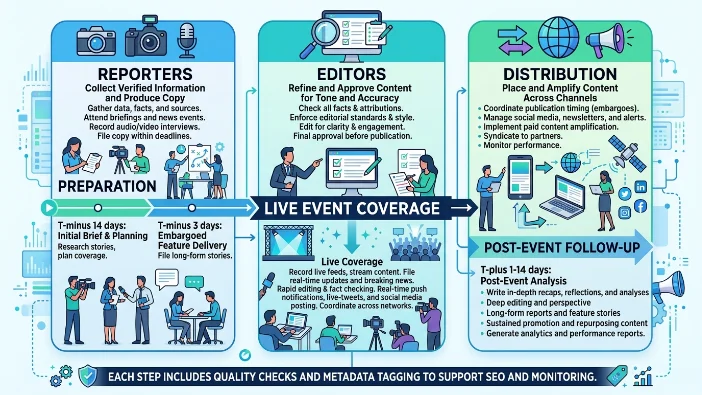
Reporters attend briefings, record interviews, and file copy within defined deadlines. Editors review facts, check attribution, and enforce editorial standards before publication. Distribution coordinates publication timing, syndication, and paid amplification where applicable. The workflow follows a production schedule with timecodes: initial brief at T-minus 14 days, embargoed feature delivery at T-minus 3 days, live coverage during the event, and post-event long-form analysis at T-plus 1–14 days. Each step includes quality checks and metadata tagging to support SEO and monitoring.
What specific roles and deliverables should teams expect from reporters?
Reporters produce 400–1,200 word articles, 90–180 second interview clips, and 5–10 high-resolution images per assignment with verified quotes and source attribution.
Reporters prepare a pre-event briefing note that includes 5 verified data points and a list of potential questions. On-site, reporters conduct interviews, record B-roll, and file initial copy within 3–6 hours of assignment. Post-event, reporters deliver final articles with 2–4 attributed quotes, time-stamped interview audio, and suggested headlines. These deliverables enable editors to publish quickly and provide distribution teams with ready assets for syndication and social amplification.
What editorial processes ensure accuracy and speed?
Editors implement fact-check protocols, headline testing, and an approval SLA of 6–12 hours for live and 24–48 hours for feature content.
Fact-check protocols require source verification, named-source attribution, and citation of primary documents when available. Headline testing involves 3–5 headline variants evaluated for clarity and search intent before final selection. Approval SLAs set maximum turnaround: live pieces published within 6–12 hours after reporter submission; feature pieces within 24–48 hours. Editors also tag content with structured metadata: event name, speaker names, locations, and keyword phrases to support indexing and distribution.
How does distribution amplify editorial content for measurement and reach?
Distribution places content on owned sites, syndicates to partner publications, and runs targeted amplification using paid and organic channels to reach specified audience segments.
Distribution plans define channels and KPIs before publication. Owned-site placement secures primary indexing and domain authority benefits. Syndication extends reach to trade and regional partner sites, generating referral traffic and backlinks. Paid amplification targets audience segments by job title, industry, and geography to drive registrations and post-event actions. Distribution also timestamps publications to align with campaign windows and coordinates social amplification when editorial pieces publish to maximize referral traffic.
What metrics demonstrate return from deployed reporting and editorial distribution?
Key metrics include number of editorial placements, estimated readership, referral sessions, backlinks, keyword ranking changes, and conversions tracked over 30–365 days.
Measure immediate editorial outputs: count of published articles, outlet tiers, and estimated readership per article. Measure web outcomes: referral sessions from editorial links, pages per session, and time on site. Measure SEO outcomes: number of referring domains, backlink quality scores, and organic ranking changes for target keywords at 30, 90, and 365 days. Measure conversions tied to editorial activity: registration lift, contact inquiries, and qualified leads attributable through UTM parameters and assisted conversion models.
What components should a BOFU media budget include for Times Intelligence deployment?
Budgets must cover reporter fees, editor hours, distribution costs, syndication fees, rapid editing, press hospitality, and monitoring and reporting for 90–365 days.
Define budget items with specific amounts and deliverables. Reporter fees cover field reporting, interviews, and asset production. Editor hours cover fact-checking, headline testing, and metadata tagging. Distribution costs include syndication fees, paid amplification, and partner placement charges. Rapid editing covers same-day clip edits and captioning. Press hospitality covers travel, accommodation, and on-site press facilities. Monitoring and reporting funds cover 90–365 days of media tracking and SEO analysis. Allocate contingency funds for last-minute journalist requests and travel.
How do legal and compliance checks integrate into editorial workflows?
Legal reviews apply to quoted material, embargoed documents, and regulated sectors with a 24–48 hour review window; compliance flags are integrated at the editorial stage.
Legal teams review direct quotations, data claims, and any material that references commercial agreements or regulated information. For regulated sectors such as finance, legal review occurs before publication and requires signed clearance for specific phrases. Editors maintain a compliance checklist and escalate flagged items to legal immediately. Embargoed documents include explicit clearance notes and an approved quote list. The process enforces recorded approvals with timestamps to protect both publishers and clients.
Explore More Expert Insights:
Events Media Coverage Pricing: What UK Organisers Pay for Different Coverage Tiers
Event Coverage Across 10 UK News Sites: Audience Reach and Engagement Data
What use cases show the highest ROI for this deployment model?
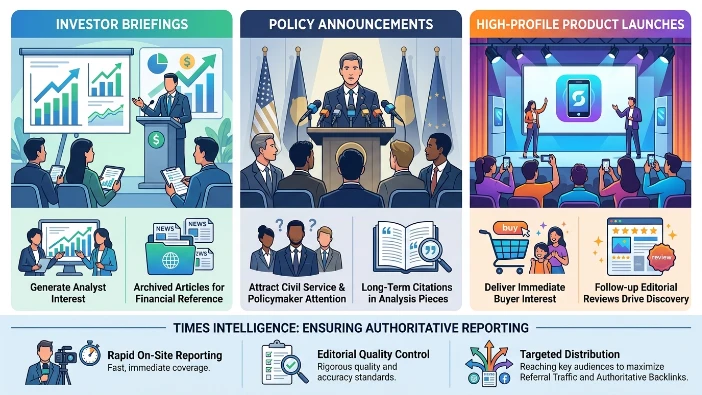
Investor briefings, policy announcements, and high-profile product launches show the highest ROI due to demand for authoritative reporting and measurable referral outcomes.
Investor briefings generate analyst interest and archived articles for financial reference. Policy announcements attract civil service and policymaker attention and long-term citations in analysis pieces. High-profile product launches deliver immediate buyer interest and follow-up editorial reviews that drive discovery. For each use case, Times Intelligence ensures rapid on-site reporting, editorial quality control, and distribution to targeted channels to maximise referral traffic and authoritative backlinks.
How do teams decide on in-house versus Times Intelligence-style outsourcing?
Compare internal editorial capacity, journalist relationships, and technical distribution ability against external deployment speed, outlet access, and 24-hour editing capability; select based on required speed and reach.
Assess internal capacity by counting available reporter and editor hours, existing media relationships, and in-house distribution tools. Evaluate external partners for verified outlet access, proven turnaround times, and capabilities for rapid editing and syndication. Use a cost-per-placement and cost-per-article model to compare options. Select outsourcing for one-off, high-profile events requiring national reach and rapid editorial cycles. Select in-house for ongoing content needs where staff already hold strong media relationships.
Explore the Advanced Guide:
What Experiential Marketing Budgets Are Missing: The Media Coverage Multiplier
Times Intelligence deploys reporters, editors, and distribution to convert event assets into measurable editorial outcomes. The model delivers rapid reporting, editorial quality control, targeted distribution, and long-term SEO benefits. Implement clear SLAs, defined deliverables, and a budget covering reporter fees, editor hours, distribution, rapid editing, hospitality, and monitoring. Measure outcomes across editorial placements, referral traffic, backlinks, and keyword performance over 30–365 days to evaluate return on investment.
Complete Details Available Here:
Social Coverage vs News Coverage: Why UK Events Need Both and How to Plan Them