Social coverage delivers immediate audience engagement via owned and third-party social channels; news coverage delivers editorial validation and long-term discoverability via journalist-published content.
Social coverage uses brand channels, attendee posts, and influencer posts to create rapid visibility and measurable engagement metrics such as impressions, shares, and view counts. News coverage uses reporters and editors to create articles, features, and analysis that publish on editorial sites with measurable placements, estimated readership, and backlinks. Social output typically drives same-day traffic spikes. News content generates searchable pages that persist for months. Both serve distinct roles in an event communications strategy and require separate planning, assets, and measurement.
How does combining social and news coverage improve event outcomes?
Combining social and news coverage increases short-term reach and long-term authority, creating complementary audiences and amplified distribution across platforms and search.
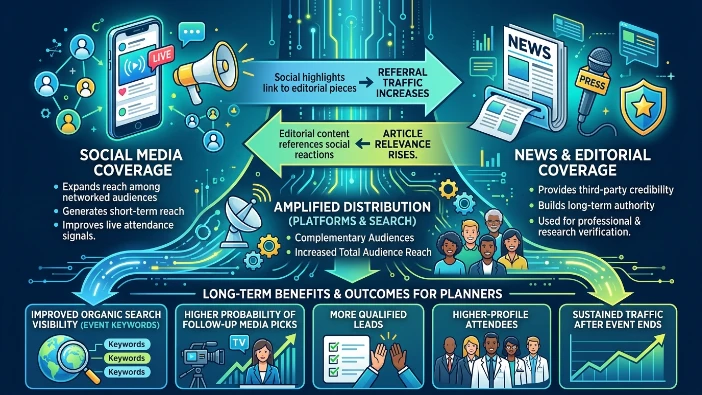
Social coverage expands reach among networked audiences and improves live attendance signals. News coverage provides third-party credibility that professional and research-focused audiences use for verification. When social highlights link to editorial pieces, referral traffic increases. When editorial content references social reactions, article relevance rises. The combined approach raises total audience reach, improves organic search visibility for event-related keywords, and increases the probability of follow-up media picks. For event planners, this leads to more qualified leads, higher-profile attendees, and sustained traffic after the event ends.
What planning steps align social and news coverage for UK events?
Define story angles, prepare a press pack, set an outreach timeline, brief spokespersons, and produce synchronized social assets with publishing windows.
Start with three distinct story angles that match UK media beats, such as policy impact, industry innovation, and regional economic effects. Create a press pack containing a one-page fact sheet, 150–300 word bios for each speaker, three quotable statements per speaker, high-resolution images (minimum 3000 x 2000 pixels), and 30–90 second B-roll clips. Build an outreach timeline that begins 14–28 days before the event for national press and 7–14 days for trade outlets. Schedule embargo windows and offer exclusive interview slots to priority journalists. Prepare 15–60 second social videos and platform-specific captions timed to journalist deadlines. Assign roles: one person handles journalist outreach, one handles social publishing, and one handles on-site media logistics.
Which resources and budget lines support a media coverage multiplier?
Allocate budget to press relations, asset production, media distribution, journalist hosting, on-site media facilities, rapid editing, and monitoring and measurement.
Specify budget percentages to ensure clarity: press relations 25% of the media multiplier budget, asset production 15%, media distribution 10%, journalist hosting 15%, on-site facilities 10%, rapid editing and encoding 15%, monitoring and reporting 10%. Define deliverables for each line item such as number of media contacts outreached, number of edited video clips delivered within 24 hours, number of journalists hosted, and length of monitoring (30, 90, or 180 days). Include a contingency of 5–10% for travel or last-minute requests. Use these allocations to compare internal resource costs versus outsourced options.
What assets do journalists need versus social teams?
Journalists need factual materials, quoted sources, and high-resolution assets; social teams need short-form clips, captions, and platform-specific formats for rapid publishing.
Provide journalists with a press pack that includes verifiable data points, full quotes with attribution, and embargo instructions. Supply high-resolution photographs and full-length interview clips in 1080p or higher. Provide social teams with cut-down clips of 15–60 seconds, vertical video formats for mobile, caption files, and suggested hashtags. Ensure all assets reference the same factual sources and speaker quotes to maintain consistency. Label files with clear metadata including speaker name, role, and timecode for quick use by reporters and social publishers.
How should teams structure outreach to UK media?
Segment media by national, trade, and regional outlets; prioritise 10–20 contacts per segment and schedule targeted briefings with exclusives for high-priority journalists.
Create three contact lists: up to 20 national contacts, up to 20 trade contacts, and up to 20 regional contacts. Draft tailored pitches for each segment emphasising the most relevant story angle and relevant data points. Offer embargoed materials to national features 10–14 days before publication windows and offer same-day briefing slots for trade reporters 3–7 days before the event. Provide regional outlets localised angles with regional data and local speaker details. Track outreach using a central spreadsheet or media database and record responses, promised coverage, and publication dates.
What measurement approach demonstrates value from combined coverage?
Measure immediate social KPIs and editorial placements, then attribute referral traffic, backlink counts, and organic search changes over a 3–12 month window.
Report same-day social metrics: impressions, reach, engagement rate, and video views. Report editorial outcomes: number of articles published, estimated readership, and URL placements. Use web analytics to measure referral sessions from editorial links, bounce rate, and time on page. Track backlinks and referring domains using an SEO tool and measure keyword ranking changes for targeted event queries. Monitor organic traffic uplift over 90 and 365 days to capture long-term discovery benefits. Present a combined dashboard with social and editorial metrics and a simple attribution model that assigns weighted credit to social for short-term conversions and editorial for long-term discovery.
What common mistakes reduce the multiplier effect?
Failing to define story angles, underfunding press relations, providing inconsistent assets, and mis-timing outreach reduce media multiplier outcomes.
Change story angles mid-campaign without notifying journalists. Underfund press relations and expect earned coverage to scale without outreach. Provide social-only assets that lack verifiable facts for reporters. Send press packs without clear attribution or metadata. Time social posts opposite journalist deadlines. These failures reduce editorial pickup and create missed synergy. Plan timelines, confirm asset versions, and coordinate publication windows to avoid these errors.
Explore More Expert Insights:
Post-Event Wrap-Up Reports: How to Keep Your UK Brand in the News for 2 More Weeks
The Event Coverage Brief: What to Give a UK Media Partner 6 Weeks Before Your Event
Which UK event types benefit most from combined coverage?
Policy roundtables, product launches aimed at professional buyers, and investor briefings benefit most because they require immediate visibility and authoritative validation.
Policy roundtables need social amplification to engage stakeholders and editorial validation to influence decision-makers. Product launches aimed at procurement teams need live demos and immediate social proof plus press features for analyst consideration. Investor briefings need rapid updates for stakeholders and detailed editorial coverage for analysts and potential partners. For each event type, align story angles with targeted media segments and produce the full press pack and synchronised social set.
How can teams decide between in-house and outsourced media relations?
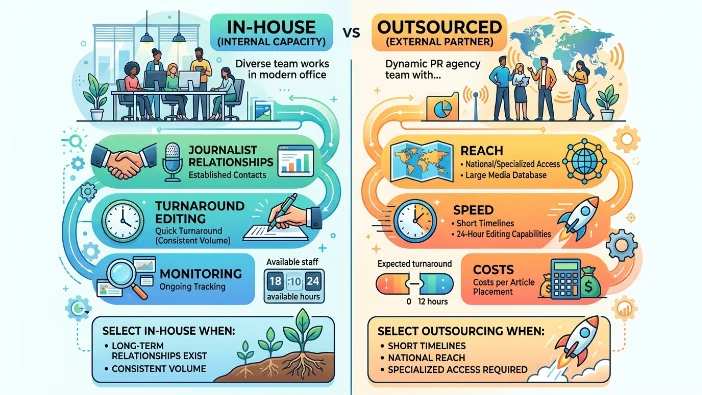
Compare internal capacity for journalist relationships, turnaround editing, and monitoring against external partner costs and reach; choose based on speed requirements and media access needs.
Assess internal capacity by counting available staff hours for outreach, the number of established journalist contacts, and in-house editing turnaround time. Estimate external partner reach by confirmed outlet relationships, size of distribution lists, and 24-hour editing capabilities. Calculate costs per expected article placement and expected turnaround in hours. Select in-house when long-term relationships exist and volume is consistent. Select outsourcing when short timelines, national reach, or specialised journalist access are required.
Explore More Useful Information:
What Experiential Marketing Budgets Are Missing: The Media Coverage Multiplier
Social coverage and news coverage provide complementary channels for UK events. Social creates immediate engagement and measurable short-term conversions. News coverage creates authoritative pages, backlinks, and long-term discoverability. Plan using defined story angles, a complete press pack, segmented outreach, synchronised social assets, and clear budget allocations. Measure immediate social KPIs and editorial outcomes, then track referral traffic and SEO impact over 3–12 months to quantify the media coverage multiplier.
Check the Complete Explanation:
How Times Intelligence Deploys Reporters, Editors and Distribution for UK Events